
Thermionic Emission and Acceleration of Electrons
Thermionic emission is the process by which electrons are released from a metal surface when it is heated. Once emitted, electrons can be accelerated and deflected using electric and magnetic fields.
Thermionic Emission
Definition: Thermionic emission is the emission of electrons from the surface of a metal when thermal energy is supplied.
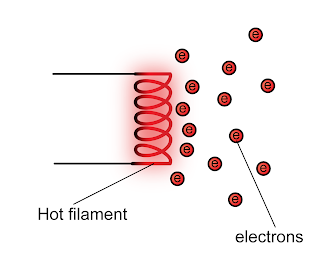
- Occurs in metals containing free (conduction) electrons.
- Heating the metal increases the kinetic energy of electrons.
- Some electrons gain enough energy to escape the metal surface.
Work Function
- Electrons are held in the metal by attractive forces.
- The work function is the minimum energy needed to remove an electron.
- Thermionic emission occurs when electron energy exceeds the work function.
Thermionic Emission in a Vacuum Tube
- A metal filament (cathode) is heated by an electric current.
- Electrons are emitted into the surrounding vacuum.
- A vacuum prevents collisions with air molecules.
Acceleration of Electrons by an Electric Field
When electrons move through a potential difference, they experience an electric force.

\( F = qE \)
- \( q \) = charge of electron
- \( E \) = electric field strength
Effects of an electric field:
- Electrons accelerate towards the positive terminal (anode).
- Their speed increases.
- Kinetic energy gained equals electrical work done.
\( \text{Gain in kinetic energy} = qV \)
Motion of Electrons in a Magnetic Field
Moving electrons in a magnetic field experience a force perpendicular to their motion.
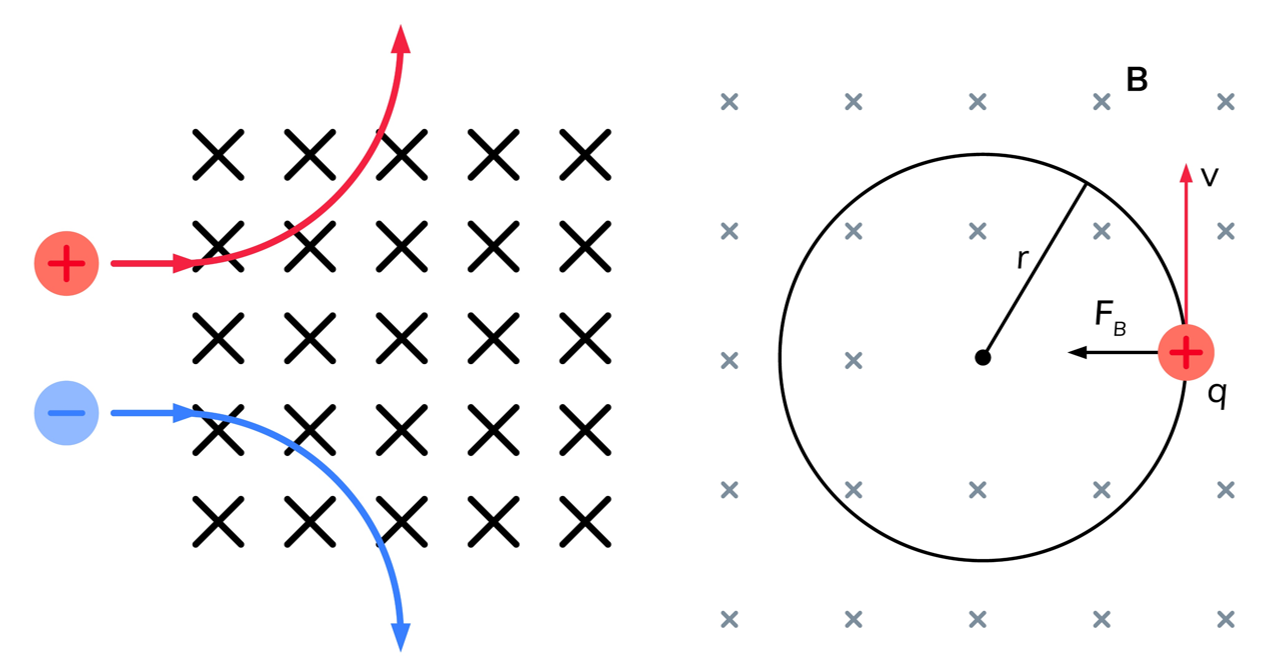
\( F = Bqv\sin\theta \)
- \( B \) = magnetic flux density
- \( v \) = speed of electron
- \( \theta \) = angle between velocity and field
Important features:
- Magnetic force does not change speed, only direction.
- When motion is perpendicular to the field, electrons move in a circular path.
- The magnetic field provides the centripetal force.
Comparison: Electric vs Magnetic Fields
| Electric Field | Magnetic Field |
|---|---|
| Changes speed of electrons | Changes direction of electrons |
| Force parallel to field direction | Force perpendicular to motion and field |
| Acts on stationary charges | Acts only on moving charges |
Applications
- Cathode ray tubes
- Oscilloscopes
- Electron guns
- Television and display technology
Example (Easy)
Explain why heating a metal causes electrons to be emitted.
▶️ Answer / Explanation
- Heating increases electron kinetic energy.
- Some electrons gain energy greater than the work function.
- These electrons escape the metal surface.
Example (Medium)
Describe the effect of an electric field on electrons emitted from a cathode.
▶️ Answer / Explanation
- Electrons accelerate towards the anode.
- Their speed increases.
- Their kinetic energy increases.
Example (Hard)
An electron enters a magnetic field perpendicular to the field direction. Describe its subsequent motion.
▶️ Answer / Explanation
- A magnetic force acts perpendicular to its velocity.
- The force provides centripetal acceleration.
- The electron moves in a circular path at constant speed.