
Role of Electric and Magnetic Fields in Particle Accelerators and Detectors
Electric and magnetic fields play a crucial role in accelerating charged particles to high energies and in detecting them. The principles are based on acceleration by electric fields and deflection by magnetic fields.
General Roles of Fields
- Electric fields accelerate charged particles (increase speed and kinetic energy).
- Magnetic fields deflect charged particles (change direction but not speed).
Linear Accelerator (LINAC)
A linear accelerator accelerates charged particles along a straight line using electric fields.
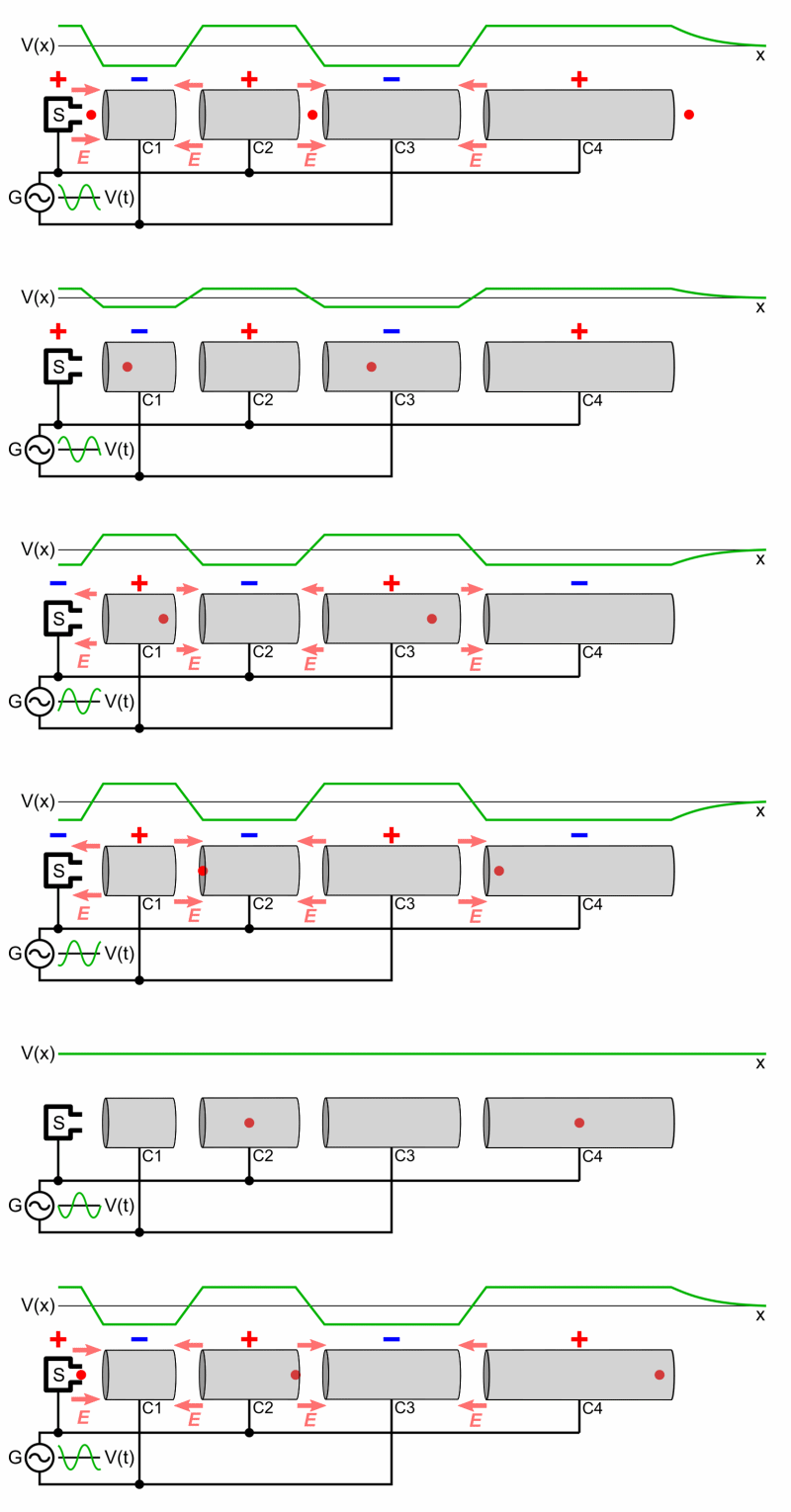
Principle:
- Particles pass through a series of hollow metal tubes.
- An alternating potential difference is applied between adjacent tubes.
- Electric fields exist only in the gaps between tubes.
- Particles gain kinetic energy each time they cross a gap.
Role of Electric Fields:
- Provide a force \( F = qE \) on charged particles.
- Particles accelerate forward.
- Speed increases after each gap.
Role of Magnetic Fields:
- Not essential for acceleration.
- May be used for beam focusing and steering.
Cyclotron
A cyclotron accelerates charged particles in a spiral path using both electric and magnetic fields.
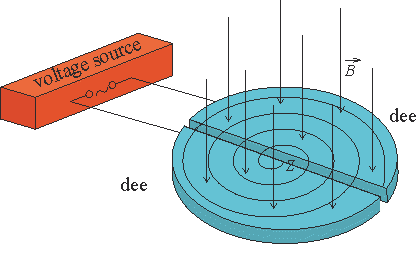
Principle:
- Two hollow semicircular electrodes called “dees”.
- A uniform magnetic field acts perpendicular to the plane of motion.
- An alternating voltage is applied between the dees.
Role of Electric Fields:
- Particles accelerate each time they cross the gap between the dees.
- Kinetic energy increases in steps.
Role of Magnetic Fields:
- Provide centripetal force:
\( Bqv = \dfrac{mv^2}{r} \)
- Cause particles to move in circular paths.
- As speed increases, radius increases → spiral path.
- Magnetic field does not change particle speed.
Comparison: LINAC vs Cyclotron
| LINAC | Cyclotron |
|---|---|
| Straight-line motion | Circular / spiral motion |
| Electric fields do acceleration | Electric fields accelerate, magnetic fields bend path |
| No fixed magnetic field required | Uniform magnetic field essential |
Particle Detectors — General Principles
Particle detectors use ionisation and deflection to detect and identify particles.

Ionisation
- Charged particles collide with atoms in a medium.
- They knock electrons out of atoms, producing ions.
- The amount of ionisation depends on particle type and energy.
- The ions or electrons can be detected as an electric signal.
Used in:
- Ionisation chambers
- Geiger–Müller tubes
- Cloud and bubble chambers
Deflection by Electric and Magnetic Fields
- Electric fields deflect particles according to charge.
- Magnetic fields deflect particles depending on charge, speed, and mass.
- Direction of deflection shows the sign of charge.
- Radius of curvature gives information about momentum.
Importance in Experiments
- Accelerators produce high-energy particles.
- Detectors observe particle paths and interactions.
- Together, they allow investigation of atomic and nuclear structure.
Example (Easy)
State which field accelerates particles in a particle accelerator.
▶️ Answer / Explanation
Electric fields accelerate charged particles.
Example (Medium)
Explain the role of the magnetic field in a cyclotron.
▶️ Answer / Explanation
- Provides centripetal force.
- Causes circular motion.
- Does not increase particle speed.
Example (Hard)
Explain how ionisation allows a particle to be detected.
▶️ Answer / Explanation
- Particle ionises atoms in the detector.
- Free electrons and ions are produced.
- These charges create a measurable electrical signal.