
Radius of Circular Motion of a Charged Particle in a Magnetic Field
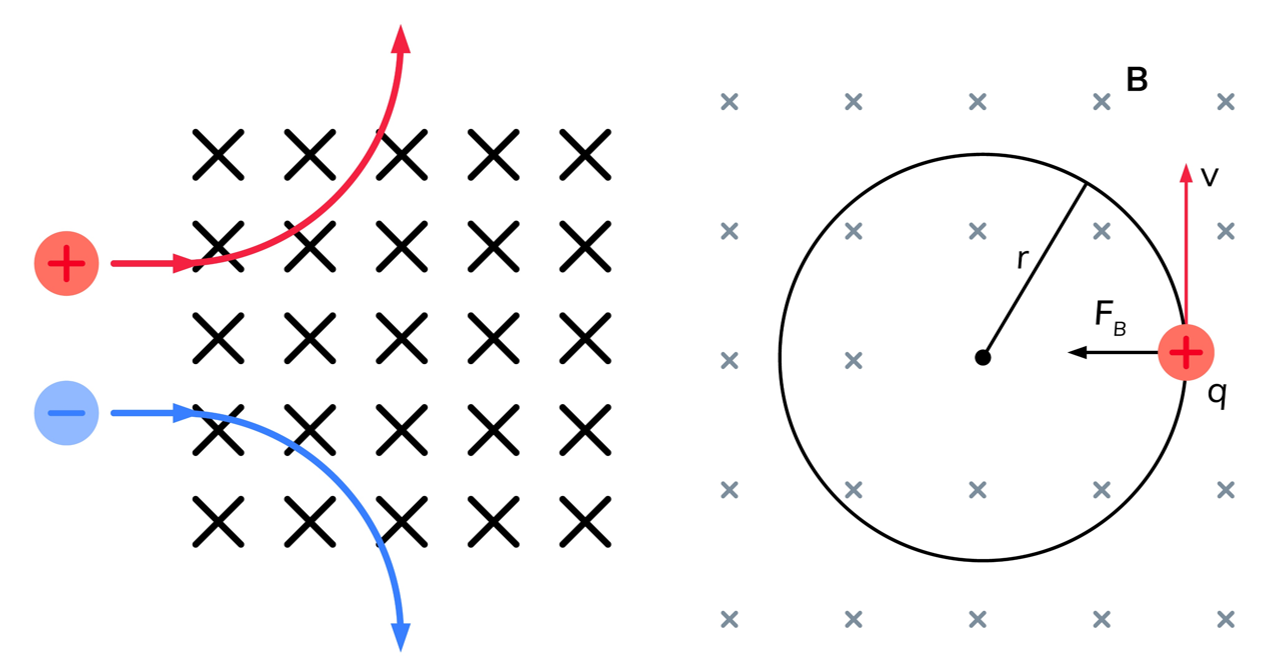
When a charged particle moves through a uniform magnetic field with its velocity perpendicular to the field, it follows a circular path. The radius of this path depends on the particle’s momentum, the magnetic flux density, and the charge.
Magnetic Force on a Moving Charged Particle
The magnetic force acting on a charged particle moving perpendicular to a magnetic field is:
\( F = BQv \)
- \( B \) = magnetic flux density (T)
- \( Q \) = charge of the particle (C)
- \( v \) = speed of the particle (m s⁻¹)
Centripetal Force for Circular Motion
For circular motion of radius \( r \), the required centripetal force is:
\( F = \dfrac{mv^2}{r} \)
- \( m \) = mass of the particle (kg)
- \( r \) = radius of the circular path (m)
Derivation of \( r = \dfrac{p}{BQ} \)
In a magnetic field, the magnetic force provides the centripetal force:
\( BQv = \dfrac{mv^2}{r} \)
Rearranging:
\( r = \dfrac{mv}{BQ} \)
Since momentum \( p \) is defined as:
\( p = mv \)
Substitute \( p \) into the equation:
\( r = \dfrac{p}{BQ} \)
Meaning of the Equation
- Larger momentum → larger radius.
- Stronger magnetic field → smaller radius.
- Greater charge → smaller radius.
- Magnetic field changes direction of motion, not speed.
Conditions for the Equation
- Magnetic field is uniform.
- Particle velocity is perpendicular to the magnetic field.
- Speed remains constant.
Applications
- Mass spectrometers
- Cyclotrons
- Particle detectors
- Determining momentum of charged particles
Example (Easy)
A proton of momentum \( 3.2\times10^{-19}\ \mathrm{kg\,m\,s^{-1}} \) enters a magnetic field of flux density \( 0.80\ \mathrm{T} \) at right angles. Calculate the radius of its circular path. (Charge of proton \( = 1.6\times10^{-19}\ \mathrm{C} \))
▶️ Answer / Explanation
\( r = \dfrac{p}{BQ} = \dfrac{3.2\times10^{-19}}{0.80 \times 1.6\times10^{-19}} = 2.5\ \mathrm{m} \)
Example (Medium)
Explain why increasing the magnetic field strength reduces the radius of the circular path.
▶️ Answer / Explanation
- Magnetic force increases with \( B \).
- Greater centripetal force is provided.
- The particle follows a tighter circular path.
Example (Hard)
Two particles with the same momentum but different charges enter the same magnetic field. Compare the radii of their circular paths.
▶️ Answer / Explanation
- Radius is inversely proportional to charge.
- The particle with the smaller charge has the larger radius.