
Conservation of Charge, Energy and Momentum in Particle Interactions
When particles interact, collide, or decay, their behaviour is governed by fundamental conservation laws. By applying these laws, particle interactions can be analysed and particle tracks interpreted.
Conservation of Charge
Principle: The total electric charge before an interaction is equal to the total electric charge after the interaction.

Total charge (before) = Total charge (after)
- Charge cannot be created or destroyed.
- Applies to all particle interactions and decays.
- Helps identify unknown particles in reactions.
Example:
- If a neutral particle decays, the charges of the decay products must sum to zero.
Conservation of Energy
Principle: Total energy is conserved in all particle interactions.

Energy before = Energy after
- Includes kinetic energy, rest mass energy, and radiation energy.
- Energy can change form but cannot be lost.
- Mass can be converted into energy and vice versa.
Key idea:
- Some kinetic energy may appear as new particles.
- Some energy may be carried away by unseen particles.
Conservation of Momentum
Principle: Total momentum of a system is conserved provided no external forces act.

Total momentum (before) = Total momentum (after)
- Momentum is a vector quantity.
- Both magnitude and direction must be conserved.
- Very important in analysing particle tracks.
Applying Conservation Laws to Particle Interactions
In particle collisions or decays:
- Check charge conservation to confirm possible reactions.
- Use energy conservation to determine kinetic energies or particle creation.
- Apply momentum conservation to find directions and speeds of particles.
Interpreting Particle Tracks
Particle tracks are observed in detectors such as cloud chambers and bubble chambers.
Track Features and What They Show:
- Curvature: caused by motion in a magnetic field.
- Direction of curvature: shows the sign of charge.
- Radius of curvature: related to momentum.
- Track thickness: indicates ionisation and particle type.
Momentum and Track Curvature
For a charged particle in a magnetic field:
\( r = \dfrac{p}{BQ} \)
- Larger radius → larger momentum.
- Tighter curve → lower momentum or higher charge.
Identifying Particle Interactions
Particle Creation:
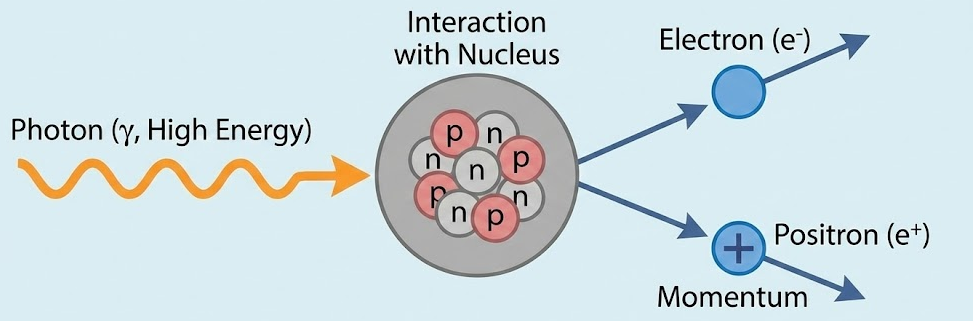
- Single track splitting into two or more tracks.
- Total charge before equals total charge after.
Particle Annihilation:

- Two tracks meet and disappear.
- Energy carried away by radiation or unseen particles.
Particle Decay:

- A track suddenly changes into two or more tracks.
- Momentum vectors of products balance.
Using Conservation Laws Together
- Charge conservation restricts possible reactions.
- Energy conservation explains particle creation or missing energy.
- Momentum conservation explains track directions and angles.
Example (Easy)
A neutral particle decays into two charged particles. State one conservation law that must apply.
▶️ Answer / Explanation
Total charge must remain zero.
Example (Medium)
Two particles emerge from a collision at equal and opposite angles. Explain what this shows about momentum.
▶️ Answer / Explanation
- Momentum vectors balance.
- Total momentum is conserved.
Example (Hard)
A charged particle track suddenly splits into two curved tracks of opposite curvature. Explain what conservation laws are satisfied.
▶️ Answer / Explanation
- Opposite curvature shows opposite charges.
- Total charge is conserved.
- Momentum directions balance.
- Energy is shared between products.