
Why High Energies Are Required to Investigate the Structure of Nucleons
Nucleons (protons and neutrons) are not fundamental particles — they have an internal structure. To investigate this structure, particles with very high energies are required.
Size of Nucleons
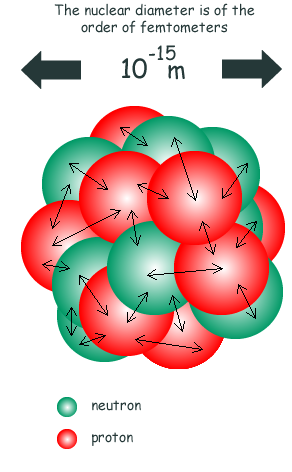
- Nucleons have extremely small sizes (of the order of \( 10^{-15}\ \mathrm{m} \)).
- To probe such small distances, probes with very short wavelengths are required.
Wave–Particle Duality and Resolution
Particles used as probes (such as electrons or protons) behave like waves.
Their de Broglie wavelength is given by:

\( \lambda = \dfrac{h}{p} \)
- To resolve small structures, the wavelength must be comparable to or smaller than the size of the object.
- This requires a very large momentum \( p \).
- Large momentum means high particle energy.
Need for High-Energy Particles
- Low-energy particles have long wavelengths.
- They cannot resolve fine internal details of nucleons.
- High-energy particles have short wavelengths.
- They can probe inside nucleons and reveal internal structure.
Overcoming Strong Nuclear Forces
- Quarks inside nucleons are held together by the strong nuclear force.
- This force is extremely strong at short distances.
- High energies are needed to overcome or significantly disturb this force.
Deep Inelastic Scattering
Experiments using very high-energy electrons scattered from protons showed:
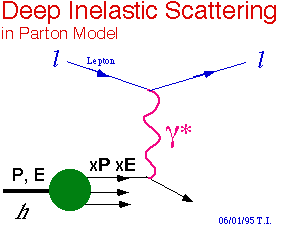
- Electrons were scattered at large angles.
- Energy was transferred to smaller constituents inside the proton.
- This provided evidence for point-like particles (quarks).
This type of experiment is known as deep inelastic scattering.
Role of Particle Accelerators
- Particle accelerators provide particles with extremely high energies.
- These particles have very small de Broglie wavelengths.
- They can probe distances much smaller than nucleon size.
Example (Easy)
State one reason why low-energy particles cannot probe nucleon structure.
▶️ Answer / Explanation
Low-energy particles have long wavelengths and cannot resolve very small distances.
Example (Medium)
Explain how the de Broglie wavelength supports the need for high-energy probes.
▶️ Answer / Explanation
- Short wavelength is needed to see small structures.
- Short wavelength requires large momentum.
- Large momentum requires high energy.
Example (Hard)
Explain why scattering experiments at very high energies provided evidence for quarks.
▶️ Answer / Explanation
- High-energy particles have short wavelengths.
- They interact with small constituents inside nucleons.
- Large-angle scattering indicates concentrated internal particles.
- This reveals quark structure.