
Relativistic Increase in Particle Lifetime
When particles move at speeds close to the speed of light, their observed lifetimes can be significantly longer than when they are at rest. This effect is a consequence of relativistic time dilation.
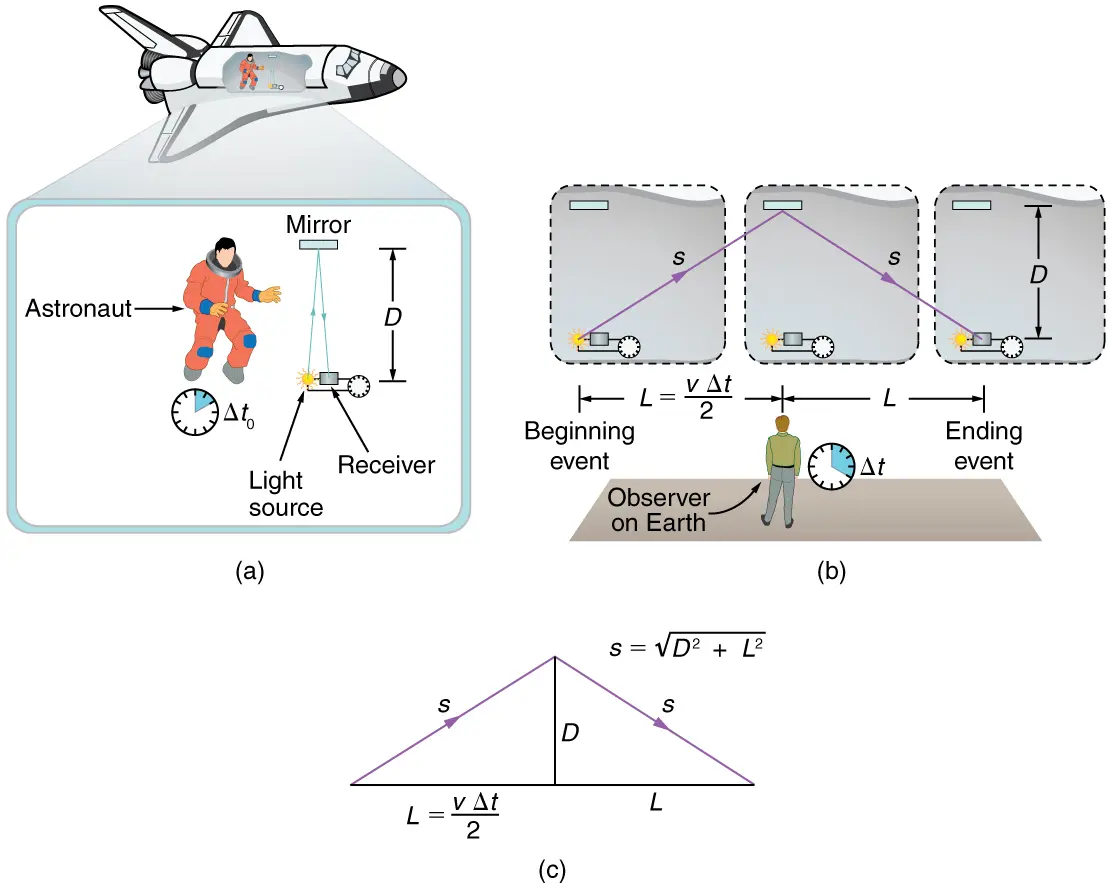
Proper Lifetime and Observed Lifetime
- The proper lifetime is the lifetime of a particle measured in its own rest frame.
- The observed lifetime is the lifetime measured by an observer for whom the particle is moving.
- For fast-moving particles, the observed lifetime is longer than the proper lifetime.
Why Lifetime Increases at High Speeds
- At speeds close to the speed of light, time does not pass at the same rate in all frames.
- From the observer’s point of view, processes inside the moving particle occur more slowly.
- As a result, particle decay takes longer to occur.
Important: The particle itself does not experience a longer lifetime — the increase is observed only in the laboratory frame.
Situations Where the Effect Is Significant
(a) Cosmic Ray Particles
- High-energy particles are produced in the upper atmosphere by cosmic rays.
- Some of these particles have very short proper lifetimes.
- Despite this, they are detected at the Earth’s surface.
- This is only possible because their lifetimes are increased due to relativistic effects.
(b) Particle Accelerators
- Particles are accelerated to speeds close to the speed of light.
- Unstable particles survive long enough to be detected.
- Their increased lifetime allows experiments to be carried out.
(c) High-Energy Nuclear and Particle Experiments
- Relativistic particles travel large distances before decaying.
- Tracks in detectors are longer than expected from rest lifetimes.
- This provides direct evidence of relativistic effects.
Why Relativistic Equations Are Not Always Needed
- The effect becomes noticeable only at very high speeds.
- Qualitative understanding is often sufficient.
- Recognising situations where lifetimes increase is the key requirement.
Key Idea Summary
- Fast-moving particles live longer when observed in the laboratory frame.
- The effect is significant only at speeds close to the speed of light.
- Explains why short-lived particles can be detected over large distances.
- This is evidence for relativistic time dilation.
Example (Easy)
Why can some particles with very short lifetimes still be detected at the Earth’s surface?
▶️ Answer / Explanation
Because they are moving at very high speeds, their observed lifetimes are increased due to relativistic effects.
Example (Medium)
Explain why relativistic lifetime increase is not noticeable for slow-moving particles.
▶️ Answer / Explanation
- Time dilation effects are negligible at low speeds.
- Observed and proper lifetimes are almost the same.
Example (Hard)
A particle produced high in the atmosphere reaches the ground even though its rest lifetime is very short. Explain how this is possible.
▶️ Answer / Explanation
- The particle moves at a speed close to the speed of light.
- Its lifetime is increased in the Earth’s frame.
- This allows it to travel a much greater distance before decaying.