
Particle Classification in the Standard Quark–Lepton Model
The standard quark–lepton model classifies all known fundamental and composite particles into distinct groups based on their structure and interactions. This model successfully explains particle properties and predicted the existence of new particles, including the top quark.
Baryons
Definition: Baryons are particles made from three quarks.
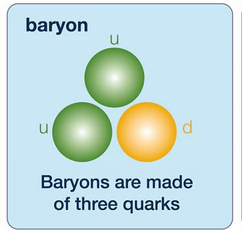
- They are composite particles.
- They interact via the strong nuclear force.
- They have relatively large masses.
Examples:
- Proton (uud)
- Neutron (udd)
Key point: All baryons are made of three quarks, and no antiquarks.
Mesons
Definition: Mesons are particles made from one quark and one antiquark.
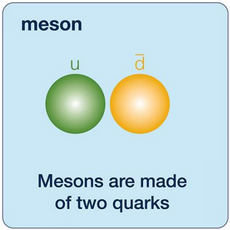
- They are composite particles.
- They experience the strong nuclear force.
- They are generally unstable.
Examples:
- Pions
- Kaons
Key point: Mesons always contain a quark–antiquark pair.
Leptons
Definition: Leptons are fundamental particles — they are not made of quarks.

- They do not experience the strong nuclear force.
- They occur in three generations.
- Each charged lepton has an associated neutrino.
Examples:
- Electron
- Muon
- Tau
- Neutrinos
Photons
Definition: Photons are particles that mediate the electromagnetic interaction.
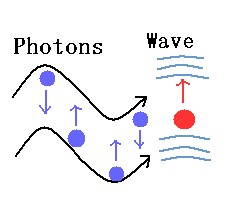
- They have zero rest mass.
- They carry energy and momentum.
- They are fundamental particles.
Key role: Photons are responsible for all electromagnetic forces.
Summary of Particle Classes
| Class | Composition | Examples |
|---|---|---|
| Baryons | Three quarks | Proton, neutron |
| Mesons | Quark + antiquark | Pions |
| Leptons | Fundamental | Electron, neutrinos |
| Photons | Fundamental | Electromagnetic radiation |
Symmetry and the Prediction of the Top Quark
- The model arranges quarks into pairs (up-type and down-type).
- Known quarks showed a symmetrical pattern.
- The existence of the bottom quark implied a missing partner.
- This led to the prediction of the top quark.
Key idea:
- Symmetry in the model required a sixth quark.
- The top quark was later discovered experimentally.
- This confirmed the predictive power of the model.
Importance of the Model
- Explains particle structure and interactions.
- Classifies particles in a systematic way.
- Correctly predicts new particles.
Example (Easy)
State the quark composition of a proton.
▶️ Answer / Explanation
A proton is made of two up quarks and one down quark.
Example (Medium)
Explain why leptons are considered fundamental particles.
▶️ Answer / Explanation
- They are not made of quarks.
- They have no known internal structure.
Example (Hard)
Explain how symmetry in the quark model led to the prediction of the top quark.
▶️ Answer / Explanation
- Quarks were arranged in pairs.
- A partner for the bottom quark was missing.
- Symmetry required another up-type quark.
- This quark was predicted and later discovered.