
Particles and Antiparticles: Properties and Deductions
In particle physics, every particle has a corresponding antiparticle. The antiparticle has the same mass but opposite values of certain properties. By knowing the properties of a particle, the properties of its antiparticle can be deduced, and vice versa.
What Is an Antiparticle?
Definition: An antiparticle is a particle with the same mass as its corresponding particle but with opposite values of specific quantum properties.
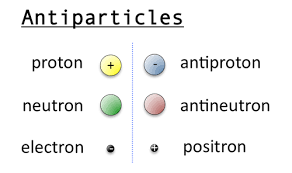
- Same rest mass
- Opposite electric charge
- Opposite lepton number or baryon number
- Opposite magnetic moment
Properties That Are the Same
- Rest mass
- Lifetime (if unstable)
- Speed in the same conditions
Key point: Mass does not change between a particle and its antiparticle.
Properties That Are Opposite
- Electric charge: sign is reversed
- Baryon number: sign is reversed
- Lepton number: sign is reversed
- Magnetic moment: direction is reversed
Example: Electron and Positron
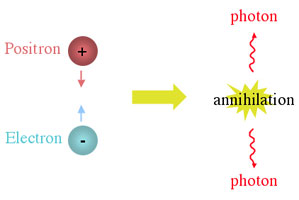
- Electron charge: \( -1.6\times10^{-19}\ \mathrm{C} \)
- Positron charge: \( +1.6\times10^{-19}\ \mathrm{C} \)
- Both have the same mass.
- Electron has lepton number +1, positron has lepton number −1.
Example: Proton and Antiproton
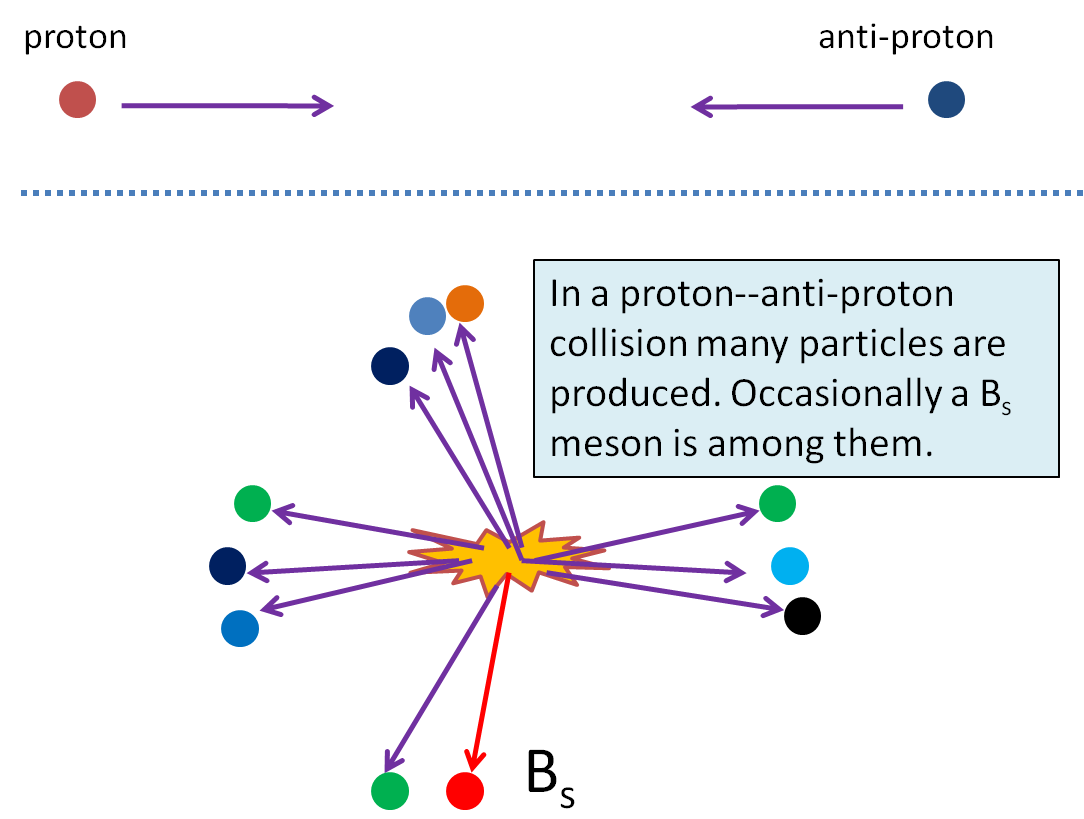
- Proton charge: positive
- Antiproton charge: negative
- Both have the same mass.
- Proton has baryon number +1, antiproton has baryon number −1.
Using Properties to Deduce Antiparticles
To deduce the properties of an antiparticle:
- Keep the mass the same.
- Reverse the sign of electric charge.
- Reverse baryon or lepton number.
- Reverse magnetic properties.
Annihilation and Pair Production
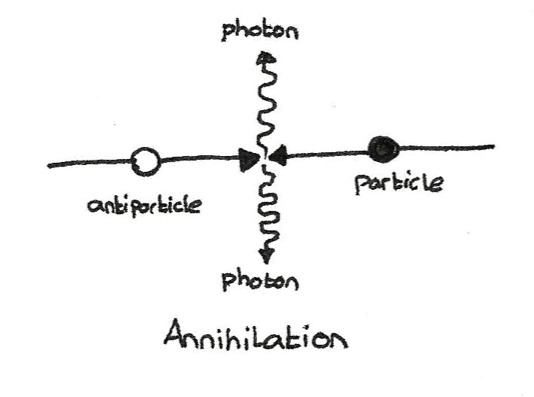
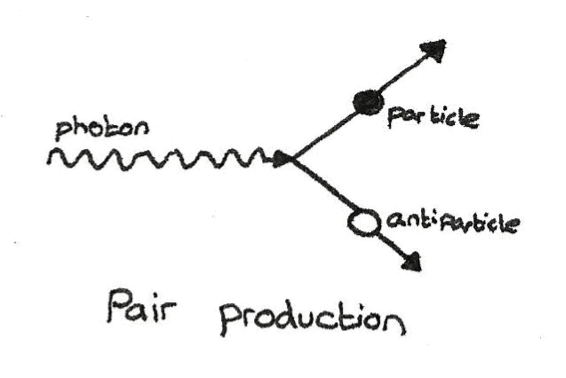
- When a particle meets its antiparticle, annihilation occurs.
- Their mass is converted into energy.
- High-energy photons can create particle–antiparticle pairs.
Importance in Experiments
- Opposite curvature in magnetic fields identifies antiparticles.
- Charge conservation confirms particle–antiparticle creation.
- Energy conservation explains annihilation radiation.
Example (Easy)
An electron has charge \( -1.6\times10^{-19}\ \mathrm{C} \). State the charge of its antiparticle.
▶️ Answer / Explanation
The antiparticle (positron) has charge \( +1.6\times10^{-19}\ \mathrm{C} \).
Example (Medium)
A particle has baryon number +1 and zero charge. State the baryon number and charge of its antiparticle.
▶️ Answer / Explanation
- Baryon number = −1
- Charge = 0
Example (Hard)
A particle track curves clockwise in a magnetic field. The corresponding antiparticle is detected. Describe how its track will appear.
▶️ Answer / Explanation
- Charge is opposite.
- Direction of magnetic force is reversed.
- The track curves in the opposite direction.