
Using Conservation Laws to Determine Possible Particle Interactions
Whether a particle interaction, decay, or reaction can occur is determined by conservation laws. In the standard model, three key quantities must be conserved in all allowed interactions: electric charge, baryon number, and lepton number.
Conservation of Electric Charge
Law: The total electric charge before an interaction equals the total electric charge after the interaction.
Total charge (before) = Total charge (after) 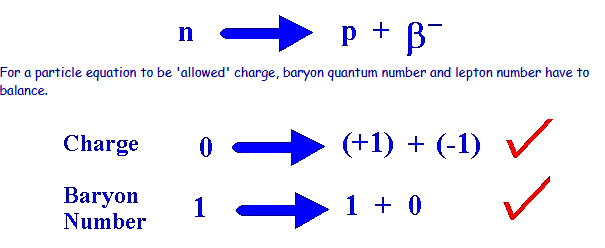
- Charge can be positive, negative, or zero.
- Charge cannot be created or destroyed.
- This law applies to all particle processes.
Conservation of Baryon Number
Definition:
- Baryons (e.g. protons, neutrons): baryon number \( +1 \)
- Antibaryons: baryon number \( -1 \)
- All other particles: baryon number \( 0 \)
Law:
Total baryon number (before) = Total baryon number (after)
- Baryons cannot be created or destroyed on their own.
- Baryon–antibaryon pairs may be created or annihilated.
Conservation of Lepton Number
Definition:
- Leptons (e.g. electron, muon): lepton number \( +1 \)

- Antileptons: lepton number \( -1 \)
- Non-leptons: lepton number \( 0 \)
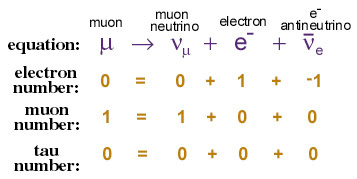
Law:
Total lepton number (before) = Total lepton number (after)
- Leptons cannot appear or disappear without corresponding antileptons.
- Applies separately to each interaction.
How to Decide If an Interaction Is Possible
To test whether a proposed interaction is allowed:
- Add up total charge before and after.
- Add up total baryon number before and after.
- Add up total lepton number before and after.
- If all three are conserved, the interaction is possible.
- If any one is not conserved, the interaction is forbidden.
Worked Reasoning Examples
(a) Allowed Interaction
- Charge conserved
- Baryon number conserved
- Lepton number conserved
- Interaction is possible
(b) Forbidden Interaction
- Charge conserved
- Baryon number conserved
- Lepton number not conserved
- Interaction cannot occur
Typical Situations
- Beta decay: lepton number conserved by emission of a neutrino.
- Pair production: particle and antiparticle created together.
- Annihilation: particle–antiparticle pair destroyed together.
Key Exam Tip
- Always show conservation checks explicitly.
- State clearly which quantity is not conserved if an interaction is impossible.
Example (Easy)
Can a neutron decay into a proton and an electron only? Explain using conservation laws.
▶️ Answer / Explanation
- Charge: conserved
- Baryon number: conserved
- Lepton number: not conserved
- A neutrino is required → decay as written is impossible
Example (Medium)
Determine whether the interaction is possible: proton → positron + pion
▶️ Answer / Explanation
- Baryon number before = +1
- Baryon number after = 0
- Baryon number not conserved
- Interaction is impossible
Example (Hard)
A photon produces an electron and a positron near a nucleus. Explain why this interaction is allowed.
▶️ Answer / Explanation
- Charge before = 0, after = +1 − 1 = 0
- Baryon number = 0 before and after
- Lepton number = +1 − 1 = 0
- All conservation laws satisfied