
Writing and Interpreting Particle Equations
Particle equations are used to represent particle interactions, decays, creation and annihilation. To write and interpret these equations correctly, the relevant particle symbols must be used and conservation laws must be satisfied.
Common Particle Symbols
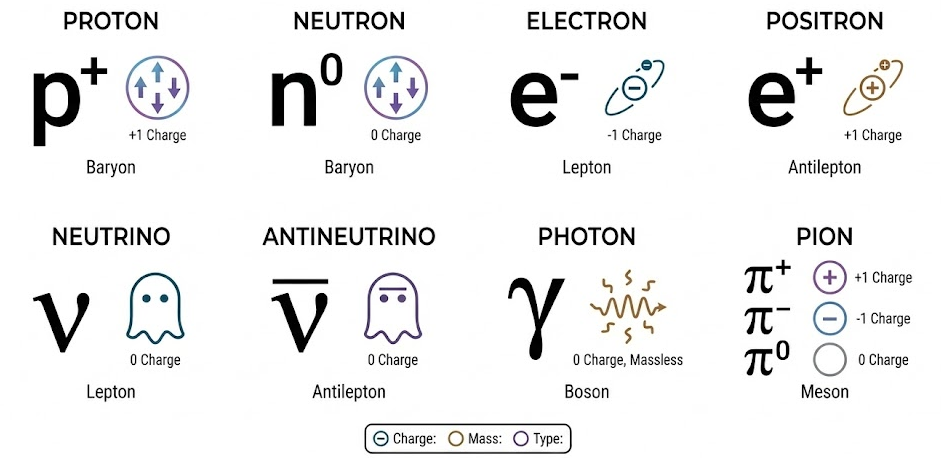
- Proton: \( \mathrm{p} \)
- Neutron: \( \mathrm{n} \)
- Electron: \( \mathrm{e^-} \)
- Positron: \( \mathrm{e^+} \)
- Neutrino: \( \mathrm{\nu} \)
- Antineutrino: \( \mathrm{\bar{\nu}} \)
- Photon: \( \mathrm{\gamma} \)
- Pion: \( \mathrm{\pi^+}, \mathrm{\pi^-}, \mathrm{\pi^0} \)
General Form of a Particle Equation
A particle equation is written as:
Initial particles → Final particles
- Left-hand side: particles before interaction
- Right-hand side: particles after interaction
- The arrow shows the direction of the process
Interpreting Particle Equations
To interpret a particle equation:
- Identify the particles involved.
- Determine whether it is decay, collision, annihilation or creation.
- Check conservation of charge.
- Check conservation of baryon number.
- Check conservation of lepton number.
Example: Beta Minus Decay

\( \mathrm{n \rightarrow p + e^- + \bar{\nu}} \)
- A neutron decays into a proton.
- An electron is emitted.
- An antineutrino is emitted to conserve lepton number.
Example: Beta Plus Decay

\( \mathrm{p \rightarrow n + e^+ + \nu} \)
- A proton changes into a neutron.
- A positron and a neutrino are emitted.
Example: Pair Production
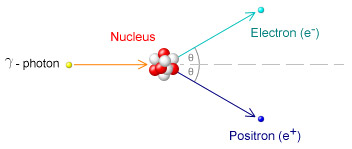
\( \mathrm{\gamma \rightarrow e^- + e^+} \)
- A high-energy photon creates a particle–antiparticle pair.
- Charge is conserved.
- Lepton number is conserved.
Example: Annihilation
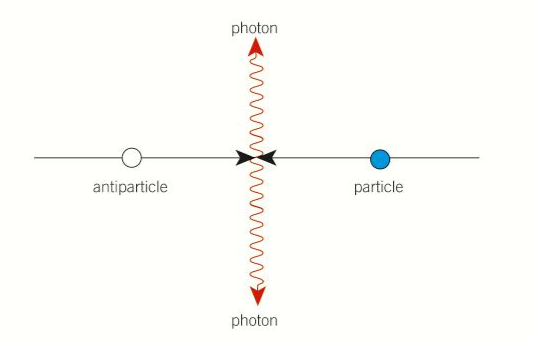
\( \mathrm{e^- + e^+ \rightarrow \gamma + \gamma} \)
- An electron and positron annihilate.
- Energy is released as photons.
Writing Particle Equations
When asked to write a particle equation:
- Use correct particle symbols.
- Ensure charge is conserved.
- Ensure baryon number is conserved.
- Ensure lepton number is conserved.
- Add neutrinos or antineutrinos if required.
Common Exam Mistakes
- Forgetting neutrinos or antineutrinos.
- Incorrect charge signs.
- Baryon or lepton number not conserved.
Example (Easy)
Write the particle equation for electron–positron annihilation.
▶️ Answer / Explanation
\( \mathrm{e^- + e^+ \rightarrow \gamma + \gamma} \)
Example (Medium)
Complete the equation: \( \mathrm{n \rightarrow p + e^- + \, ? } \)
▶️ Answer / Explanation
An antineutrino is required: \( \mathrm{\bar{\nu}} \)
Example (Hard)
Determine whether the following interaction is possible and explain: \( \mathrm{p \rightarrow e^+ + \pi^0} \)
▶️ Answer / Explanation
- Charge is conserved.
- Baryon number is not conserved.
- Interaction is not possible.