
Angular Displacement in Radians and Degrees
Angular displacement describes how far an object has rotated about a fixed point or axis. It can be measured in either degrees or radians, but radians are the SI unit used in physics equations.
Angular Displacement in Degrees

- A full circle is divided into 360 degrees.
- Degrees are commonly used in geometry and everyday situations.
- Symbol used: \( ^\circ \).
Full rotation \( = 360^\circ \)
Angular Displacement in Radians
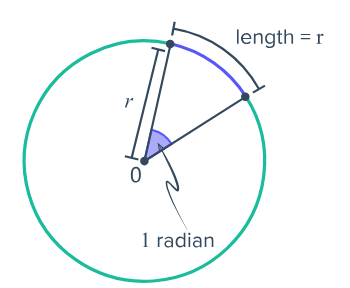
The radian is defined using the geometry of a circle.
 F
F
Definition:
One radian is the angle subtended at the centre of a circle by an arc equal in length to the radius.
Key results:
- Arc length of a full circle = \( 2\pi r \)
- Therefore, a full circle corresponds to \( 2\pi \) radians
Full rotation \( = 2\pi\ \text{radians} \)
Relationship Between Degrees and Radians
Since:
\( 360^\circ = 2\pi\ \text{radians} \)
We obtain the conversion factors:
\( 180^\circ = \pi\ \text{radians} \)
Conversion Formulae

Degrees to radians:
\( \theta(\text{radians}) = \theta(^\circ)\times\dfrac{\pi}{180} \)
Radians to degrees:
\( \theta(^\circ) = \theta(\text{radians})\times\dfrac{180}{\pi} \)
Why Radians Are Used in Physics
- Radians are dimensionless.
- Many physics equations (e.g. arc length, angular velocity, SHM) only work correctly in radians.
- Using degrees in these equations gives incorrect results.
Common Angular Values
| Degrees | Radians |
|---|---|
| \( 30^\circ \) | \( \dfrac{\pi}{6} \) |
| \( 45^\circ \) | \( \dfrac{\pi}{4} \) |
| \( 60^\circ \) | \( \dfrac{\pi}{3} \) |
| \( 90^\circ \) | \( \dfrac{\pi}{2} \) |
| \( 180^\circ \) | \( \pi \) |
| \( 360^\circ \) | \( 2\pi \) |
Example (Easy)
Convert \( 60^\circ \) to radians.
▶️ Answer / Explanation
\( \theta = 60 \times \dfrac{\pi}{180} = \dfrac{\pi}{3}\ \text{radians} \)
Example (Medium)
Convert \( \dfrac{5\pi}{6} \) radians to degrees.
▶️ Answer / Explanation
\( \theta = \dfrac{5\pi}{6} \times \dfrac{180}{\pi} = 150^\circ \)
Example (Hard)
A wheel rotates through \( 2.5 \) revolutions. Express this angular displacement in radians.
▶️ Answer / Explanation
One revolution = \( 2\pi \) radians
\( \theta = 2.5 \times 2\pi = 5\pi\ \text{radians} \)