
Mechanism of Nuclear Fusion and the Need for Very High Temperature and Density
Nuclear fusion is the process in which two light nuclei combine to form a heavier nucleus, releasing energy. Although fusion releases enormous energy, it is extremely difficult to initiate and sustain because of strong electrostatic repulsion between nuclei.
The Basic Fusion Process
In a typical fusion reaction (such as in stars):
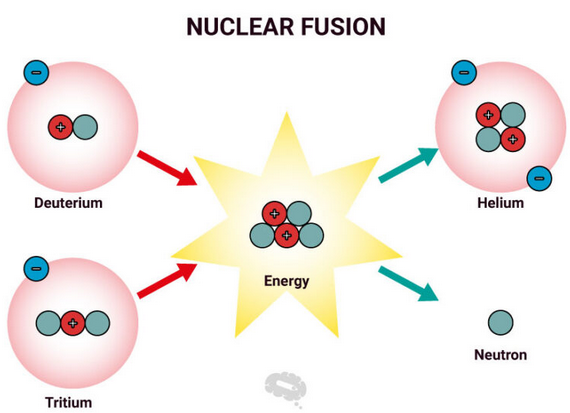
- Two light nuclei (e.g. hydrogen isotopes) approach each other.
- If they get close enough, the strong nuclear force binds them together.
- A new nucleus forms with a higher binding energy per nucleon.
- The mass defect is converted into energy using \( \Delta E = c^2 \Delta m \).
Key condition: Nuclei must come within about \( 1\times10^{-15}\ \mathrm{m} \) for the strong nuclear force to act.
Coulomb Repulsion (Electrostatic Barrier)
All nuclei are positively charged, so they repel each other due to electrostatic force.
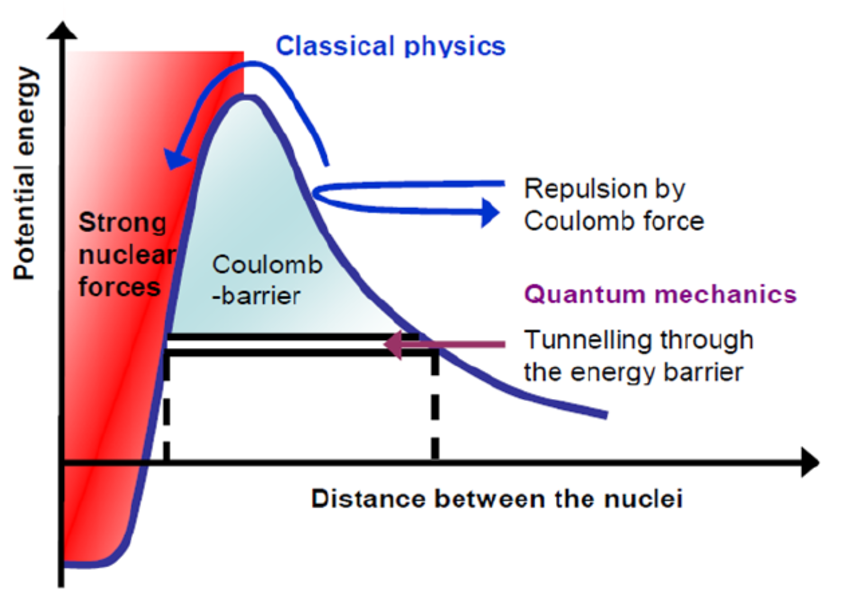
- This repulsion is called the Coulomb barrier.
- The force increases as nuclei get closer.
- Fusion cannot occur unless this barrier is overcome.
Conclusion: Very high kinetic energy is required for nuclei to get close enough to fuse.
Why Very High Temperature Is Required
Temperature is a measure of the average kinetic energy of particles:
\( \text{average kinetic energy} = \tfrac{3}{2} kT \)
- High temperature → nuclei move very fast.
- High speed increases chance of overcoming Coulomb repulsion.
- Fusion typically requires temperatures of the order of \( 10^7 \) to \( 10^8\ \mathrm{K} \).
Example: The core of the Sun has a temperature of about \( 1.5\times10^7\ \mathrm{K} \).
Why Very High Density Is Required
High density increases the probability of fusion reactions.
- More nuclei per unit volume.
- More frequent collisions between nuclei.
- Greater chance that collisions occur with sufficient energy.
Without high density:
- Collisions are too infrequent.
- Fusion rate is too low to sustain energy output.
Maintaining Nuclear Fusion
For fusion to be self-sustaining:
- Energy released must maintain high temperature.
- Particles must remain confined long enough to collide.
- Energy losses must be minimised.
This condition is known as plasma confinement.
Methods:
- Gravitational confinement: stars (e.g. the Sun)
- Magnetic confinement: tokamaks and fusion reactors
- Inertial confinement: high-powered lasers
Why Fusion Occurs Naturally in Stars
- Enormous gravitational pressure creates extremely high density.
- Gravitational energy raises temperature to fusion levels.
- Fusion energy balances gravitational collapse.
This balance keeps stars stable over billions of years.
Example (Easy)
Why do nuclei need very high kinetic energy for fusion?
▶️ Answer / Explanation
- Nuclei are positively charged.
- They repel each other due to electrostatic force.
- High kinetic energy allows them to overcome this repulsion.
Example (Medium)
Explain why high temperature alone is not sufficient for sustained fusion.
▶️ Answer / Explanation
- High temperature gives nuclei high kinetic energy.
- But without high density, collisions are too rare.
- Fusion rate would be too low to sustain energy output.
Example (Hard)
Explain why nuclear fusion is difficult to achieve on Earth but occurs naturally in stars.
▶️ Answer / Explanation
- Stars have immense gravitational pressure.
- This creates very high temperature and density.
- Earth lacks gravitational confinement of sufficient strength.
- Artificial confinement methods are technologically challenging.