
Applying Conservation of Energy to Damped and Undamped Oscillations
In oscillating systems, energy is continually transferred between different forms. The way energy behaves depends on whether the system is undamped or damped.
Energy in an Undamped Oscillating System
An undamped system is one where no energy is lost to the surroundings.
- No friction or air resistance.

- Total mechanical energy remains constant.
- The amplitude stays constant.
Forms of energy involved:
- Kinetic energy
- Potential energy (elastic or gravitational)
Conservation of energy:
Total energy = kinetic energy + potential energy = constant
For a mass–spring system, maximum energy is:
\( E = \dfrac{1}{2}kA^2 \)
Energy Changes During One Oscillation (Undamped)
- At maximum displacement: potential energy is maximum, kinetic energy is zero.
- At equilibrium: kinetic energy is maximum, potential energy is minimum.
- Between these points: energy is continuously exchanged.
Key idea: Energy changes form, but the total remains constant.
Energy in a Damped Oscillating System
A damped system is one where energy is lost to the surroundings.
- Energy is lost due to friction or air resistance.
- Mechanical energy is converted into thermal energy.
- The amplitude decreases with time.
Important: The system still obeys conservation of energy, but energy is transferred out of the system.
Applying Conservation of Energy in Damped Motion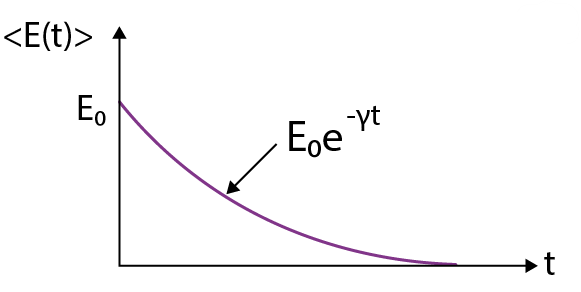
For a damped system:
- Total mechanical energy decreases each cycle.
- Lost energy appears as heat or sound.
- The oscillator eventually comes to rest.
This can be written conceptually as:
Initial energy = remaining mechanical energy + energy dissipated
Comparison of Undamped and Damped Systems
- Undamped: total mechanical energy constant.
- Damped: total mechanical energy decreases.
- Undamped: amplitude constant.
- Damped: amplitude decreases exponentially.
Real Oscillating Systems
- Perfectly undamped systems do not exist in practice.
- Light damping approximates undamped motion over short times.
- Heavy damping removes oscillations quickly.
Exam Application Tips
- State clearly whether damping is present.
- Identify energy transfers correctly.
- Do not say energy is “lost” — say it is transferred.
- Relate decreasing amplitude to energy dissipation.
Example (Easy)
Why does an undamped oscillator continue oscillating indefinitely?
▶️ Answer / Explanation
No energy is lost to the surroundings, so total mechanical energy remains constant.
Example (Medium)
Explain why the amplitude of a damped oscillator decreases with time.
▶️ Answer / Explanation
- Energy is transferred to the surroundings.
- Mechanical energy decreases each cycle.
- Less energy means smaller amplitude.
Example (Hard)
Explain how conservation of energy applies to a pendulum oscillating in air.
▶️ Answer / Explanation
- Gravitational potential and kinetic energy are exchanged.
- Air resistance transfers energy to thermal energy.
- Total energy is conserved when surroundings are included.