
Distinction Between Free and Forced Oscillations
Oscillatory motion can be classified as free oscillations or forced oscillations depending on whether an external driving force is applied.
Free Oscillations
Free oscillations occur when a system is displaced from its equilibrium position and then allowed to oscillate without any external driving force.

- No external periodic force acts on the system.
- The system oscillates at its natural frequency.
- Energy is not supplied after motion begins.
Energy considerations:
- In an ideal system, total mechanical energy is constant.
- In real systems, energy is gradually lost due to damping.
Examples:
- A pendulum released from a small angle.
- A mass on a spring pulled and released.
Forced Oscillations
Forced oscillations occur when an external periodic force continuously supplies energy to the system.
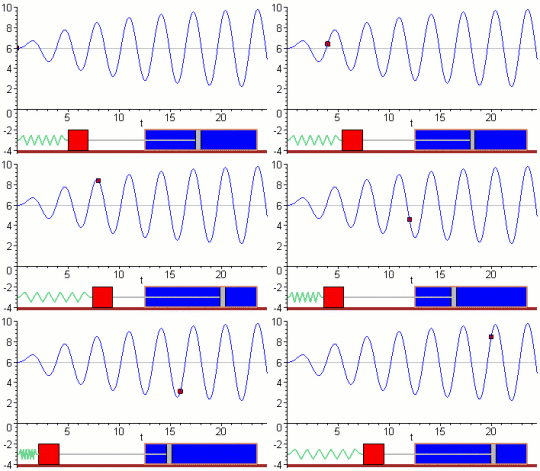
- An external driving force acts on the system.
- The system oscillates at the frequency of the driving force.
- Energy lost due to damping is replaced by the driving force.
Examples:
- A swing being pushed periodically.
- A mass–spring system attached to a vibration driver.
Key Differences Between Free and Forced Oscillations
- Free oscillations require no continuous energy input.
- Forced oscillations require an external energy source.
- Free oscillations occur at natural frequency.
- Forced oscillations occur at driving frequency.
Role of Damping
- In free oscillations, damping causes amplitude to decrease.
- In forced oscillations, damping limits the amplitude.
- Damping is necessary to prevent destructive resonance.
Link to Resonance
In forced oscillations:
- Resonance occurs when driving frequency equals natural frequency.
- Amplitude becomes maximum.
Important: Resonance does not occur in free oscillations.
Example (Easy)
Why does a free oscillation eventually stop?
▶️ Answer / Explanation
Energy is transferred to the surroundings due to damping, so the amplitude decreases.
Example (Medium)
Why can forced oscillations continue with constant amplitude?
▶️ Answer / Explanation
- Energy lost due to damping is replaced.
- The external force supplies energy continuously.
Example (Hard)
Explain why a bridge may collapse due to forced oscillations but not free oscillations.
▶️ Answer / Explanation
- Wind or traffic provides a driving force.
- Resonance may occur.
- Large amplitude oscillations cause structural failure.