
Amplitude of Forced Oscillations and the Effect of Damping on Resonance
When a system undergoes forced oscillations, its amplitude depends on the frequency of the driving force and the amount of damping present in the system.
Amplitude Variation with Driving Frequency
As the driving frequency is changed:
- At low driving frequencies, the amplitude is small.
- As driving frequency increases, amplitude increases.
- Maximum amplitude occurs near the natural frequency.
- At high frequencies, amplitude decreases again.

This behaviour is shown on an amplitude–frequency graph, called a resonance curve.
Resonance
Resonance occurs when the driving frequency is equal (or very close) to the natural frequency of the system.
- Energy transfer from the driving force is maximum.

- The system oscillates with maximum amplitude.
- The oscillations are most pronounced.

Key idea: At resonance, the system absorbs energy most efficiently.
Effect of Damping on Resonance
Damping is the loss of energy from the system due to friction or resistance.
Qualitative effects of increasing damping:
- Maximum amplitude at resonance decreases.
- The resonance peak becomes lower.
- The resonance peak becomes broader.
- The resonant frequency shifts slightly to a lower value.
Light and Heavy Damping
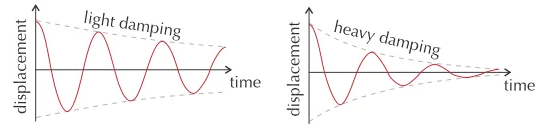
Light damping:
- High, sharp resonance peak.
- Large maximum amplitude.
- Resonant frequency close to natural frequency.
Heavy damping:
- Lower, broader resonance peak.
- Reduced maximum amplitude.
- Resonance effect less pronounced.
Important: Very heavy damping can prevent resonance entirely.
Why Damping Is Important
- Prevents excessively large amplitudes.
- Protects structures and machines.
- Ensures stable operation in engineering systems.
Exam Language to Use
- Say “energy is transferred to the surroundings”, not “lost”.
- State that damping reduces amplitude.
- Mention broadening and lowering of resonance peak.
- Relate changes to reduced energy build-up.
Example (Easy)
When is the amplitude of a forced oscillation greatest?
▶️ Answer / Explanation
The amplitude is greatest when the driving frequency equals the natural frequency of the system (resonance).
Example (Medium)
How does increasing damping affect the resonance curve?
▶️ Answer / Explanation
- The maximum amplitude decreases.
- The resonance peak becomes broader.
- The resonant frequency shifts slightly lower.
Example (Hard)
Explain why shock absorbers in cars are designed to be damped.
▶️ Answer / Explanation
- Damping reduces oscillation amplitude.
- Prevents resonance with road vibrations.
- Ensures comfort and safety.