
Reduction of Oscillation Amplitude by Damping and Plastic Deformation
The amplitude of an oscillating system decreases when energy is transferred away from the motion. This reduction can occur due to damping or due to plastic deformation in ductile materials.
Effect of Damping on Oscillation Amplitude
Damping occurs when resistive forces (such as friction or air resistance) act on an oscillating system.
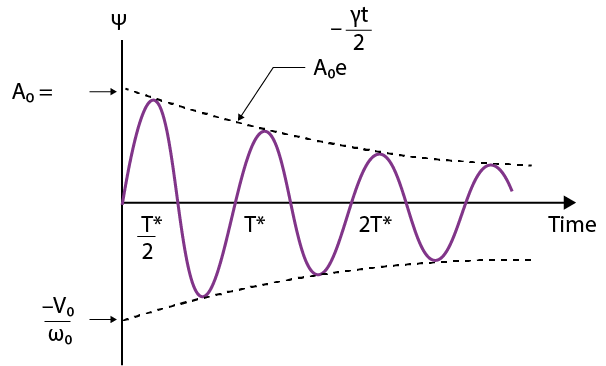
- Mechanical energy is transferred to thermal energy or sound.
- Less energy is available for oscillation.
- The amplitude decreases with time.
Key idea:
- Each oscillation loses some energy.
- Successive peaks become smaller.
- Eventually the system comes to rest.
In lightly damped systems, oscillations continue for many cycles with gradually decreasing amplitude.
Energy Perspective for Damping
Applying conservation of energy:
- Initial mechanical energy = remaining mechanical energy + energy transferred to surroundings.
- The loss of mechanical energy directly reduces amplitude.
Important exam wording: Energy is not destroyed — it is transferred to the surroundings.
Plastic Deformation in Ductile Materials
Ductile materials can undergo permanent (plastic) deformation when stressed beyond their elastic limit.
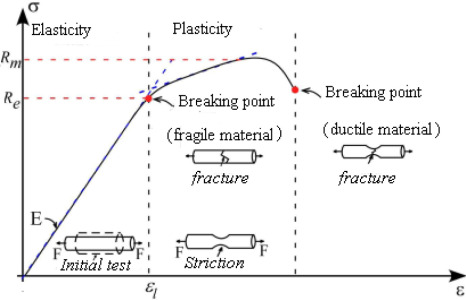
- Some work done during deformation is not recovered.
- Energy is dissipated internally within the material.
- This energy appears mainly as thermal energy.
Key idea: Plastic deformation converts mechanical energy into internal energy.
How Plastic Deformation Reduces Oscillation Amplitude
- During each oscillation, energy is lost due to plastic deformation.
- The system cannot return all stored energy.
- The maximum displacement decreases.
- Amplitude steadily reduces.
This effect is often represented by a hysteresis loop on a stress–strain graph.

Comparison of Damping and Plastic Deformation
- Damping: energy lost due to external resistive forces.
- Plastic deformation: energy lost internally within the material.
- Both reduce mechanical energy.
- Both cause amplitude to decrease.
Practical Applications
- Shock absorbers use damping to control oscillations.
- Structures include damping to prevent resonance damage.
- Ductile materials are used to absorb energy during impacts.
Exam Tips
- Always link reduced amplitude to energy transfer.
- Mention thermal energy when discussing damping.
- For plastic deformation, state energy is not fully recovered.
- Use clear cause-and-effect explanations.
Example (Easy)
Why does the amplitude of a damped oscillator decrease with time?
▶️ Answer / Explanation
Energy is transferred to the surroundings due to damping, so less mechanical energy remains to sustain the oscillation.
Example (Medium)
Explain how plastic deformation reduces the amplitude of oscillation in a metal system.
▶️ Answer / Explanation
- Energy is dissipated internally.
- Not all work done is recovered.
- Mechanical energy decreases each cycle.
Example (Hard)
Explain why a structure made of ductile material is safer during oscillations than a brittle one.
▶️ Answer / Explanation
- Ductile materials undergo plastic deformation.
- Energy is absorbed internally.
- Oscillation amplitude is reduced.
- Risk of sudden failure is lowered.