
Derivation and Use of the Gravitational Field Equation for a Point Mass
The gravitational field strength due to a point mass can be derived directly from Newton’s law of universal gravitation and the definition of gravitational field strength.
Starting Definitions
Newton’s law of universal gravitation:
\( F = \dfrac{G M m}{r^2} \)
- \( M \) = mass creating the gravitational field (kg)
- \( m \) = test mass (kg)
- \( r \) = distance from the centre of mass \( M \) (m)
- \( G \) = gravitational constant
Definition of gravitational field strength:
\( g = \dfrac{F}{m} \)
Derivation of \( g = \dfrac{GM}{r^2} \)
Substitute the gravitational force into the definition of field strength:
\( g = \dfrac{F}{m} = \dfrac{1}{m}\left(\dfrac{G M m}{r^2}\right) \)
Cancel the mass \( m \):
\( g = \dfrac{G M}{r^2} \)
Conclusion: The gravitational field strength due to a point mass depends only on the mass creating the field and the distance from it.
Meaning of the Equation
\( g = \dfrac{G M}{r^2} \)
- \( g \) = gravitational field strength (N kg⁻¹)
- \( M \) = mass producing the field (kg)
- \( r \) = distance from the centre of the mass (m)
Key ideas:
- Gravitational field strength follows an inverse-square law.
- Doubling \( r \) reduces \( g \) by a factor of 4.
- The field strength is independent of the test mass.
Direction of the Gravitational Field
- The gravitational field is radial.
- It always acts towards the centre of the mass.
- The direction of \( g \) is the direction of the force on a unit mass.
Application to the Earth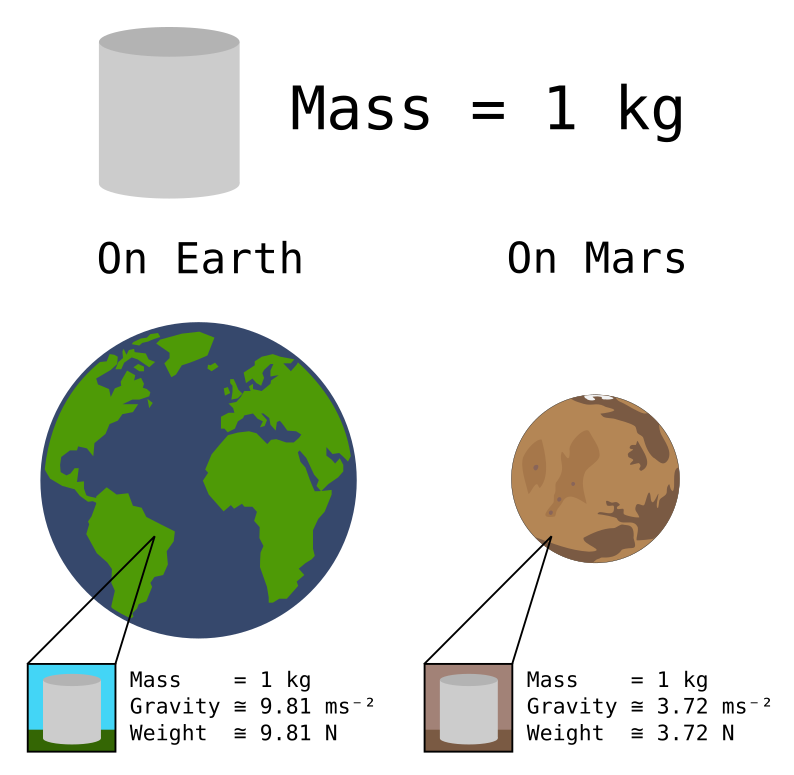
For the Earth:
- \( M \) = mass of the Earth
- \( r \) = distance from the centre of the Earth
Near the Earth’s surface:
\( g \approx 9.8\,\mathrm{N\,kg^{-1}} \)
This explains why \( g \) decreases with altitude.
Using the Equation in Calculations
- Ensure all quantities are in SI units.
- Use distance from the centre of the mass, not the surface.
- Apply inverse-square reasoning where appropriate.
Rearranged forms:
\( M = \dfrac{g r^2}{G} \)
\( r = \sqrt{\dfrac{G M}{g}} \)
Example (Easy)
Explain why the gravitational field strength decreases as distance from a planet increases.
▶️ Answer / Explanation
Gravitational field strength follows an inverse-square law, so increasing distance reduces the field strength.
Example (Medium)
Calculate the gravitational field strength \( 1.0\times10^{7}\,\mathrm{m} \) from the centre of the Earth \( (M = 6.0\times10^{24}\,\mathrm{kg}) \).
▶️ Answer / Explanation
\( g = \dfrac{(6.67\times10^{-11})(6.0\times10^{24})}{(1.0\times10^{7})^2} \)
\( g \approx 4.0\,\mathrm{N\,kg^{-1}} \)
Example (Hard)
The gravitational field strength at a distance \( r \) from a planet is \( g \). What is the field strength at distance \( 2r \)?
▶️ Answer / Explanation
Using the inverse-square law:
\( g_{\text{new}} = \dfrac{g}{4} \)