
Determining Astronomical Distances Using Trigonometric Parallax
Trigonometric parallax is a geometric method used to measure the distances to nearby stars by observing their apparent shift in position.
What Is Trigonometric Parallax?
As the Earth orbits the Sun, a nearby star appears to shift slightly relative to distant background stars.
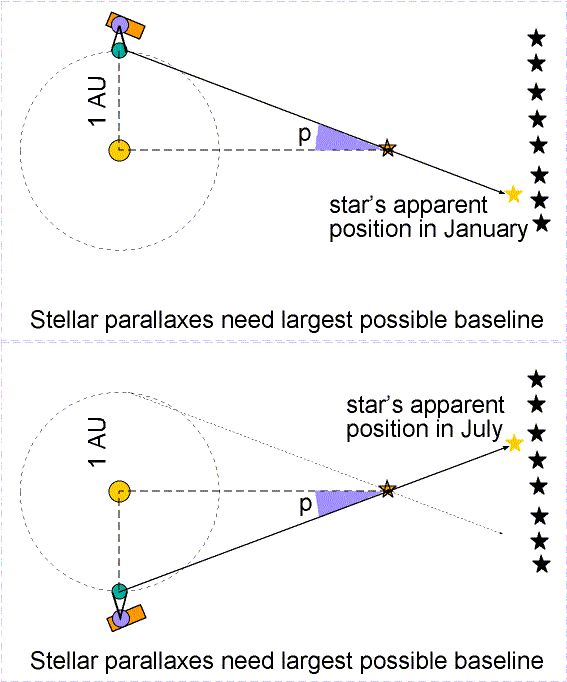
- This apparent shift is called parallax.
- More distant stars show a smaller parallax.
- Nearby stars show a larger parallax.
Key idea:
- Distance is found using geometry and trigonometry.
Parallax Angle
The parallax angle \( p \) is defined as:
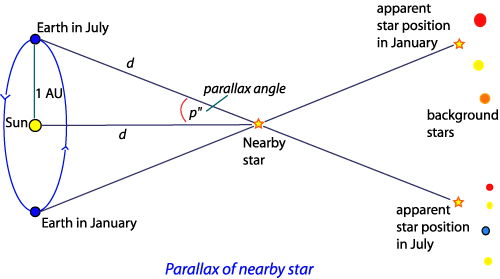
- Half the total angular shift observed over six months.
- The angle subtended at the star by a baseline of 1 astronomical unit (AU).
Baseline:
- Earth–Sun distance = 1 AU
Distance Formula Using Parallax
For very small angles:
\( d = \dfrac{1}{p} \)
- \( d \) = distance to the star (parsecs)
- \( p \) = parallax angle (arcseconds)
Important:
- This formula defines the parsec.
- 1 parsec is the distance at which \( p = 1 \) arcsecond.
Meaning of a Parsec
- 1 parsec ≈ \( 3.09\times10^{16}\,\mathrm{m} \)
- Used for nearby stars.
- Larger distances require other methods.
Limitations of Trigonometric Parallax
- Parallax angles are extremely small.
- Measurement accuracy limits the method.
- Effective only for relatively nearby stars.
Conclusion:
- Best method for stars within a few hundred parsecs.
Example (Easy)
A star has a parallax angle of \( 0.50 \) arcseconds. Calculate its distance.
▶️ Answer / Explanation
\( d = \dfrac{1}{p} = \dfrac{1}{0.50} = 2.0\,\text{pc} \)
Example (Medium)
The total observed angular shift of a star over six months is \( 0.20 \) arcseconds. Calculate the distance to the star.
▶️ Answer / Explanation
Parallax angle:
\( p = \dfrac{0.20}{2} = 0.10\,\text{arcseconds} \)
Distance:
\( d = \dfrac{1}{0.10} = 10\,\text{pc} \)
Example (Hard)
A star is at a distance of \( 50\,\text{pc} \). Calculate its parallax angle.
▶️ Answer / Explanation
\( p = \dfrac{1}{d} = \dfrac{1}{50} = 0.020\,\text{arcseconds} \)
This very small angle explains why distant stars are difficult to measure.