
Relating the Hertzsprung–Russell Diagram to the Life Cycle of Stars
The Hertzsprung–Russell (H–R) diagram not only classifies stars, but also shows how stars change position as they evolve during their life cycle.
Birth of a Star (Protostar Stage)
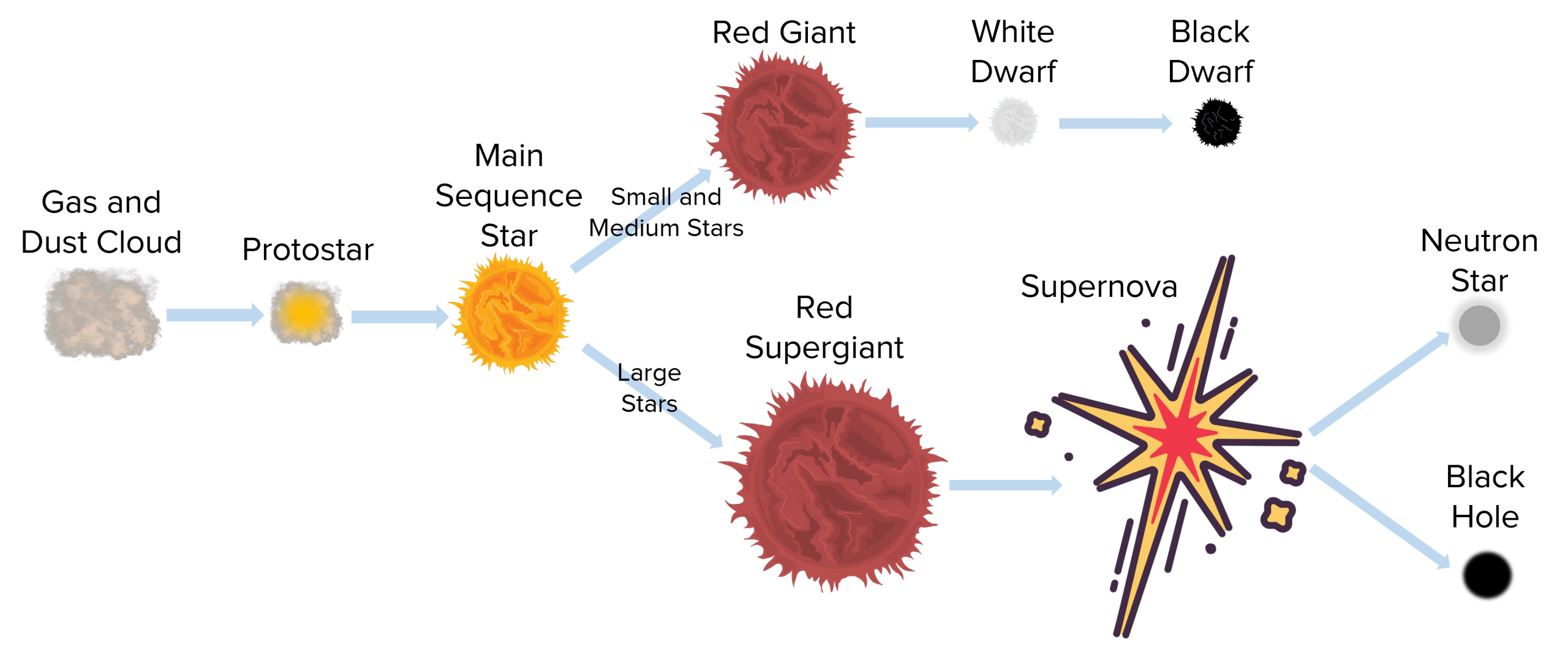
Stars form from large clouds of gas and dust called nebulae.
- Gravitational collapse increases temperature.
- Nuclear fusion has not yet begun.
- The object is called a protostar.
H–R diagram position:
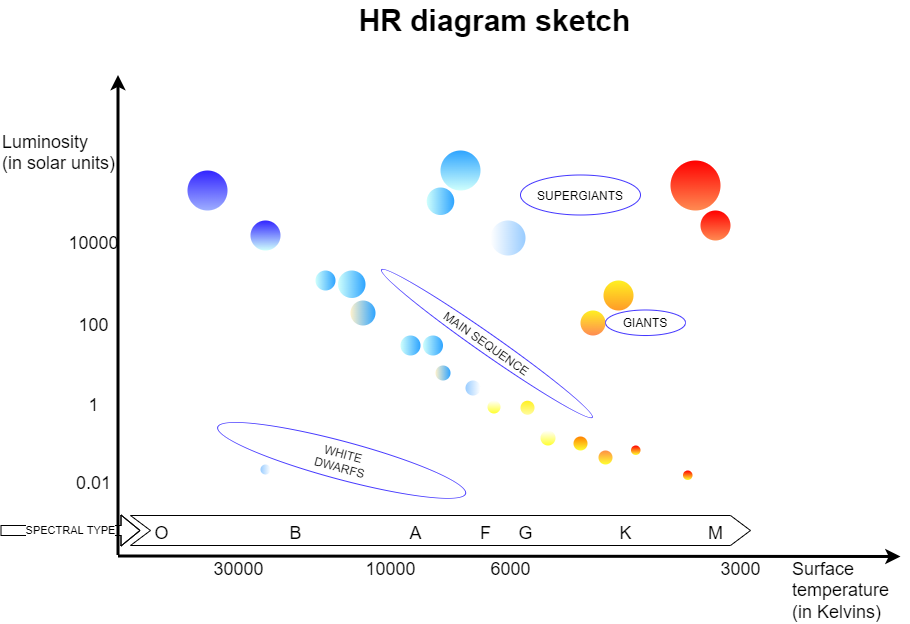
- Low temperature
- Low luminosity
- Bottom-right region
Main Sequence Stage
When nuclear fusion of hydrogen begins in the core, the star enters the main sequence.
- Hydrogen fuses into helium.
- Outward radiation pressure balances gravity.
- This is the longest stage of a star’s life.
H–R diagram position: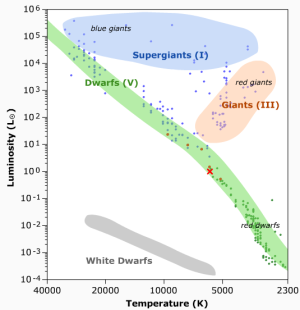
- Diagonal band from top-left to bottom-right.
- Massive stars are hot and luminous (upper-left).
- Low-mass stars are cool and dim (lower-right).
Red Giant or Red Supergiant Stage
When hydrogen in the core is exhausted:
- Core contracts and heats up.
- Outer layers expand and cool.
- Luminosity increases greatly.
H–R diagram movement:
- Star moves upward and to the right.
- Becomes a red giant (low-mass star).
- Becomes a red supergiant (high-mass star).
Final Stages of Low-Mass Stars (e.g. Sun)
For stars similar in mass to the Sun:
- Outer layers are ejected.
- Core remains as a white dwarf.
White dwarf properties:
- High temperature
- Low luminosity
- No nuclear fusion
H–R diagram position:
- Bottom-left region
Final Stages of High-Mass Stars
For stars much more massive than the Sun:
- Fusion continues to heavier elements.
- Ends in a supernova explosion.
- Core collapses into a neutron star or black hole.
H–R diagram relevance:
- Rapid movement off the main sequence.
- Extremely high luminosity before collapse.
Example (Easy)
Where is a red giant located on the H–R diagram?
▶️ Answer / Explanation
A red giant is found in the upper-right region of the H–R diagram.
Example (Medium)
A star moves to the right and upward on the H–R diagram. What stage of its life cycle is it entering?
▶️ Answer / Explanation
The star is becoming a red giant as its outer layers expand and cool.
Example (Hard)
Two stars have the same surface temperature, but one is much more luminous. Which star is more evolved and why?
▶️ Answer / Explanation
- Higher luminosity at same temperature implies larger radius.
- The star is likely a giant.
- Giants are later in the stellar life cycle.