
Doppler Effect: Frequency Shift Due to Relative Motion
The Doppler effect describes how the observed frequency of a wave changes when there is relative motion between the source of waves and the observer.
What Is the Doppler Effect?
The Doppler effect occurs when:
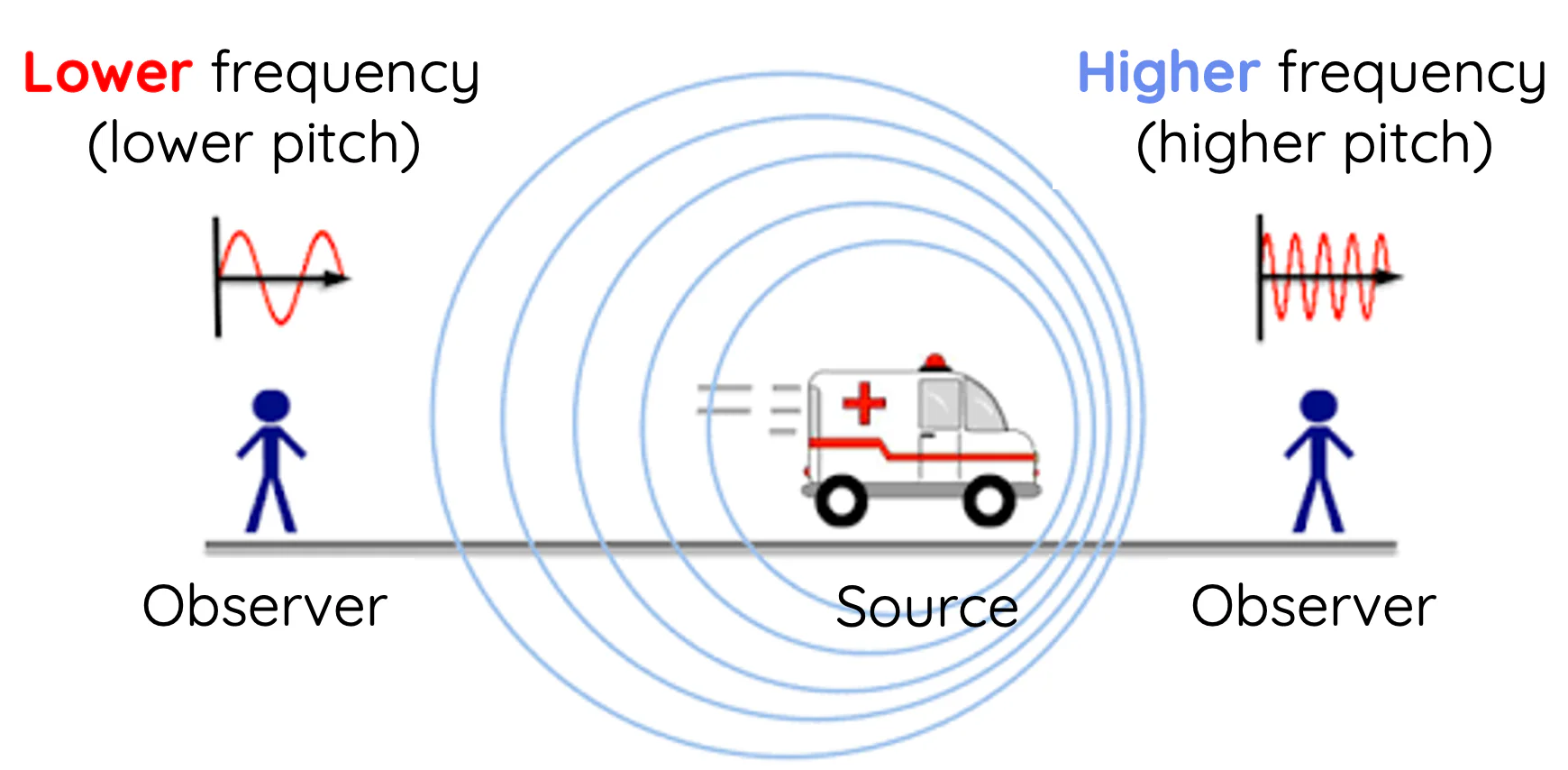
- A wave source moves relative to an observer, or
- An observer moves relative to a wave source.
This relative motion causes the observed frequency to differ from the emitted frequency.
Source Moving Towards the Observer
- Wavefronts are compressed.
- Wavelength decreases.
- Observed frequency increases.
Result:
- Higher pitch for sound.
- Blueshift for light.
Source Moving Away from the Observer
- Wavefronts are stretched.
- Wavelength increases.
- Observed frequency decreases.
Result:
- Lower pitch for sound.
- Redshift for light.
Doppler Effect for Waves
The Doppler effect changes:
- Observed frequency
- Observed wavelength
It does NOT change:
- The speed of the wave in the medium
Simple Doppler Effect Equation (Source Moving, Observer Stationary)
Approaching source:
\( f’ = f \dfrac{v}{v – v_s} \)
Receding source:
\( f’ = f \dfrac{v}{v + v_s} \)
- \( f’ \) = observed frequency
- \( f \) = emitted frequency
- \( v \) = wave speed
- \( v_s \) = speed of source
Doppler Effect for Light (Qualitative)

- Approaching source → blueshift
- Receding source → redshift
- Used in astronomy to study star and galaxy motion
Important:
- Relativistic equations are used at very high speeds.
- For IAL Physics, qualitative understanding is sufficient.
Example (Easy)
A sound source moves towards a stationary observer. How does the observed frequency compare with the emitted frequency?
▶️ Answer / Explanation
The observed frequency is higher than the emitted frequency.
Example (Medium)
A siren emits sound at \( 500\,\mathrm{Hz} \). It moves away from a stationary observer. State what happens to the observed frequency and wavelength.
▶️ Answer / Explanation
- Observed frequency decreases.
- Observed wavelength increases.
Example (Hard)
A source emits sound at \( 600\,\mathrm{Hz} \) and moves towards a stationary observer at \( 20\,\mathrm{m\,s^{-1}} \). The speed of sound is \( 340\,\mathrm{m\,s^{-1}} \). Calculate the observed frequency.
▶️ Answer / Explanation
Use Doppler equation for approaching source:
\( f’ = f \dfrac{v}{v – v_s} \)
\( f’ = 600 \times \dfrac{340}{340 – 20} \)
\( f’ = 600 \times \dfrac{340}{320} \approx 638\,\mathrm{Hz} \)
The observer hears a higher frequency.