
Age and Ultimate Fate of the Universe: Hubble Constant and Dark Matter
The estimated age and ultimate fate of the Universe depend strongly on the value of the Hubble constant and on the possible existence of dark matter.
Age of the Universe from the Hubble Constant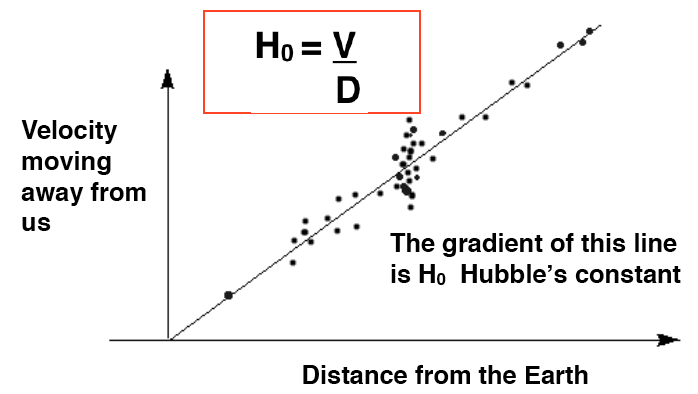
Hubble’s law is:
\( v = H_0 d \)
Rearranging gives an estimate for the age of the Universe:
\( t \approx \dfrac{1}{H_0} \)
Meaning:
- The inverse of the Hubble constant gives the time since expansion began.
- This assumes a constant rate of expansion.
Controversy Over the Value of the Hubble Constant
Different measurement methods give different values of \( H_0 \):

- Observations of nearby galaxies using standard candles.
- Observations of the cosmic microwave background.
Resulting issue:
- A larger \( H_0 \) → younger Universe.
- A smaller \( H_0 \) → older Universe.
This disagreement is known as the Hubble tension.
Numerical Example: Estimating the Age of the Universe

If:
\( H_0 = 2.2\times10^{-18}\,\mathrm{s^{-1}} \)
Then:
\( t = \dfrac{1}{2.2\times10^{-18}} = 4.5\times10^{17}\,\mathrm{s} \)
Convert to years:
\( t = \dfrac{4.5\times10^{17}}{3.15\times10^{7}} \approx 1.4\times10^{10}\,\mathrm{years} \)
Estimated age ≈ 14 billion years
Ultimate Fate of the Universe
The fate of the Universe depends on the balance between:
- Expansion due to the Big Bang.
- Gravitational attraction due to matter.
Three possible models are considered:
- Open Universe: Expansion continues forever.
- Closed Universe: Expansion stops and reverses (Big Crunch).
- Flat Universe: Expansion slows but never stops.
Role of Dark Matter
Dark matter is matter that:
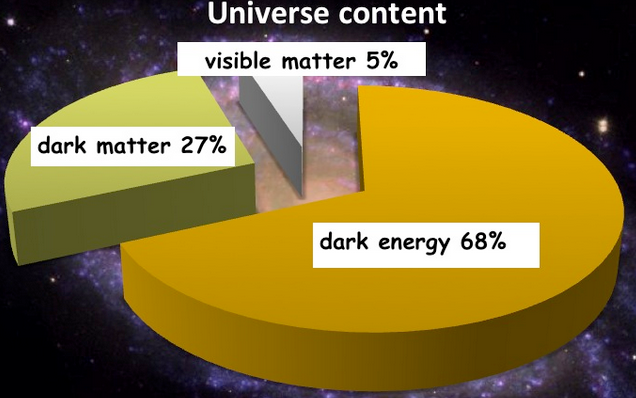
- Does not emit or absorb electromagnetic radiation.
- Is detected through gravitational effects.
Evidence for dark matter includes:
- Galaxy rotation curves.
- Gravitational lensing.
- Large-scale structure of the Universe.
How Dark Matter Affects the Fate of the Universe
- More dark matter → stronger gravity.
- Stronger gravity slows expansion.
- Sufficient matter could cause eventual collapse.
However:
- Observations suggest expansion is accelerating.
- This introduces further uncertainty.
Why There Is Controversy
- Different values of \( H_0 \) give different ages.
- Uncertainty in amount of dark matter.
- Expansion may not have been constant.
- Dark energy effects are not fully understood.
Conclusion:
- The age and fate of the Universe are not precisely known.
- They depend on measurements and assumptions.
Example (Easy)
What effect does a larger Hubble constant have on the estimated age of the Universe?
▶️ Answer / Explanation
A larger Hubble constant gives a smaller value of \( 1/H_0 \), so the Universe appears younger.
Example (Medium)
Explain why dark matter affects predictions of the Universe’s fate.
▶️ Answer / Explanation
Dark matter increases the total gravitational attraction, which can slow or reverse expansion.
Example (Hard)
Two values of the Hubble constant give ages of 12 billion years and 15 billion years. Explain why both could be considered reasonable.
▶️ Answer / Explanation
- Different measurement techniques give different \( H_0 \).
- Expansion rate may not have been constant.
- Uncertainty in dark matter content affects models.