
Algorithms and Their Implementation
An algorithm is a finite, ordered set of clear instructions designed to carry out a task or solve a problem. Algorithms are fundamental to computing and problem-solving and must be precise, unambiguous, and capable of being followed step by step.
In this syllabus, the focus is on understanding and implementing algorithms, rather than analysing their efficiency or order.
Key Characteristics of an Algorithm
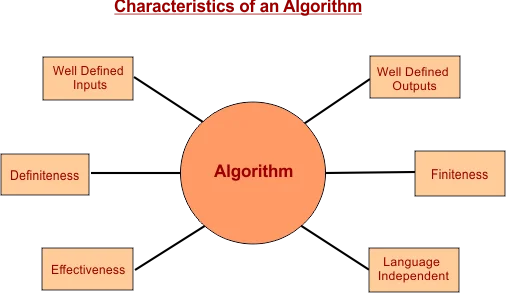
- Has a clearly defined start and finish
- Consists of a sequence of well-defined steps
- Produces an output for a given input
- Terminates after a finite number of steps
Ways of Representing an Algorithm
Algorithms may be represented in several forms. In this syllabus, two common representations are used:
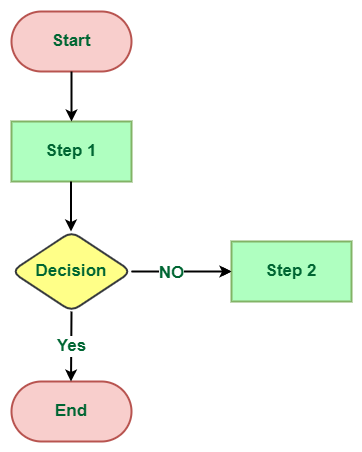
Flow charts – graphical representations using standard symbols
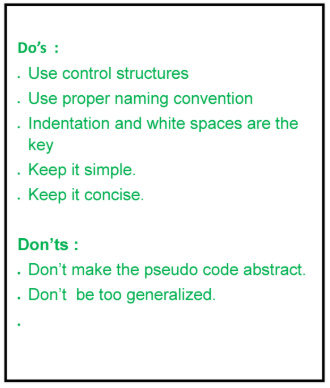
Text or pseudocode – step-by-step instructions written in structured English
Students must be able to follow and implement an algorithm given in either of these forms.
Flow Charts
A flow chart represents an algorithm using standard symbols such as:
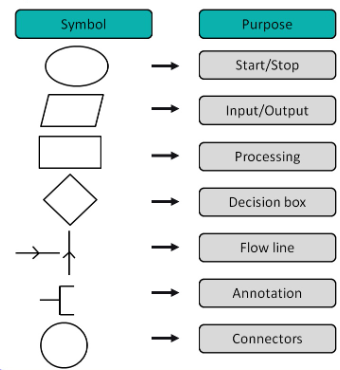
- Oval – start or end
- Rectangle – process or calculation
- Diamond – decision (yes/no)
- Parallelogram – input or output
Arrows show the direction of flow from one step to the next.
Algorithms Given in Text Form
An algorithm may also be written in words or pseudocode. This typically includes:
- Input statements
- Processing steps (calculations or assignments)
- Decision statements (e.g. IF … THEN … ELSE)
- Output statements
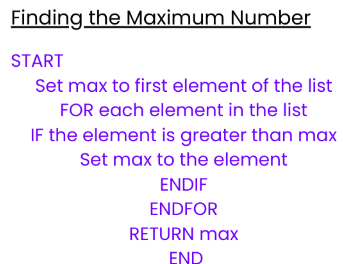
Students should be able to trace the algorithm step by step to determine the final output.
Middle Item of a List
Whenever an algorithm requires the middle item of a list, the method defined in the glossary must be used.
For a list containing \( \mathrm{N} \) items:
If \( \mathrm{N} \) is odd, the middle item has position \( \mathrm{\dfrac{1}{2}(N + 1)} \)
If \( \mathrm{N} \) is even, the middle item has position \( \mathrm{\dfrac{1}{2}(N + 2)} \)
This ensures that a single, well-defined middle item is always chosen.
Examples:
If \( \mathrm{N = 9} \), middle position \( = \mathrm{\dfrac{1}{2}(9 + 1) = 5} \)
If \( \mathrm{N = 6} \), middle position \( = \mathrm{\dfrac{1}{2}(6 + 2) = 4} \)
Important Notes
- The efficiency or order of an algorithm is not required
- Correct interpretation of steps is essential
- The glossary definition of the middle item must always be followed
Example (Algorithm in Text Form)
An algorithm takes a list of numbers and outputs the middle item.
Algorithm:
Step 1: Let the number of items in the list be \( \mathrm{N} \)
Step 2: If \( \mathrm{N} \) is odd, set \( \mathrm{M = \dfrac{1}{2}(N + 1)} \)
Step 3: If \( \mathrm{N} \) is even, set \( \mathrm{M = \dfrac{1}{2}(N + 2)} \)
Step 4: Output the item in position \( \mathrm{M} \)
The input list is:
4, 7, 9, 12, 15, 18
▶️ Answer/Explanation
Number of items:
\( \mathrm{N = 6} \) (even)
Middle position:
\( \mathrm{M = \dfrac{1}{2}(6 + 2) = 4} \)
Conclusion: The middle item is the 4th item, which is 12.
Example (Tracing an Algorithm)
An algorithm processes a list of numbers as follows:
Step 1: Arrange the numbers in ascending order
Step 2: Find the middle item using the glossary definition
Step 3: Output the middle item
The input list is:
11, 3, 8, 6, 14, 2, 9
▶️ Answer/Explanation
After sorting:
2, 3, 6, 8, 9, 11, 14
Number of items:
\( \mathrm{N = 7} \) (odd)
Middle position:
\( \mathrm{M = \dfrac{1}{2}(7 + 1) = 4} \)
Conclusion: The algorithm outputs 8.
Example (Flow-chart Style Logic)
An algorithm accepts a list of test scores and outputs:
“PASS” if the middle score is at least 50
“FAIL” otherwise
The scores are:
42, 55, 61, 48, 50, 70
▶️ Answer/Explanation
Step 1: Arrange in ascending order:
42, 48, 50, 55, 61, 70
Number of scores:
\( \mathrm{N = 6} \) (even)
Middle position:
\( \mathrm{M = \dfrac{1}{2}(6 + 2) = 4} \)
Middle score:
55
Conclusion: Since \( \mathrm{55 \geq 50} \), the algorithm outputs PASS.