
Activity Networks (Activity-on-Arc)
An activity network is used to model a project by showing the order in which activities must be carried out. In this syllabus, projects are modelled using an activity-on-arc (AOA) network.
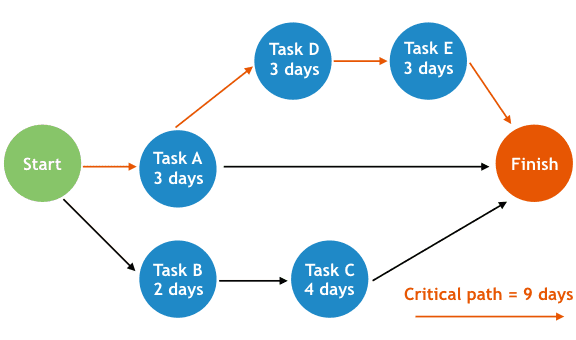
The network is constructed from a precedence table, which lists each activity together with its immediate predecessors.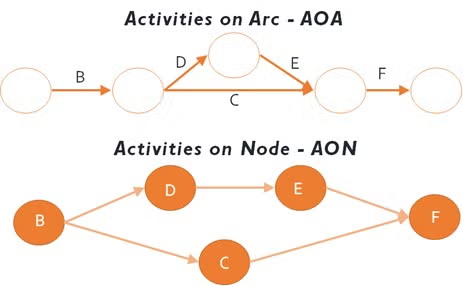
Activity-on-Arc Representation
In an activity-on-arc network:
- Activities are represented by arrows (arcs)
- Events (start or finish points) are represented by nodes
- The direction of an arrow shows the order of activities
Each activity must start only after all its immediate predecessors have been completed.
Precedence Tables
A precedence table lists: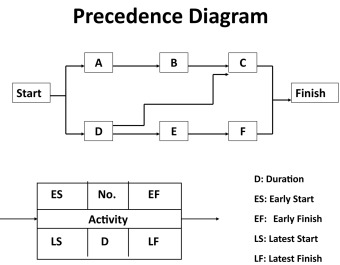
- The activity label
- The immediate predecessor(s) of that activity
Only immediate predecessors are shown. Indirect dependencies are not listed.
Dummy Activities
A dummy activity is an activity with:
- No duration
- No resource requirement
Dummy activities are used to:
- Preserve correct precedence relationships
- Avoid ambiguity in the network
They are usually shown as dashed arrows.
Rules for Drawing an Activity Network
- Each activity must be represented once only
- No two activities may have the same start and finish nodes
- The network must flow from left to right with no cycles
Example :
The precedence table below describes a project:
A: none
B: A
C: A
Draw an activity-on-arc network.
▶️ Answer/Explanation
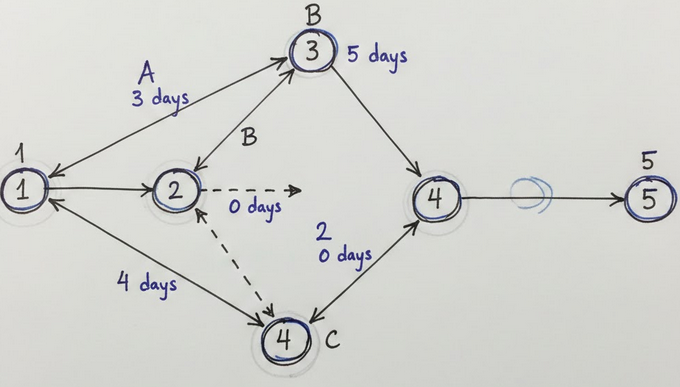
Activity A starts at the initial node.
Activities B and C both start after A finishes.
Conclusion: The network has A first, followed by B and C in parallel.
Example :
A project has the following precedence table:
A: none
B: A
C: A
D: B, C
Explain why a dummy activity is required.
▶️ Answer/Explanation
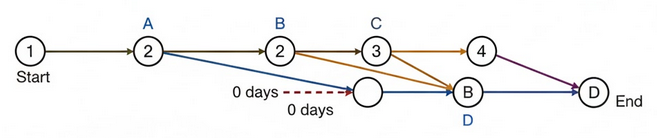
Activity D must not start until both B and C are completed.
A dummy activity is needed to show this dependency without creating ambiguity.
Conclusion: The dummy ensures D depends on both B and C.
Example :
Explain why a precedence table showing only immediate predecessors is sufficient to construct an activity network.
▶️ Answer/Explanation
Immediate predecessors already include all necessary ordering information.
Indirect dependencies are automatically enforced through the network structure.
Conclusion: Listing immediate predecessors is sufficient.