
Critical Path Analysis (CPA)
Critical Path Analysis is a project planning technique used to schedule activities, determine the minimum completion time of a project, and identify activities that must not be delayed.
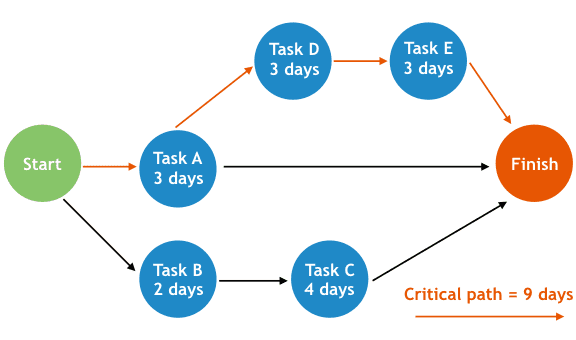
It is based on a network diagram showing activities and events.
Events and Activities
Event: A point in time when one or more activities start or finish
Activity: A task that takes time, represented by an arrow between two events
Earliest Event Time (EET)
The earliest event time of an event is the earliest possible time at which the event can occur.
EETs are found by a forward pass through the network.
The start event has EET = 0
For each event, take the maximum of (earliest time of previous event + activity duration)
Latest Event Time (LET)
The latest event time of an event is the latest time it can occur without delaying the project. 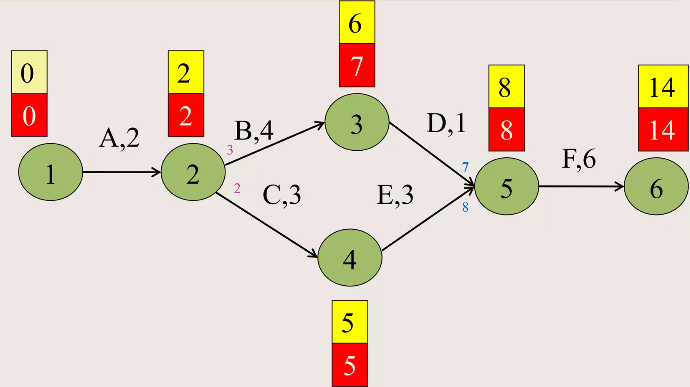
LETs are found by a backward pass through the network.
The final event has LET = its EET
For each event, take the minimum of (latest time of next event − activity duration)
Earliest and Latest Times for Activities
For an activity from event \( i \) to event \( j \) with duration \( d \):
- Earliest Start Time (EST): EET of event \( i \)
- Earliest Finish Time (EFT): EST + \( d \)
- Latest Finish Time (LFT): LET of event \( j \)
- Latest Start Time (LST): LFT − \( d \)

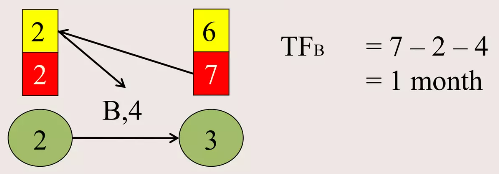
Total Float
The total float of an activity is the amount of time it can be delayed without affecting the overall project duration.
$\text{Total float = LST − EST = LFT − EFT}$
Activities with zero float are critical.
Critical Path
The critical path is the sequence of activities: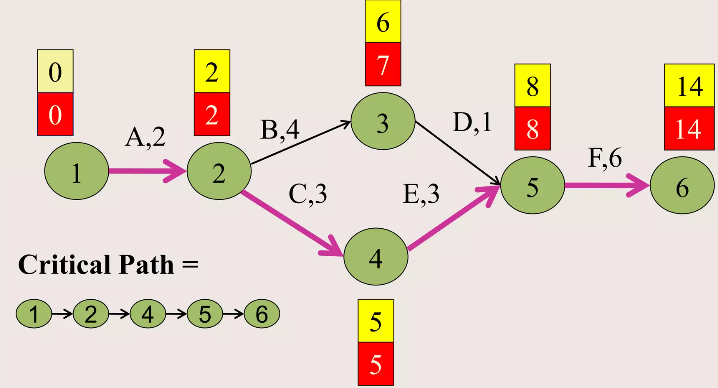
- With zero total float
- That determines the minimum project completion time
Any delay on the critical path will delay the entire project.
Algorithm for Finding the Critical Path
- Step 1: Draw the network diagram with all activities and durations
- Step 2: Perform a forward pass to find all EETs
- Step 3: Perform a backward pass to find all LETs
- Step 4: Calculate EST, EFT, LST, and LFT for each activity
- Step 5: Identify activities with zero total float
- Step 6: Trace the critical path through these activities
Key Examination Points
- Always start EET at 0
- Use maximum in forward pass, minimum in backward pass
- Clearly state the critical path and project duration
Example :
A project consists of the following activities:
A: 1 → 2 (4 days)
B: 1 → 3 (6 days)
C: 2 → 4 (5 days)
D: 3 → 4 (3 days)
Find the critical path and the minimum completion time.
▶️ Answer/Explanation
Forward pass (EET):
Event 1: 0
Event 2: \( 0 + 4 = 4 \)
Event 3: \( 0 + 6 = 6 \)
Event 4: max\( (4+5,\;6+3) = 9 \)
Backward pass (LET):
Event 4: 9
Event 2: \( 9 – 5 = 4 \)
Event 3: \( 9 – 3 = 6 \)
Event 1: min\( (4-4,\;6-6) = 0 \)
Zero-float activities: A, C
Conclusion: Critical path is 1–2–4 and the minimum completion time is 9 days.
Example :
The following activities form a project:
A: 1 → 2 (3)
B: 1 → 3 (2)
C: 2 → 4 (4)
D: 3 → 4 (6)
E: 4 → 5 (5)
Determine the earliest and latest start times for activity E.
▶️ Answer/Explanation
Forward pass (EET):
Event 1: 0
Event 2: 3
Event 3: 2
Event 4: max\( (3+4,\;2+6) = 8 \)
Event 5: \( 8 + 5 = 13 \)
Backward pass (LET):
Event 5: 13
Event 4: \( 13 – 5 = 8 \)
Activity E:
EST = EET of event 4 = 8
LST = LET of event 5 − 5 = 8
Conclusion: Activity E must start at time 8 and has zero float.
Example :
A project has the following activities:
A: 1 → 2 (5)
B: 2 → 3 (4)
C: 2 → 4 (2)
D: 3 → 5 (3)
E: 4 → 5 (6)
Find the total float of activity C.
▶️ Answer/Explanation
Forward pass (EET):
Event 1: 0
Event 2: 5
Event 3: 9
Event 4: 7
Event 5: max\( (9+3,\;7+6) = 13 \)
Backward pass (LET):
Event 5: 13
Event 3: \( 13 – 3 = 10 \)
Event 4: \( 13 – 6 = 7 \)
Event 2: min\( (10-4,\;7-2) = 5 \)
Activity C:
EST = 5, EFT = 7
LST = 5, LFT = 7
Total float: \( 0 \)
Conclusion: Activity C is critical.