
Formulation of Problems as Linear Programs
Linear programming is a mathematical technique used to optimise (maximise or minimise) a quantity subject to a set of linear constraints.
The first and most important step is the correct formulation of the real-world problem as a linear program.
Decision Variables
Decision variables represent the unknown quantities to be determined.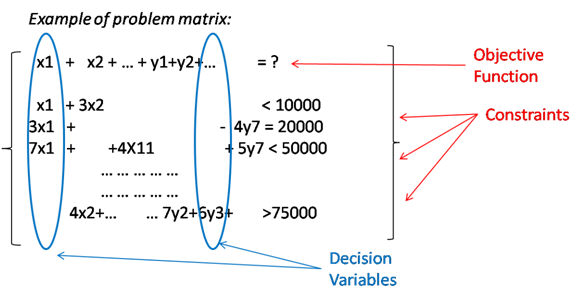
They are usually defined as:
- Let \( \mathrm{x} \) = number of units of product A
- Let \( \mathrm{y} \) = number of units of product B
All decision variables must satisfy non-negativity conditions:
\( \mathrm{x \geq 0,\; y \geq 0} \)
Objective Function
The objective function is the quantity to be maximised or minimised.
It is always a linear function of the decision variables.
Typical examples:
- Maximise profit
- Minimise cost or time
Example objective function:
Maximise \( \mathrm{Z = 5x + 3y} \)
Constraints
Constraints represent the limitations or restrictions of the problem.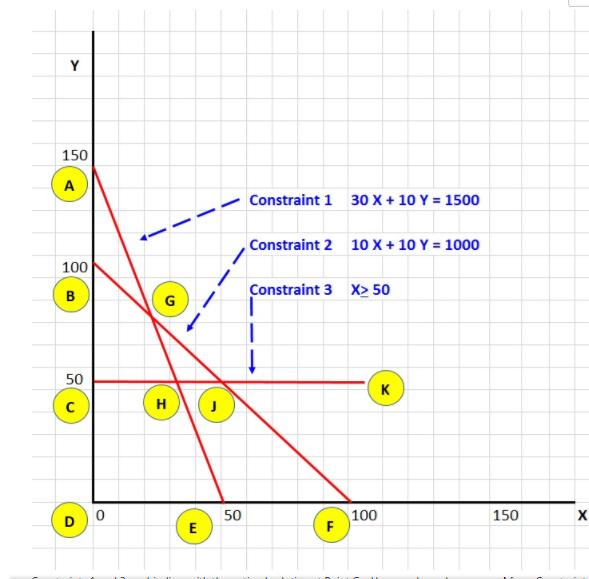
They arise from limited resources such as:
- Time
- Labour
- Materials
Each constraint must be a linear inequality or equation.
Example constraints:
\( \mathrm{2x + y \leq 20} \)
\( \mathrm{x + 3y \leq 30} \)
Assumptions of Linear Programming
When formulating a linear program, the following assumptions are made:
- Proportionality: contributions are directly proportional to variable values
- Additivity: total contribution is the sum of individual contributions
- Divisibility: variables may take fractional values
- Certainty: all coefficients are known and constant
Steps in Formulating a Linear Programming Problem
- Define the decision variables clearly
- Write down the objective function
- Identify all constraints from the problem statement
- Express constraints as linear inequalities
- Include non-negativity conditions
Standard Mathematical Form
A linear programming problem is typically written as:
Maximise or Minimise \( \mathrm{Z = ax + by} \)
Subject to:
\( \mathrm{c_1x + d_1y \leq k_1} \)
\( \mathrm{c_2x + d_2y \leq k_2} \)
\( \mathrm{x \geq 0,\; y \geq 0} \)
Key Examination Point
- Always define variables explicitly
- Check that all constraints are linear
- Include non-negativity conditions
- State clearly whether the objective is maximisation or minimisation
Example
A factory produces two products, A and B. Each unit of A gives a profit of ₹40 and each unit of B gives a profit of ₹30.
Product A requires 2 hours of machine time and product B requires 1 hour. The machine is available for at most 40 hours.
Formulate this problem as a linear program.
▶️ Answer/Explanation
Let
\( \mathrm{x} \) = number of units of product A
\( \mathrm{y} \) = number of units of product B
Objective function:
Maximise \( \mathrm{Z = 40x + 30y} \)
Constraint:
\( \mathrm{2x + y \leq 40} \)
Non-negativity:
\( \mathrm{x \geq 0,\; y \geq 0} \)
Conclusion: The linear program is fully formulated.
Example
A dietician is preparing a meal using two foods, X and Y. Food X costs ₹5 per unit and food Y costs ₹8 per unit.
Each unit of X contains 3 units of protein and each unit of Y contains 6 units. At least 30 units of protein are required.
Formulate this problem as a linear program.
▶️ Answer/Explanation
Let
\( \mathrm{x} \) = units of food X
\( \mathrm{y} \) = units of food Y
Objective function:
Minimise \( \mathrm{C = 5x + 8y} \)
Constraint:
\( \mathrm{3x + 6y \geq 30} \)
Non-negativity:
\( \mathrm{x \geq 0,\; y \geq 0} \)
Conclusion: The minimisation problem is correctly formulated.
Example
A workshop makes two items, P and Q. Each item P requires 1 hour of labour and 2 kg of material. Each item Q requires 2 hours of labour and 1 kg of material.
There are at most 40 hours of labour and 30 kg of material available. Each item P gives a profit of ₹20 and item Q gives a profit of ₹25.
Formulate this problem as a linear program.
▶️ Answer/Explanation
Let
\( \mathrm{x} \) = number of items P
\( \mathrm{y} \) = number of items Q
Objective function:
Maximise \( \mathrm{Z = 20x + 25y} \)
Constraints:
Labour: \( \mathrm{x + 2y \leq 40} \)
Material: \( \mathrm{2x + y \leq 30} \)
Non-negativity:
\( \mathrm{x \geq 0,\; y \geq 0} \)
Conclusion: The linear programming model is completely defined.