
Complex Numbers
A complex number is a number of the form:
\( z = a + ib \)
where:
- \( a \) is the real part
- \( b \) is the imaginary part
- \( i \) is the imaginary unit with \( i^2 = -1 \)
Polar (Trigonometric) Form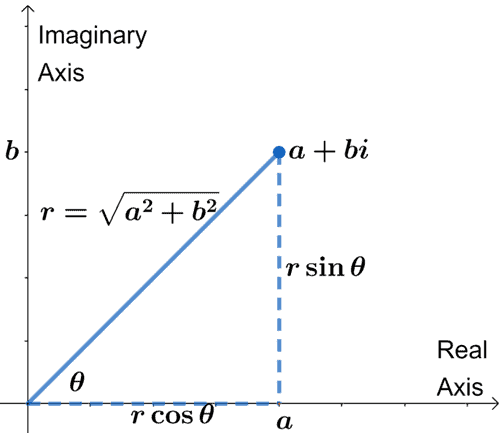
A complex number can also be written as:
\( z = r(\cos\theta + i\sin\theta) \)
where:
- \( r \) is the modulus
- \( \theta \) is the argument
Key Definitions
| Term | Meaning |
| Real part | \( \text{Re}(z) = a \) |
| Imaginary part | \( \text{Im}(z) = b \) |
| Conjugate | \( \overline{z} = a – ib \) |
| Modulus | \( |z| = \sqrt{a^2 + b^2} \) |
| Argument | \( \theta = \tan^{-1}\!\left(\dfrac{b}{a}\right) \) |
Equality of Complex Numbers
Two complex numbers are equal if and only if their real parts and imaginary parts are equal.
If \( a + ib = c + id \), then \( a = c \) and \( b = d \).
Example
Let \( z = 3 + 4i \). Find its real part, imaginary part, modulus, and conjugate.
▶️ Answer / Explanation
\( \text{Re}(z) = 3 \)
\( \text{Im}(z) = 4 \)
\( |z| = \sqrt{3^2 + 4^2} = 5 \)
\( \overline{z} = 3 – 4i \)
Example
Write the complex number \( z = -1 + \sqrt{3}i \) in the form \( r(\cos\theta + i\sin\theta) \).
▶️ Answer / Explanation
Modulus:
\( r = \sqrt{(-1)^2 + (\sqrt{3})^2} = \sqrt{4} = 2 \)
Argument:
\( \theta = \tan^{-1}\!\left(\dfrac{\sqrt{3}}{-1}\right) \)
The number lies in the second quadrant, so:
\( \theta = \dfrac{2\pi}{3} \)
Therefore:
\( z = 2(\cos\dfrac{2\pi}{3} + i\sin\dfrac{2\pi}{3}) \)
Example
If \( z = x + yi \) and \( \overline{z} = 3 – 2i \), find \( x \) and \( y \).
▶️ Answer / Explanation
Since \( \overline{z} = x – yi \), compare with \( 3 – 2i \):
\( x = 3 \), \( -y = -2 \Rightarrow y = 2 \)
So \( z = 3 + 2i \).