
Geometrical Representation of Complex Numbers (Argand Diagram)
An Argand diagram is a two-dimensional plane used to represent complex numbers geometrically.
A complex number \( z = a + ib \) is represented by the point \( (a, b) \), where:
- The horizontal axis represents the real part.
- The vertical axis represents the imaginary part.
Representation of a Complex Number
If \( z = a + ib \), then:
Point representing \( z \) is \( (a, b) \)
This point may also be viewed as a vector from the origin to \( (a, b) \).
Modulus and Argument in the Argand Diagram
Let \( z = a + ib \).
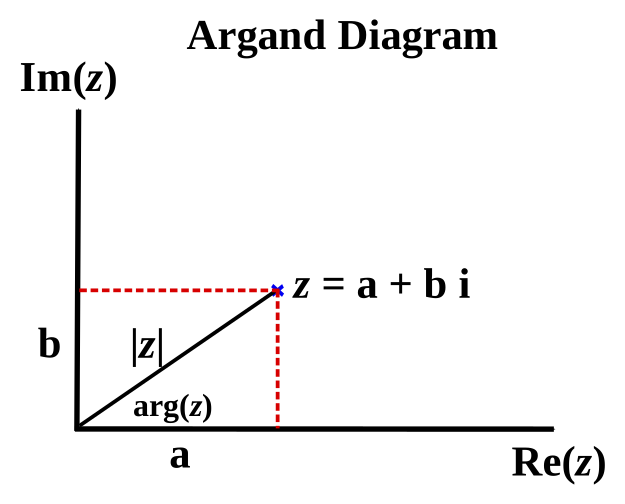
- The modulus \( |z| \) is the distance from the origin to the point \( (a, b) \).
- The argument \( \arg(z) \) is the angle between the positive real axis and the line joining the origin to \( (a, b) \).
\( |z| = \sqrt{a^2 + b^2} \), \( \arg(z) = \tan^{-1}\!\left(\dfrac{b}{a}\right) \)
Complex Conjugate in the Argand Diagram
If \( z = a + ib \), then its conjugate is \( \overline{z} = a – ib \).

On the Argand diagram, \( \overline{z} \) is the reflection of \( z \) in the real axis.
Geometric Interpretation of Operations
| Operation | Geometric Meaning |
| \( z_1 + z_2 \) | Vector addition |
| \( z_1 – z_2 \) | Vector from \( z_2 \) to \( z_1 \) |
| \( \overline{z} \) | Reflection in real axis |
Example
Plot the complex number \( z = 3 + 4i \) on the Argand diagram and find its modulus.
▶️ Answer / Explanation
The point is \( (3, 4) \).
\( |z| = \sqrt{3^2 + 4^2} = 5 \)
Example
Find the argument of the complex number \( z = -1 + \sqrt{3}i \).
▶️ Answer / Explanation
The point lies in the second quadrant.
\( \tan\theta = \dfrac{\sqrt{3}}{-1} \)
\( \theta = \dfrac{2\pi}{3} \)
Example
If \( z = 2 + i \), find the coordinates of the point representing \( \overline{z} \).
▶️ Answer / Explanation
\( \overline{z} = 2 – i \)
The point is \( (2, -1) \).
Geometrical Representation of Sums, Products and Quotients of Complex Numbers
In an Argand diagram, complex numbers are represented as points or vectors in the plane. Operations on complex numbers can be interpreted geometrically in terms of movements, rotations and scalings.
Sum of Complex Numbers
Let:
\( z_1 = a + ib,\quad z_2 = c + id \)
The sum is:
\( z_1 + z_2 = (a + c) + i(b + d) \)
Geometrical meaning:
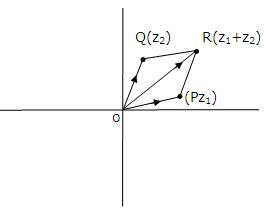
The sum corresponds to vector addition. To find \( z_1 + z_2 \), place the vector representing \( z_2 \) at the end of the vector representing \( z_1 \). The vector from the origin to the final point represents \( z_1 + z_2 \).
Product of Complex Numbers
If a complex number is written in polar form:
\( z = r(\cos\theta + i\sin\theta) \)
Multiplication has a simple geometric interpretation.
If:
\( z_1 = r_1(\cos\theta_1 + i\sin\theta_1) \), \( z_2 = r_2(\cos\theta_2 + i\sin\theta_2) \)
Then:
\( z_1 z_2 = r_1 r_2(\cos(\theta_1 + \theta_2) + i\sin(\theta_1 + \theta_2)) \)
Geometrical meaning:
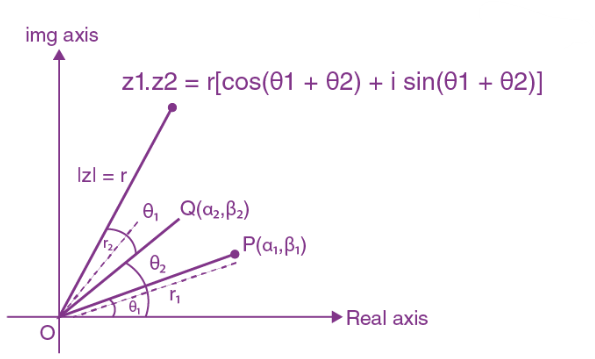
- The modulus is multiplied by \( r_2 \).
- The argument is increased by \( \theta_2 \).
- This means multiplication produces a stretch and a rotation.
Quotient of Complex Numbers
If:
\( z_1 = r_1(\cos\theta_1 + i\sin\theta_1) \), \( z_2 = r_2(\cos\theta_2 + i\sin\theta_2) \)
Then:
\( \dfrac{z_1}{z_2} = \dfrac{r_1}{r_2}(\cos(\theta_1 – \theta_2) + i\sin(\theta_1 – \theta_2)) \)
Geometrical meaning:
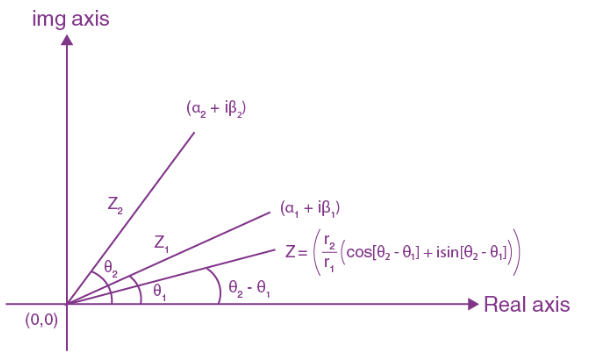
- The modulus is divided by \( r_2 \).
- The argument is reduced by \( \theta_2 \).
- This corresponds to a scaling and a rotation in the opposite direction.
Summary Table
| Operation | Geometric Effect |
| \( z_1 + z_2 \) | Vector addition |
| \( z_1 z_2 \) | Stretch and rotate |
| \( \dfrac{z_1}{z_2} \) | Shrink and rotate backwards |
Example
If \( z_1 = 1 + i \) and \( z_2 = 2 + i \), describe geometrically what \( z_1 + z_2 \) represents.
▶️ Answer / Explanation
The sum is the vector obtained by adding the vectors representing \( z_1 \) and \( z_2 \).
This corresponds to placing \( z_2 \) at the end of \( z_1 \) and drawing the resultant from the origin.
Example
Let \( z = 2(\cos \dfrac{\pi}{4} + i\sin \dfrac{\pi}{4}) \). Describe geometrically the effect of multiplying any complex number by \( z \).
▶️ Answer / Explanation
The modulus is multiplied by 2.
The argument is increased by \( \dfrac{\pi}{4} \).
This represents a stretch by factor 2 and a rotation of \( 45^\circ \) anticlockwise.
Example
Explain geometrically what dividing a complex number by \( 2(\cos \dfrac{\pi}{6} + i\sin \dfrac{\pi}{6}) \) does.
▶️ Answer / Explanation
The modulus is divided by 2.
The argument is reduced by \( \dfrac{\pi}{6} \).
This corresponds to shrinking by a factor of 2 and rotating clockwise by \( 30^\circ \).