
Sum and Product of Roots of a Quadratic Equation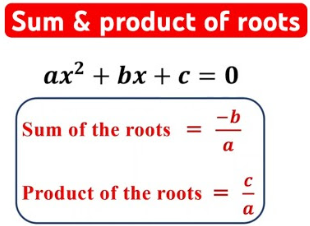
A quadratic equation is an equation of the form:
\( ax^2 + bx + c = 0 \), where \( a \neq 0 \)
Such an equation has two roots, which may be real or complex. Let these roots be \( \alpha \) and \( \beta \).
The quadratic can be written in factorised form using its roots:
\( a(x – \alpha)(x – \beta) = 0 \)
Expanding this gives:
\( a(x^2 – (\alpha + \beta)x + \alpha\beta) = ax^2 – a(\alpha + \beta)x + a\alpha\beta \)
Comparing this with the standard form \( ax^2 + bx + c \), we obtain two very important results:
\( \alpha + \beta = -\dfrac{b}{a} \)
\( \alpha\beta = \dfrac{c}{a} \)
These formulae allow us to relate the coefficients of a quadratic equation directly to its roots without solving the equation.
Why These Results Are Important
The sum and product of roots are used to:
- Construct a quadratic equation when the roots are known.
- Find expressions involving the roots without calculating them.
- Solve problems involving the behaviour of roots.
- Link algebraic equations to graphical properties.
Forming a Quadratic from Its Roots
If the roots are \( \alpha \) and \( \beta \), then the quadratic equation with leading coefficient 1 is:
\( x^2 – (\alpha + \beta)x + \alpha\beta = 0 \)
If a different leading coefficient is required, the equation can be multiplied throughout by a constant.
Symmetric Expressions in Roots
Many expressions in \( \alpha \) and \( \beta \) can be written using only their sum and product. For example:
\( \alpha^2 + \beta^2 = (\alpha + \beta)^2 – 2\alpha\beta \)
This avoids finding the roots explicitly.
Example
Find the sum and product of the roots of \( 3x^2 – 7x + 2 = 0 \).
▶️ Answer / Explanation
Here \( a = 3 \), \( b = -7 \), \( c = 2 \).
\( \alpha + \beta = -\dfrac{-7}{3} = \dfrac{7}{3} \)
\( \alpha\beta = \dfrac{2}{3} \)
Example
The sum of the roots of a quadratic equation is 5 and the product is 6. Find the equation.
▶️ Answer / Explanation
The required equation is:
\( x^2 – 5x + 6 = 0 \)
Example
The roots of \( 2x^2 – 3x + 1 = 0 \) are \( \alpha \) and \( \beta \). Find the value of \( \alpha^2 + \beta^2 \).
▶️ Answer / Explanation
\( \alpha + \beta = \dfrac{3}{2} \), \( \alpha\beta = \dfrac{1}{2} \)
\( \alpha^2 + \beta^2 = (\alpha + \beta)^2 – 2\alpha\beta \)
\( = \left(\dfrac{3}{2}\right)^2 – 2\left(\dfrac{1}{2}\right) = \dfrac{9}{4} – 1 = \dfrac{5}{4} \)