
Products of Matrices
Matrix multiplication is a way of combining two matrices to form a new matrix. It is not the same as multiplying numbers and it is not commutative.
When Can Two Matrices Be Multiplied
If matrix \( A \) is of order \( m \times n \) and matrix \( B \) is of order \( n \times p \), then the product \( AB \) is defined and is a matrix of order \( m \times p \).
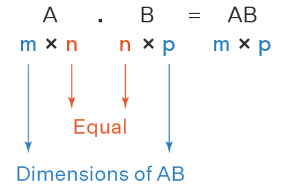
The number of columns of \( A \) must equal the number of rows of \( B \).
How Matrix Multiplication Works
Let
\( A = \begin{pmatrix} a_{11} & a_{12} \\ a_{21} & a_{22} \end{pmatrix},\quad B = \begin{pmatrix} b_{11} & b_{12} \\ b_{21} & b_{22} \end{pmatrix} \)
Then
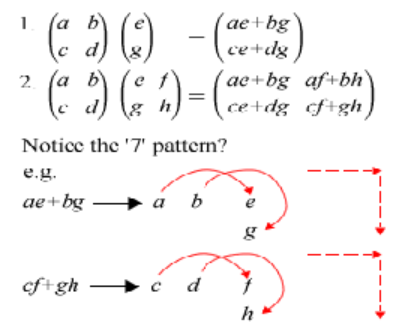
\( AB = \begin{pmatrix} a_{11}b_{11} + a_{12}b_{21} & a_{11}b_{12} + a_{12}b_{22} \\ a_{21}b_{11} + a_{22}b_{21} & a_{21}b_{12} + a_{22}b_{22} \end{pmatrix} \)
Each entry is obtained by multiplying a row of \( A \) by a column of \( B \).
Important Properties
- Matrix multiplication is generally not commutative: \( AB \ne BA \).
- Matrix multiplication is associative: \( A(BC) = (AB)C \).
- There is an identity matrix \( I \) such that \( AI = IA = A \).
Example
\( A = \begin{pmatrix} 1 & 2 \\ 3 & 4 \end{pmatrix},\quad B = \begin{pmatrix} 2 & 0 \\ 1 & 5 \end{pmatrix} \)
Find \( AB \).
▶️ Answer / Explanation
\( AB = \begin{pmatrix} 1(2) + 2(1) & 1(0) + 2(5) \\ 3(2) + 4(1) & 3(0) + 4(5) \end{pmatrix} = \begin{pmatrix} 4 & 10 \\ 10 & 20 \end{pmatrix} \)
Example
\( A = \begin{pmatrix} 1 & -1 \\ 2 & 3 \end{pmatrix},\quad B = \begin{pmatrix} 4 & 2 \\ 0 & 1 \end{pmatrix} \)
Find \( BA \).
▶️ Answer / Explanation
\( BA = \begin{pmatrix} 4(1) + 2(2) & 4(-1) + 2(3) \\ 0(1) + 1(2) & 0(-1) + 1(3) \end{pmatrix} = \begin{pmatrix} 8 & 2 \\ 2 & 3 \end{pmatrix} \)
Example
\( A = \begin{pmatrix} x & 1 \\ 2 & y \end{pmatrix},\quad B = \begin{pmatrix} 3 & 0 \\ 1 & 2 \end{pmatrix} \)
If \( AB = \begin{pmatrix} 7 & 2 \\ 8 & 4 \end{pmatrix} \), find \( x \) and \( y \).
▶️ Answer / Explanation
\( AB = \begin{pmatrix} 3x + 1 & 2 \\ 6 + y & 2y \end{pmatrix} \)
Equating entries:
\( 3x + 1 = 7 \Rightarrow x = 2 \)
\( 2y = 4 \Rightarrow y = 2 \)
Check: \( 6 + y = 8 \) gives \( y = 2 \), correct.