
2 × 2 Determinants, Singular and Non-Singular Matrices
Determinants are numbers associated with square matrices. For a \( 2 \times 2 \) matrix, the determinant tells us whether the matrix has an inverse and whether a system of equations has a unique solution.
Determinant of a \( 2 \times 2 \) Matrix
For the matrix
\( A = \begin{pmatrix} a & b \\ c & d \end{pmatrix} \)
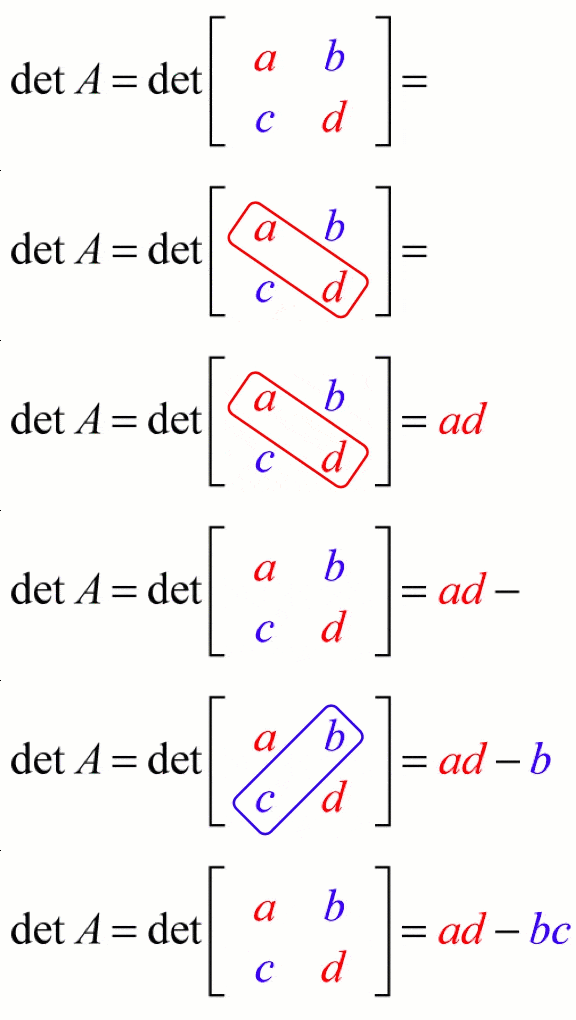
the determinant of \( A \), written \( |A| \) or \( \det(A) \), is defined as:
Meaning of the Determinant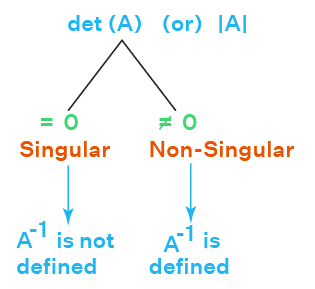
The determinant measures how a matrix scales area when used as a transformation. Most importantly in algebra, it tells us whether the matrix is invertible.
Singular and Non-Singular Matrices
- If \( |A| = 0 \), the matrix is singular. It has no inverse.
- If \( |A| \ne 0 \), the matrix is non-singular. It has an inverse.
Why This Matters
When solving simultaneous equations using matrices, a unique solution exists only if the coefficient matrix is non-singular.
Example
Find the determinant of \( \begin{pmatrix} 3 & 5 \\ 2 & 4 \end{pmatrix} \).
▶️ Answer / Explanation
\( |A| = (3)(4) – (5)(2) = 12 – 10 = 2 \)
The matrix is non-singular.
Example
Determine whether \( \begin{pmatrix} 2 & 6 \\ 1 & 3 \end{pmatrix} \) is singular or non-singular.
▶️ Answer / Explanation
\( |A| = (2)(3) – (6)(1) = 6 – 6 = 0 \)
The matrix is singular.
Example
Find the value of \( k \) for which the matrix \( \begin{pmatrix} k & 4 \\ 2 & k \end{pmatrix} \) is singular.
▶️ Answer / Explanation
\( |A| = k^2 – 8 \)
For singular matrix:
\( k^2 – 8 = 0 \)
\( k = \pm \sqrt{8} = \pm 2\sqrt{2} \)