
Inverse of \( 2 \times 2 \) Matrices and the Relation \( (AB)^{-1} = B^{-1}A^{-1} \)
The inverse of a matrix plays the same role as the reciprocal of a number. If \( A \) is a square matrix and \( A^{-1} \) exists, then:
\( AA^{-1} = A^{-1}A = I \)
where \( I \) is the identity matrix.
Inverse of a \( 2 \times 2 \) Matrix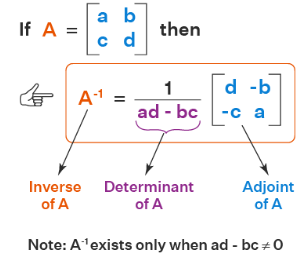
Let
\( A = \begin{pmatrix} a & b \\ c & d \end{pmatrix} \)
The determinant is:
\( |A| = ad – bc \)
The inverse exists only if \( |A| \ne 0 \).
The inverse of \( A \) is:
\( A^{-1} = \dfrac{1}{ad – bc} \begin{pmatrix} d & -b \\ -c & a \end{pmatrix} \)
This is obtained by swapping \( a \) and \( d \), changing the signs of \( b \) and \( c \), and dividing by the determinant.
Singular and Non-Singular Reminder
If \( |A| = 0 \), the matrix is singular and has no inverse. If \( |A| \ne 0 \), the matrix is non-singular and has an inverse.
The Relation \( (AB)^{-1} = B^{-1}A^{-1} \)
If \( A \) and \( B \) are invertible matrices, then:
\( (AB)^{-1} = B^{-1}A^{-1} \)
The order is reversed. This is because matrix multiplication is not commutative.
Why the Order Reverses
Since \( AB \cdot B^{-1}A^{-1} = A(BB^{-1})A^{-1} = AIA^{-1} = I \), \( B^{-1}A^{-1} \) is the inverse of \( AB \).
Example
Find the inverse of \( A = \begin{pmatrix} 3 & 2 \\ 1 & 1 \end{pmatrix} \).
▶️ Answer / Explanation
\( |A| = 3(1) – 2(1) = 1 \)
\( A^{-1} = \begin{pmatrix} 1 & -2 \\ -1 & 3 \end{pmatrix} \)
Example
\( A = \begin{pmatrix} 2 & 1 \\ 3 & 2 \end{pmatrix},\quad B = \begin{pmatrix} 1 & 1 \\ 0 & 1 \end{pmatrix} \)
Find \( (AB)^{-1} \).
▶️ Answer / Explanation
First find \( A^{-1} \) and \( B^{-1} \).
\( |A| = 4 – 3 = 1 \)
\( A^{-1} = \begin{pmatrix} 2 & -1 \\ -3 & 2 \end{pmatrix} \)
\( B^{-1} = \begin{pmatrix} 1 & -1 \\ 0 & 1 \end{pmatrix} \)
\( (AB)^{-1} = B^{-1}A^{-1} \)
\( = \begin{pmatrix} 1 & -1 \\ 0 & 1 \end{pmatrix} \begin{pmatrix} 2 & -1 \\ -3 & 2 \end{pmatrix} = \begin{pmatrix} 5 & -3 \\ -3 & 2 \end{pmatrix} \)
Example
Find the inverse of \( AB \) where \( A = \begin{pmatrix} 1 & 2 \\ 3 & 4 \end{pmatrix} \), \( B = \begin{pmatrix} 2 & 1 \\ 1 & 1 \end{pmatrix} \).
▶️ Answer / Explanation
First find inverses.
\( |A| = -2 \), \( A^{-1} = \dfrac{1}{-2}\begin{pmatrix} 4 & -2 \\ -3 & 1 \end{pmatrix} \)
\( |B| = 1 \), \( B^{-1} = \begin{pmatrix} 1 & -1 \\ -1 & 2 \end{pmatrix} \)
\( (AB)^{-1} = B^{-1}A^{-1} \)