
Linear Transformations in Two Dimensions and Their Matrix Representation
A linear transformation is a rule that moves points or vectors in the plane in a consistent, linear way. Examples include rotations, reflections, stretches and shears.
In two dimensions, a point or vector is written as a column vector: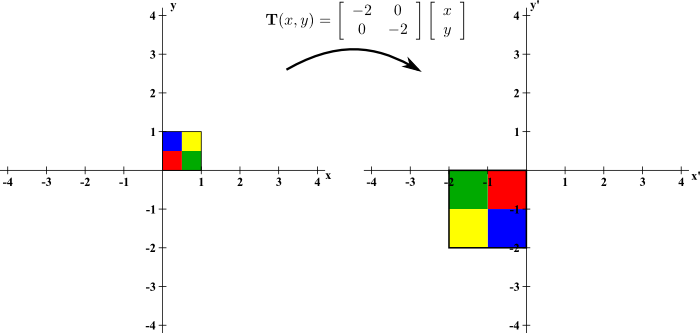
\( \begin{pmatrix} x \\ y \end{pmatrix} \)
A linear transformation can be represented by multiplying this vector by a \( 2 \times 2 \) matrix.
Matrix Representation of a Transformation
If a transformation \( T \) is represented by the matrix
\( A = \begin{pmatrix} a & b \\ c & d \end{pmatrix} \)
then the image of the vector \( \begin{pmatrix} x \\ y \end{pmatrix} \) is
\( A \begin{pmatrix} x \\ y \end{pmatrix} = \begin{pmatrix} ax + by \\ cx + dy \end{pmatrix} \)
This gives the new coordinates after the transformation.
Finding a Transformation Matrix
The columns of the matrix give the images of the unit vectors.
Let
\( \mathbf{i} = \begin{pmatrix} 1 \\ 0 \end{pmatrix}, \quad \mathbf{j} = \begin{pmatrix} 0 \\ 1 \end{pmatrix} \)
If:
\( A\mathbf{i} = \begin{pmatrix} p \\ q \end{pmatrix}, \quad A\mathbf{j} = \begin{pmatrix} r \\ s \end{pmatrix} \)
then
\( A = \begin{pmatrix} p & r \\ q & s \end{pmatrix} \)
Combining Transformations
If transformation \( B \) is applied first, followed by transformation \( A \), then the combined transformation is represented by:
\( AB \)
This order is important. Matrix multiplication follows the same order as the transformations.
Example
The matrix \( A = \begin{pmatrix} 2 & 0 \\ 0 & 3 \end{pmatrix} \) represents a transformation. Find the image of the vector \( \begin{pmatrix} 1 \\ 2 \end{pmatrix} \).
▶️ Answer / Explanation
\( A \begin{pmatrix} 1 \\ 2 \end{pmatrix} = \begin{pmatrix} 2(1) + 0(2) \\ 0(1) + 3(2) \end{pmatrix} = \begin{pmatrix} 2 \\ 6 \end{pmatrix} \)
Example
A transformation maps \( \mathbf{i} \) to \( \begin{pmatrix} 1 \\ 2 \end{pmatrix} \) and \( \mathbf{j} \) to \( \begin{pmatrix} 3 \\ 1 \end{pmatrix} \). Find its matrix.
▶️ Answer / Explanation
\( A = \begin{pmatrix} 1 & 3 \\ 2 & 1 \end{pmatrix} \)
Example
A vector is transformed by \( B \) and then by \( A \), where \( A = \begin{pmatrix} 1 & 1 \\ 0 & 1 \end{pmatrix} \), \( B = \begin{pmatrix} 2 & 0 \\ 0 & 1 \end{pmatrix} \). Find the matrix of the combined transformation.
▶️ Answer / Explanation
\( AB = \begin{pmatrix} 1 & 1 \\ 0 & 1 \end{pmatrix} \begin{pmatrix} 2 & 0 \\ 0 & 1 \end{pmatrix} = \begin{pmatrix} 2 & 1 \\ 0 & 1 \end{pmatrix} \)