
Combinations of Transformations and Their Matrix Representation
When two or more geometrical transformations are applied one after another, the result is called a combined transformation. Matrices allow us to represent and calculate combined transformations efficiently.
If transformation \( B \) is applied first, followed by transformation \( A \), then the combined transformation is represented by the matrix: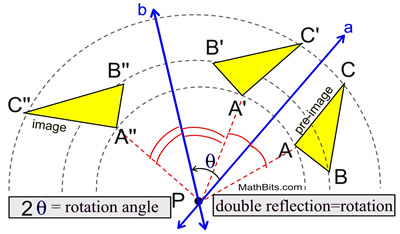
\( AB \)
The order is important because matrix multiplication is not commutative.
Key Principle
Transformation \( B \) followed by transformation \( A \) \( \Longleftrightarrow \) matrix product \( AB \)
The rightmost matrix acts first.
Geometric Meaning
Each matrix transforms the vector. Applying two matrices in sequence means multiplying them in the correct order.
For a point \( (x,y) \):
\( A(B \begin{pmatrix} x \\ y \end{pmatrix}) = (AB)\begin{pmatrix} x \\ y \end{pmatrix} \)
Examples of Common Combinations
1. Two reflections
Two reflections in different lines can produce a rotation.
2. Stretch followed by reflection
This changes both the size and orientation of the shape.
3. Rotation followed by stretch
Order matters. Reversing the order gives a different result.
Example
A point is reflected in the x-axis and then reflected in the y-axis. Find the combined transformation matrix.
▶️ Answer / Explanation
Reflection in x-axis:
\( X = \begin{pmatrix} 1 & 0 \\ 0 & -1 \end{pmatrix} \)
Reflection in y-axis:
\( Y = \begin{pmatrix} -1 & 0 \\ 0 & 1 \end{pmatrix} \)
First x-axis, then y-axis:
\( YX = \begin{pmatrix} -1 & 0 \\ 0 & 1 \end{pmatrix} \begin{pmatrix} 1 & 0 \\ 0 & -1 \end{pmatrix} = \begin{pmatrix} -1 & 0 \\ 0 & -1 \end{pmatrix} \)
This is a rotation of \( 180^\circ \).
Example
A transformation consists of a rotation of \( 90^\circ \) anticlockwise followed by a stretch of scale factor 2 parallel to the x-axis. Find the combined matrix.
▶️ Answer / Explanation
Rotation \( 90^\circ \):
\( R = \begin{pmatrix} 0 & -1 \\ 1 & 0 \end{pmatrix} \)
Stretch in x-direction:
\( S = \begin{pmatrix} 2 & 0 \\ 0 & 1 \end{pmatrix} \)
Combined matrix \( = SR \)
\( \begin{pmatrix} 2 & 0 \\ 0 & 1 \end{pmatrix} \begin{pmatrix} 0 & -1 \\ 1 & 0 \end{pmatrix} = \begin{pmatrix} 0 & -2 \\ 1 & 0 \end{pmatrix} \)
Example
A transformation is a reflection in the line \( y = x \) followed by a rotation of \( 180^\circ \). Find the combined transformation matrix.
▶️ Answer / Explanation
Reflection in \( y = x \):
\( A = \begin{pmatrix} 0 & 1 \\ 1 & 0 \end{pmatrix} \)
Rotation \( 180^\circ \):
\( R = \begin{pmatrix} -1 & 0 \\ 0 & -1 \end{pmatrix} \)
Combined matrix \( = RA \)
\( \begin{pmatrix} -1 & 0 \\ 0 & -1 \end{pmatrix} \begin{pmatrix} 0 & 1 \\ 1 & 0 \end{pmatrix} = \begin{pmatrix} 0 & -1 \\ -1 & 0 \end{pmatrix} \)