
Inverse of Transformations and the Determinant as an Area Scale Factor
In matrix transformations, an inverse transformation is one that undoes the effect of the original transformation.
If a transformation is represented by a matrix \( A \), then its inverse transformation is represented by \( A^{-1} \), provided the inverse exists.
This means: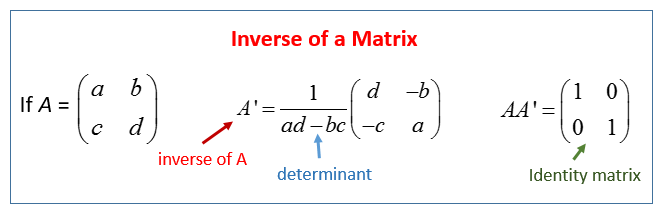
\( A^{-1}A = AA^{-1} = I \)
where \( I \) is the identity matrix.
When Does an Inverse Exist
A transformation has an inverse if and only if its matrix is non-singular, that is:
\( \det(A) \ne 0 \)
If the determinant is zero, the transformation squashes the plane into a line or a point, and it cannot be reversed.
Inverse of a Combined Transformation
If two transformations are applied, first \( B \) and then \( A \), the combined transformation is \( AB \).
The inverse of the combined transformation is:
\( (AB)^{-1} = B^{-1}A^{-1} \)
The order is reversed.
Determinant as an Area Scale Factor
When a transformation with matrix \( A \) is applied to a shape, the area of the shape changes by a factor equal to the absolute value of the determinant.
Area scale factor \( = |\det(A)| \)
If \( |\det(A)| > 1 \), the area increases. If \( 0 < |\det(A)| < 1 \), the area decreases. If \( \det(A) = 0 \), the area becomes zero.
Geometric Meaning
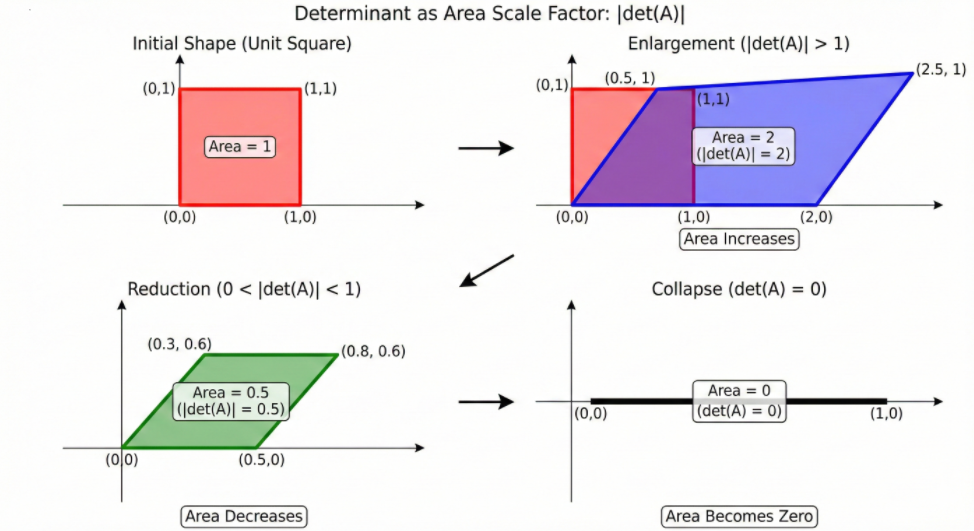
The determinant measures how much a transformation stretches or compresses the plane. A negative determinant also indicates a reflection.
Example
A transformation is represented by \( A = \begin{pmatrix} 2 & 0 \\ 0 & 3 \end{pmatrix} \). Find the area scale factor.
▶️ Answer / Explanation
\( \det(A) = 2 \times 3 = 6 \)
The area is multiplied by 6.
Example
A transformation is represented by \( B = \begin{pmatrix} 0 & -1 \\ 1 & 0 \end{pmatrix} \). Find its inverse.
▶️ Answer / Explanation
\( \det(B) = 1 \)
\( B^{-1} = \begin{pmatrix} 0 & 1 \\ -1 & 0 \end{pmatrix} \)
This corresponds to a rotation of \( -90^\circ \).
Example
A transformation is a stretch by factor 3 in the x-direction followed by a reflection in the x-axis. Find the inverse transformation matrix.
▶️ Answer / Explanation
Stretch:
\( S = \begin{pmatrix} 3 & 0 \\ 0 & 1 \end{pmatrix} \)
Reflection:
\( R = \begin{pmatrix} 1 & 0 \\ 0 & -1 \end{pmatrix} \)
Combined matrix:
\( RS = \begin{pmatrix} 3 & 0 \\ 0 & -1 \end{pmatrix} \)
\( \det(RS) = -3 \ne 0 \)
\( (RS)^{-1} = \begin{pmatrix} \frac{1}{3} & 0 \\ 0 & -1 \end{pmatrix} \)