
Algebraic Inequalities and Inequations Including Modulus
An inequality compares two algebraic expressions using symbols such as \( >,\; <,\; \ge,\; \le \). An inequation is an inequality that contains an unknown.
| Symbol | Words | Example |
| > | greater than | \( \dfrac{x+1}{3-x} > 2 \) |
| < | less than | \( \dfrac{x}{x+7} < -3 \) |
| \( \ge \) | greater than or equal to | \( \dfrac{x-1}{5-x} \ge 0 \) |
| \( \le \) | less than or equal to | \( \dfrac{3-2x}{x-1} \le 2 \) |
Solving an inequality means finding all values of the variable that make the inequality true.
Rational Inequalities
For inequalities involving fractions, such as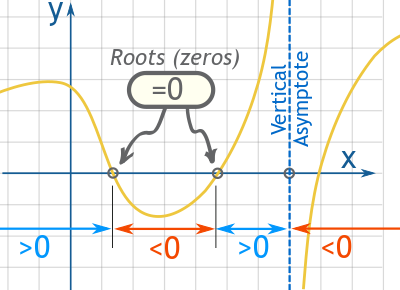
\( \dfrac{1}{x-a} > \dfrac{x}{x-b} \)
the method is:
- Bring everything to one side.
- Write the inequality as a single fraction.
- Find where the numerator is zero and where the denominator is zero.
- Use a sign diagram to determine where the inequality is satisfied.
Inequalities Involving Modulus
The modulus of a number represents its distance from zero.
\( |x| = \begin{cases} x, & x \ge 0 \\ -x, & x < 0 \end{cases} \)
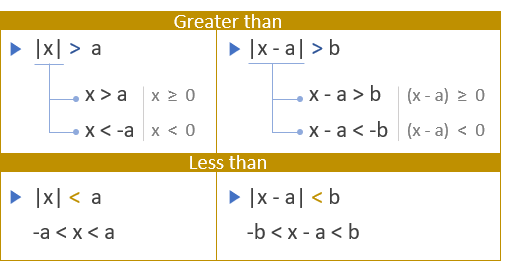
For expressions like \( |f(x)| \), we use:
- \( |f(x)| > k \) means \( f(x) > k \) or \( f(x) < -k \).
- \( |f(x)| < k \) means \( -k < f(x) < k \).
Example
Solve \( |x – 3| < 5 \).
▶️ Answer / Explanation
\( -5 < x – 3 < 5 \)
\( -2 < x < 8 \)
Example
Solve \( |x^2 – 1| > 2(x + 1) \).
▶️ Answer / Explanation
We consider two cases.
Case 1: \( x^2 – 1 > 2(x+1) \)
\( x^2 – 1 > 2x + 2 \)
\( x^2 – 2x – 3 > 0 \)
\( (x – 3)(x + 1) > 0 \Rightarrow x < -1 \text{ or } x > 3 \)
Case 2: \( x^2 – 1 < -2(x+1) \)
\( x^2 – 1 < -2x – 2 \)
\( x^2 + 2x + 1 < 0 \)
\( (x + 1)^2 < 0 \)
This has no solution.
Final answer: \( x < -1 \) or \( x > 3 \).
Example
Solve \( \dfrac{1}{x-2} > \dfrac{x}{x-1} \).
▶️ Answer / Explanation
Bring to one side:
\( \dfrac{1}{x-2} – \dfrac{x}{x-1} > 0 \)
\( \dfrac{(x-1) – x(x-2)}{(x-2)(x-1)} > 0 \)
\( \dfrac{-x^2 + 2x + x – 1}{(x-2)(x-1)} = \dfrac{-x^2 + 3x – 1}{(x-2)(x-1)} > 0 \)
Find roots of numerator:
\( x^2 – 3x + 1 = 0 \Rightarrow x = \dfrac{3 \pm \sqrt{5}}{2} \)
Use a sign diagram with critical points \( x=1, 2, \dfrac{3 \pm \sqrt{5}}{2} \).