
De Moivre’s Theorem and Its Applications
De Moivre’s theorem is a powerful result that links complex numbers, trigonometry and powers of numbers.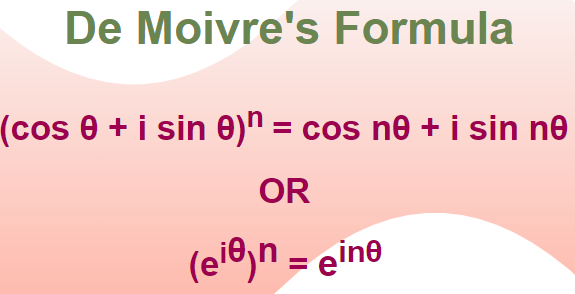
If
\( z = \cos\theta + i\sin\theta \)
then for any integer \( n \),
De Moivre’s theorem: \( z^n = (\cos\theta + i\sin\theta)^n = \cos(n\theta) + i\sin(n\theta) \)
Proof for Integer \( n \)
Using Euler’s relation:
\( \cos\theta + i\sin\theta = e^{i\theta} \)
So
\( (\cos\theta + i\sin\theta)^n = (e^{i\theta})^n = e^{in\theta} \)
Using Euler’s relation again:
\( e^{in\theta} = \cos(n\theta) + i\sin(n\theta) \)
This proves De Moivre’s theorem for integer \( n \).
Finding Trigonometric Identities
Expand \( (\cos\theta + i\sin\theta)^n \) using the binomial theorem and compare real and imaginary parts.
Example: \( n = 3 \)
\( (\cos\theta + i\sin\theta)^3 \)
\( = \cos^3\theta + 3i\cos^2\theta\sin\theta – 3\cos\theta\sin^2\theta – i\sin^3\theta \)
\( = (\cos^3\theta – 3\cos\theta\sin^2\theta) + i(3\cos^2\theta\sin\theta – \sin^3\theta) \)
By De Moivre:
\( = \cos 3\theta + i\sin 3\theta \)
So:
\( \cos 3\theta = \cos^3\theta – 3\cos\theta\sin^2\theta \)
\( \sin 3\theta = 3\cos^2\theta\sin\theta – \sin^3\theta \)
Expressing Powers in Terms of Multiple Angles
From the identity for \( \cos 3\theta \):
\( \cos^3\theta = \dfrac{1}{4}(3\cos\theta + \cos 3\theta) \)
Similarly, from \( \sin 3\theta \):
\( \sin^3\theta = \dfrac{1}{4}(3\sin\theta – \sin 3\theta) \)
Roots of a Complex Number
If \( z = r(\cos\theta + i\sin\theta) \), then the \( n \) roots of \( z \) are:
\( \sqrt[n]{r}\left(\cos\dfrac{\theta + 2k\pi}{n} + i\sin\dfrac{\theta + 2k\pi}{n}\right), \quad k = 0,1,2,\dots,n-1 \)
Example
Find \( (\cos\theta + i\sin\theta)^4 \).
▶️ Answer / Explanation
\( = \cos 4\theta + i\sin 4\theta \)
Example
Use De Moivre’s theorem to find \( \cos 2\theta \) in terms of \( \cos\theta \) and \( \sin\theta \).
▶️ Answer / Explanation
\( (\cos\theta + i\sin\theta)^2 = \cos^2\theta – \sin^2\theta + 2i\sin\theta\cos\theta \)
So \( \cos 2\theta = \cos^2\theta – \sin^2\theta \).
Example
Find the cube roots of \( 8(\cos\pi + i\sin\pi) \).
▶️ Answer / Explanation
\( r = 8, \theta = \pi \)
Roots are:
\( 2\left(\cos\dfrac{\pi + 2k\pi}{3} + i\sin\dfrac{\pi + 2k\pi}{3}\right), \quad k=0,1,2 \)