
Loci and Regions in the Argand Diagram
The Argand diagram represents a complex number \( z = x + iy \) as the point \( (x,y) \) in the plane.
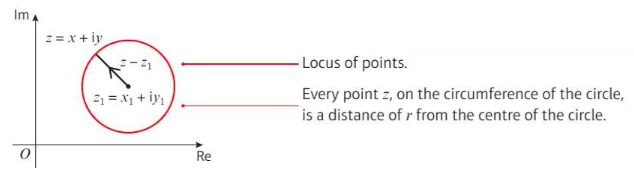
A locus is the set of all points \( z \) that satisfy a given condition. A region is the area consisting of all points that satisfy an inequality.
1. Locus of \( |z-a| = b \)
Let \( a = a_1 + ia_2 \). Then \( |z-a| \) represents the distance from the point \( z \) to the point \( a \).
\( |z-a| = b \)
is the set of all points at a fixed distance \( b \) from \( a \).
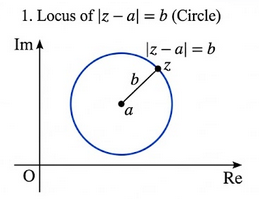
This is a circle with centre \( a \) and radius \( b \).
2. Locus of \( |z-a| = k|z-b| \)
This represents all points whose distances from \( a \) and \( b \) are in the constant ratio \( k \).
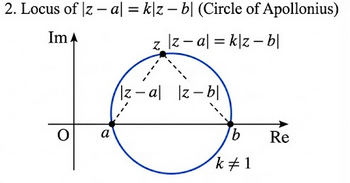
- If \( k = 1 \), it is the perpendicular bisector of the line joining \( a \) and \( b \).
- If \( k \ne 1 \), it is a circle (called an Apollonius circle).
3. Locus of \( \arg(z-a) = \beta \)
This represents all points \( z \) such that the line joining \( a \) to \( z \) makes a fixed angle \( \beta \) with the positive real axis.
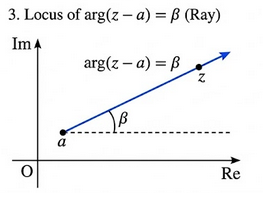
It is a half-line (ray) starting at \( a \) and making angle \( \beta \).
4. Locus of \( \arg\!\left(\dfrac{z-a}{z-b}\right) = \beta \)
This represents all points \( z \) such that the angle between the lines from \( z \) to \( a \) and from \( z \) to \( b \) is \( \beta \).
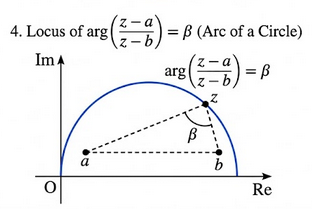
This is a circular arc passing through \( a \) and \( b \).
Regions
(a) \( |z-a| \le b \)
This is the set of all points whose distance from \( a \) is less than or equal to \( b \).
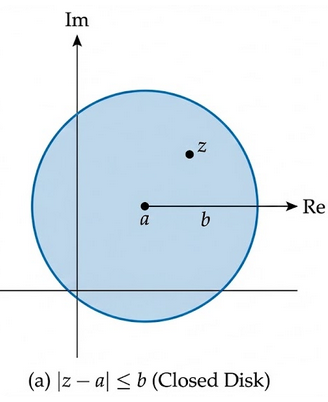
It is the interior and boundary of the circle with centre \( a \) and radius \( b \).
(b) \( |z-a| \le |z-b| \)
This means points that are at least as close to \( a \) as to \( b \).
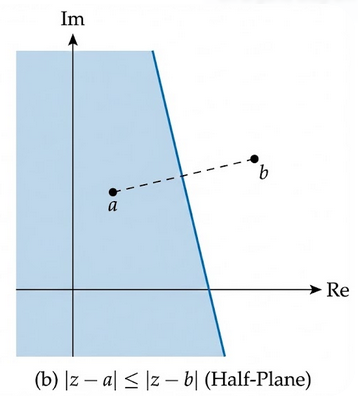
This is the region on one side of the perpendicular bisector of the line joining \( a \) and \( b \).
Example
Describe the locus \( |z – (2+i)| = 3 \).
▶️ Answer / Explanation
It is a circle with centre \( (2,1) \) and radius 3.
Example
Describe the locus \( |z – 1| = |z + 1| \).
▶️ Answer / Explanation
This is the set of points equidistant from 1 and −1.
So it is the perpendicular bisector of the real axis between −1 and 1, which is the imaginary axis.
Example
Describe the locus \( \arg\!\left(\dfrac{z-1}{z+1}\right) = \dfrac{\pi}{2} \).
▶️ Answer / Explanation
This represents points \( z \) such that the angle between the lines from \( z \) to 1 and from \( z \) to −1 is \( 90^\circ \).
It is a circular arc passing through the points 1 and −1.