
Elementary Transformations from the \( z \)-plane to the \( w \)-plane
In complex numbers, a transformation maps points from the \( z \)-plane to the \( w \)-plane using an equation of the form
\( w = f(z) \)
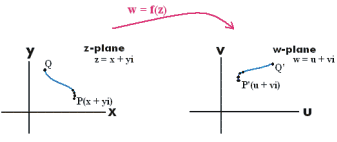
Each complex number \( z \) is sent to a new complex number \( w \), giving a transformation of the Argand diagram.
The Transformation \( w = z^2 \)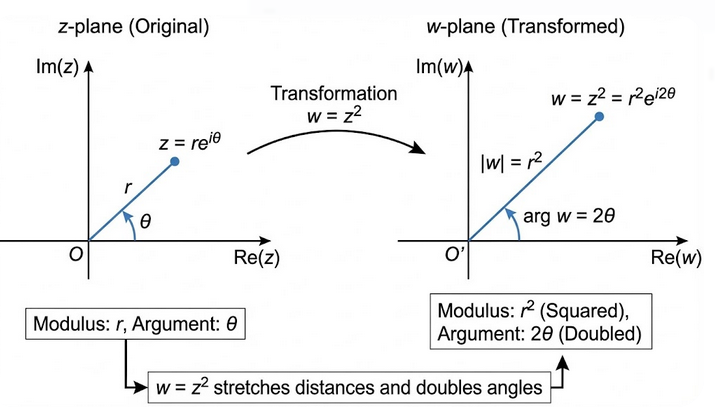
Let \( z = re^{i\theta} \). Then
\( w = z^2 = r^2 e^{i2\theta} \)
This means:
- The modulus is squared: \( |w| = r^2 \).
- The argument is doubled: \( \arg w = 2\theta \).
So \( w = z^2 \) stretches distances and doubles angles from the origin.
Linear Fractional Transformations
A transformation of the form
\( w = \dfrac{az + b}{cz + d} \), where \( a,b,c,d \in \mathbb{C} \) and \( ad – bc \ne 0 \)
is called a linear fractional transformation.
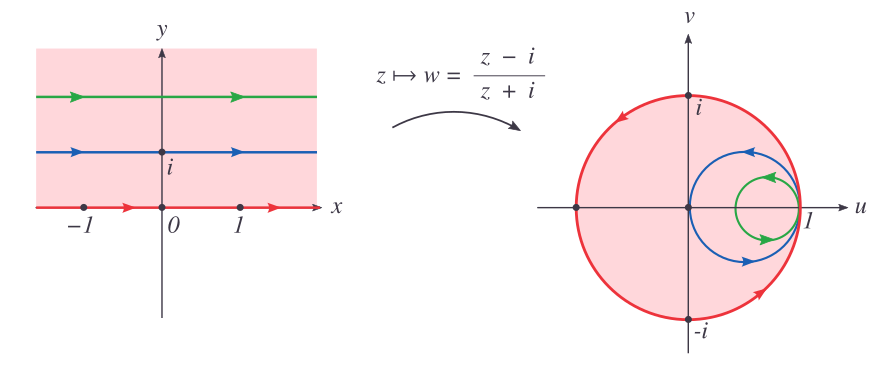
It maps lines and circles in the \( z \)-plane to lines or circles in the \( w \)-plane.
Special Cases
- If \( c = 0 \), then \( w = \dfrac{a}{d}z + \dfrac{b}{d} \), which is a combination of rotation, enlargement and translation.
- If \( b = 0 \) and \( c \ne 0 \), the transformation includes inversion.
Geometric Effects
- Multiplying by \( a \) causes a rotation and stretch.
- Adding \( b \) translates the plane.
- Dividing by \( cz + d \) introduces inversion and bending of shapes.
Example
Find the image of \( z = 1+i \) under the transformation \( w = z^2 \).
▶️ Answer / Explanation
\( w = (1+i)^2 = 1 + 2i + i^2 = 2i \)
Example
Find the image of \( z = 2 \) under the transformation \( w = \dfrac{z + 1}{z – 1} \).
▶️ Answer / Explanation
\( w = \dfrac{2 + 1}{2 – 1} = 3 \)
Example
Describe the effect of the transformation \( w = z^2 \) on arguments.
▶️ Answer / Explanation
If \( z = re^{i\theta} \), then \( w = r^2 e^{i2\theta} \).
So all arguments are doubled.