
First Order Linear Differential Equations
A first order linear differential equation has the form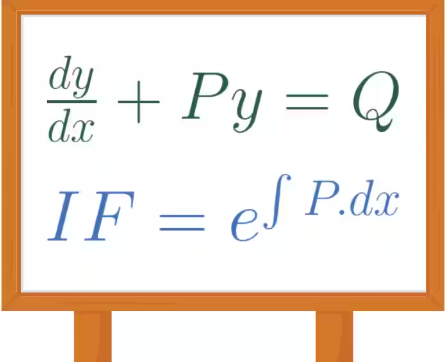
\( \dfrac{dy}{dx} + P(x)y = Q(x) \)
where \( P(x) \) and \( Q(x) \) are functions of \( x \).
These equations cannot usually be solved by simple separation of variables, so we use the integrating factor method.
Integrating Factor Method
The integrating factor (IF) is
\( \text{IF} = e^{\int P(x)\,dx} \)
Multiply every term in the differential equation by the integrating factor. This turns the left-hand side into the derivative of a product.
After multiplying:
\( \dfrac{d}{dx}\!\left(y \cdot \text{IF}\right) = Q(x)\cdot \text{IF} \)
Then integrate both sides with respect to \( x \).
General Procedure
- Write the equation in the form \( \dfrac{dy}{dx} + P(x)y = Q(x) \).
- Find the integrating factor \( e^{\int P(x)dx} \).
- Multiply the entire equation by the integrating factor.
- Recognise the left side as a derivative.
- Integrate and find the general solution.
- Use initial conditions to get a particular solution.
Example
Solve \( \dfrac{dy}{dx} + 2y = 0 \).
▶️ Answer / Explanation
\( P = 2 \Rightarrow \text{IF} = e^{2x} \)
Multiply: \( e^{2x}\dfrac{dy}{dx} + 2ye^{2x} = 0 \)
\( \dfrac{d}{dx}(ye^{2x}) = 0 \)
Integrate: \( ye^{2x} = C \Rightarrow y = Ce^{-2x} \)
Example
Solve \( \dfrac{dy}{dx} + y = e^x \).
▶️ Answer / Explanation
\( P = 1 \Rightarrow \text{IF} = e^x \)
Multiply: \( e^x\dfrac{dy}{dx} + ye^x = e^{2x} \)
\( \dfrac{d}{dx}(ye^x) = e^{2x} \)
Integrate: \( ye^x = \dfrac{e^{2x}}{2} + C \)
\( y = \dfrac{e^x}{2} + Ce^{-x} \)
Example
Solve \( \dfrac{dy}{dx} + \dfrac{2}{x}y = x^2 \), given that \( y=1 \) when \( x=1 \).
▶️ Answer / Explanation
\( P = \dfrac{2}{x} \Rightarrow \text{IF} = e^{\int 2/x\,dx} = x^2 \)
Multiply: \( x^2\dfrac{dy}{dx} + 2xy = x^4 \)
\( \dfrac{d}{dx}(x^2y) = x^4 \)
Integrate: \( x^2y = \dfrac{x^5}{5} + C \)
Use \( y=1 \) when \( x=1 \): \( C = \dfrac{4}{5} \)
\( y = \dfrac{x^3}{5} + \dfrac{4}{5x^2} \)