
Linear Second Order Differential Equationst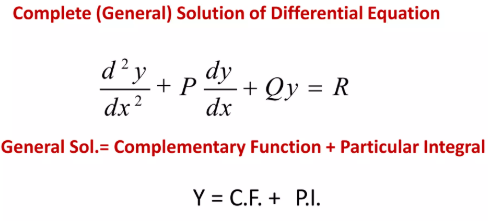
A linear second order differential equation has the form
\( a\dfrac{d^2y}{dx^2} + b\dfrac{dy}{dx} + cy = f(x) \)
where \( a, b, c \) are real constants and \( f(x) \) is a given function of \( x \).
The solution consists of two parts:
- Complementary function (CF): solves the homogeneous equation \( ay” + by’ + cy = 0 \).
- Particular integral (PI): any one solution of the full equation.
The complete solution is
\( y = \text{CF} + \text{PI} \)
Step 1: The Auxiliary Equation
For the homogeneous equation
\( ay” + by’ + cy = 0 \)
assume a solution of the form \( y = e^{mx} \). This gives the auxiliary equation:
\( am^2 + bm + c = 0 \)
The nature of the roots determines the CF.
| Roots | Complementary Function |
| Distinct real \( m_1, m_2 \) | \( Ae^{m_1x} + Be^{m_2x} \) |
| Repeated root \( m \) | \( (A + Bx)e^{mx} \) |
| Complex roots \( \alpha \pm i\beta \) | \( e^{\alpha x}(A\cos\beta x + B\sin\beta x) \) |
Step 2: Finding the Particular Integral
The particular integral depends on the form of \( f(x) \).
| \( f(x) \) | Trial PI |
| \( ke^{px} \) | \( Ae^{px} \) |
| \( A + Bx \) | \( C + Dx \) |
| Polynomial | Same degree polynomial |
| \( m\cos\omega x + n\sin\omega x \) | \( A\cos\omega x + B\sin\omega x \) |
If the trial solution clashes with the CF, multiply by \( x \).
Example
Solve \( \dfrac{d^2y}{dx^2} – 3\dfrac{dy}{dx} + 2y = 0 \).
▶️ Answer / Explanation
Auxiliary equation:
\( m^2 – 3m + 2 = 0 \Rightarrow (m-1)(m-2)=0 \)
\( m=1,2 \)
CF: \( y = Ae^x + Be^{2x} \)
Example
Solve \( \dfrac{d^2y}{dx^2} + y = x \).
▶️ Answer / Explanation
Auxiliary equation: \( m^2 + 1 = 0 \Rightarrow m = \pm i \)
CF: \( A\cos x + B\sin x \)
Trial PI: \( y = ax + b \)
Substitute and solve for \( a,b \).
Example
Solve \( \dfrac{d^2y}{dx^2} + 4y = \sin 2x \).
▶️ Answer / Explanation
Auxiliary equation: \( m^2 + 4 = 0 \Rightarrow m = \pm 2i \)
CF: \( A\cos 2x + B\sin 2x \)
Trial PI: \( y = a\cos 2x + b\sin 2x \)
Multiply by \( x \) since this clashes with CF.
Substitute \( y = x(a\cos2x + b\sin2x) \) and solve for \( a,b \).