
Series Solutions of Differential Equations Using Taylor Series
Some differential equations cannot be solved using elementary functions. In such cases, a solution can be written as a power series in \( x \) using Taylor (Maclaurin) expansions.
We assume the solution has the form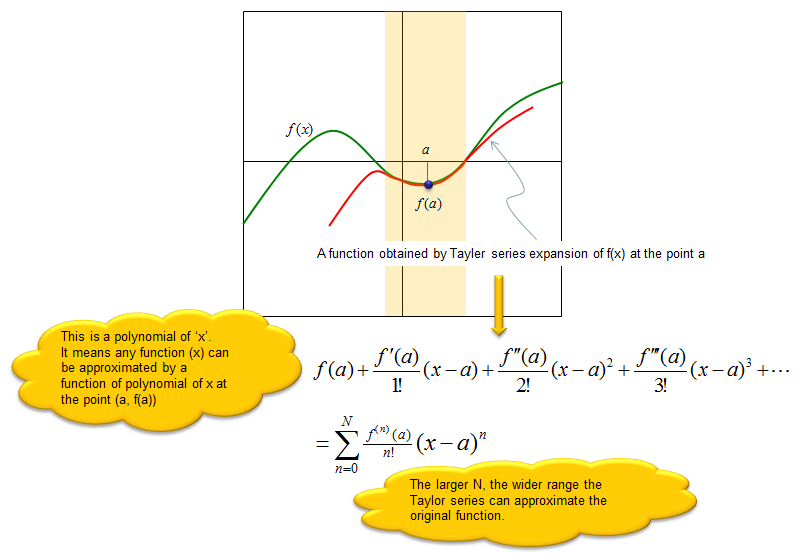
\( y = a_0 + a_1x + a_2x^2 + a_3x^3 + a_4x^4 + \cdots \)
and determine the coefficients using the differential equation and given conditions.
Method
- Assume a power series for \( y \).
- Differentiate term by term to get \( y’ \) and \( y” \).
- Substitute into the differential equation.
- Equate coefficients of like powers of \( x \).
- Use initial conditions to determine constants.
Example
Find the Maclaurin series solution up to the term in \( x^4 \) of
\( \dfrac{d^2y}{dx^2} – y = 0 \)
given \( y(0)=1 \) and \( y'(0)=0 \).
▶️ Answer / Explanation
Assume
\( y = a_0 + a_1x + a_2x^2 + a_3x^3 + a_4x^4 + \cdots \)
\( y’ = a_1 + 2a_2x + 3a_3x^2 + 4a_4x^3 + \cdots \)
\( y” = 2a_2 + 6a_3x + 12a_4x^2 + \cdots \)
Substitute into \( y” – y = 0 \):
\( (2a_2 + 6a_3x + 12a_4x^2) – (a_0 + a_1x + a_2x^2 + a_3x^3 + a_4x^4) = 0 \)
Equating coefficients:
Constant: \( 2a_2 – a_0 = 0 \)
\( x \): \( 6a_3 – a_1 = 0 \)
\( x^2 \): \( 12a_4 – a_2 = 0 \)
From initial conditions:
\( a_0 = 1,\ a_1 = 0 \)
Then
\( 2a_2 – 1 = 0 \Rightarrow a_2 = \dfrac12 \)
\( 6a_3 = 0 \Rightarrow a_3 = 0 \)
\( 12a_4 – \dfrac12 = 0 \Rightarrow a_4 = \dfrac{1}{24} \)
Therefore
\( y = 1 + \dfrac12 x^2 + \dfrac{1}{24}x^4 + \cdots \)
Example
Find the Maclaurin series up to \( x^4 \) for the solution of
\( \dfrac{d^2y}{dx^2} + y = 0 \)
given \( y(0)=0 \) and \( y'(0)=1 \).
▶️ Answer / Explanation
Assume
\( y = a_0 + a_1x + a_2x^2 + a_3x^3 + a_4x^4 + \cdots \)
\( y’ = a_1 + 2a_2x + 3a_3x^2 + 4a_4x^3 + \cdots \)
\( y” = 2a_2 + 6a_3x + 12a_4x^2 + \cdots \)
Substitute into \( y” + y = 0 \):
\( (2a_2 + 6a_3x + 12a_4x^2) + (a_0 + a_1x + a_2x^2 + a_3x^3 + a_4x^4) = 0 \)
Equating coefficients:
Constant: \( 2a_2 + a_0 = 0 \)
\( x \): \( 6a_3 + a_1 = 0 \)
\( x^2 \): \( 12a_4 + a_2 = 0 \)
Initial conditions:
\( y(0)=0 \Rightarrow a_0=0 \)
\( y'(0)=1 \Rightarrow a_1=1 \)
Then
\( 2a_2 = 0 \Rightarrow a_2 = 0 \)
\( 6a_3 + 1 = 0 \Rightarrow a_3 = -\dfrac16 \)
\( 12a_4 + 0 = 0 \Rightarrow a_4 = 0 \)
So
\( y = x – \dfrac{x^3}{6} + \cdots \)
This is the Maclaurin series for \( \sin x \), confirming the result.
Example
Find the solution in powers of \( x \) up to \( x^4 \) of
\( \dfrac{d^2y}{dx^2} + x\dfrac{dy}{dx} + y = 0 \)
given \( y(0)=1 \) and \( y'(0)=0 \).
▶️ Answer / Explanation
Step 1: Assume a series for \( y \)
\( y = a_0 + a_1x + a_2x^2 + a_3x^3 + a_4x^4 + \cdots \)
\( y’ = a_1 + 2a_2x + 3a_3x^2 + 4a_4x^3 + \cdots \)
\( y” = 2a_2 + 6a_3x + 12a_4x^2 + \cdots \)
Step 2: Substitute into the equation
\( (2a_2 + 6a_3x + 12a_4x^2) + x(a_1 + 2a_2x + 3a_3x^2) + (a_0 + a_1x + a_2x^2 + a_3x^3 + a_4x^4) = 0 \)
Group like powers of \( x \):
Constant term: \( 2a_2 + a_0 = 0 \)
\( x \): \( 6a_3 + a_1 + a_1 = 0 \Rightarrow 6a_3 + 2a_1 = 0 \)
\( x^2 \): \( 12a_4 + 2a_2 + a_2 = 0 \Rightarrow 12a_4 + 3a_2 = 0 \)
Step 3: Use initial conditions
\( y(0)=1 \Rightarrow a_0 = 1 \)
\( y'(0)=0 \Rightarrow a_1 = 0 \)
From \( 2a_2 + a_0 = 0 \):
\( 2a_2 + 1 = 0 \Rightarrow a_2 = -\dfrac12 \)
From \( 6a_3 + 2a_1 = 0 \):
\( a_3 = 0 \)
From \( 12a_4 + 3a_2 = 0 \):
\( 12a_4 – \dfrac{3}{2} = 0 \Rightarrow a_4 = \dfrac{1}{8} \)
Final series
\( y = 1 – \dfrac12 x^2 + \dfrac18 x^4 + \cdots \)