
Polar Coordinates
In the polar coordinate system, a point in the plane is represented by
\( (r,\theta) \)
where \( r \) is the distance of the point from the origin, \( \theta \) is the angle measured anticlockwise from the positive \( x \)-axis, and \( r \ge 0 \).
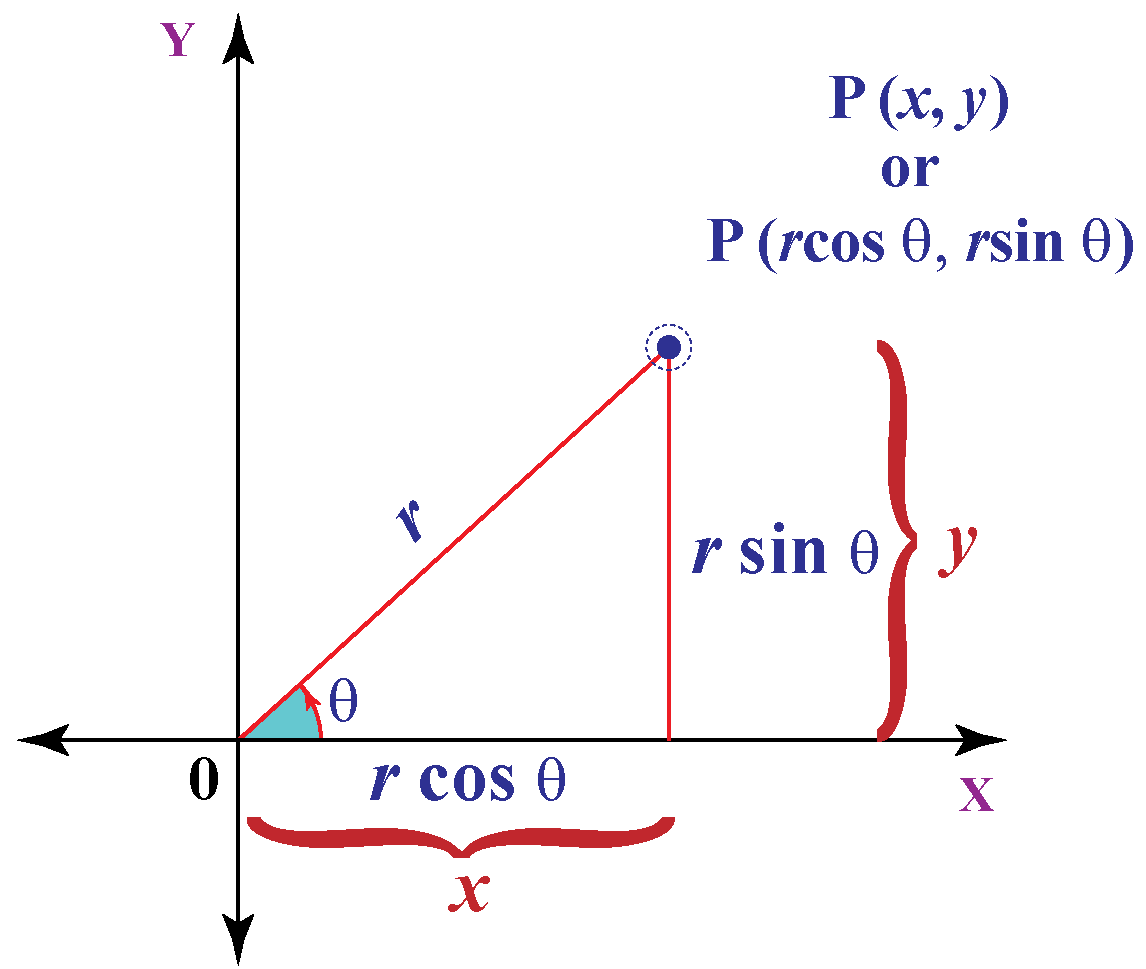
The connection between polar and Cartesian coordinates is
\( x = r\cos\theta,\qquad y = r\sin\theta \)
and therefore
\( r^2 = x^2 + y^2 \).
Basic Polar Curves
| Equation | Curve | |
| \( \theta = a \) | Straight line through the origin making angle \( a \) with the x-axis | 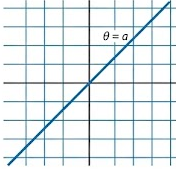 |
| \( r = p\sec(a-\theta) \) | Straight line not passing through the origin | 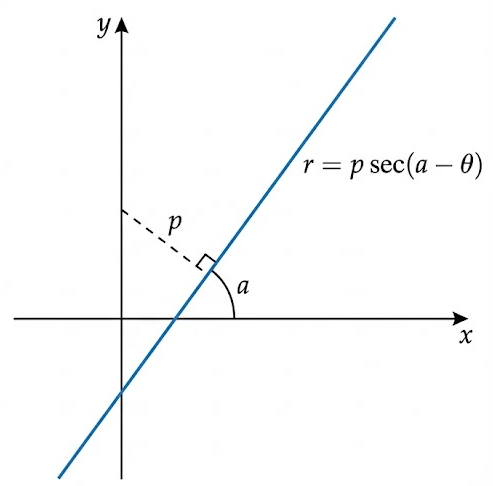 |
| \( r = a \) | Circle of radius \( a \) centred at the origin | 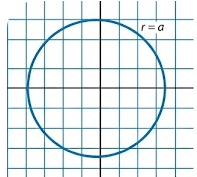 |
| \( r = 2a\cos\theta \) | Circle with centre \( (a,0) \) and radius \( a \) | 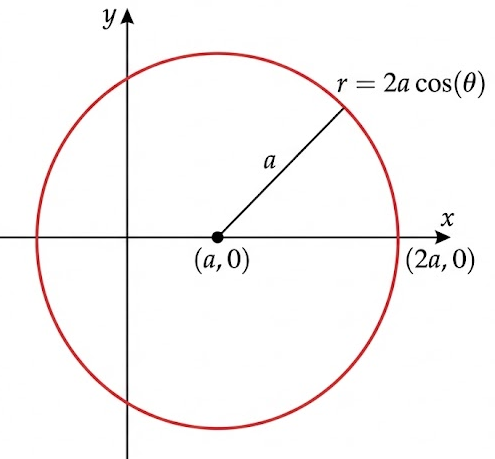 |
| \( r = k\theta \) | Archimedean spiral | 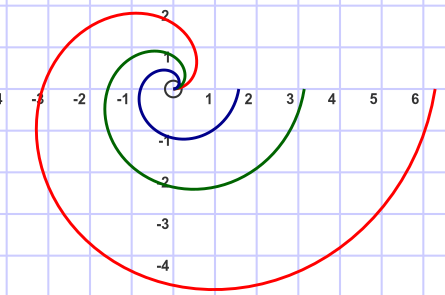 |
| \( r = a(1\pm\cos\theta) \) | Cardioid | 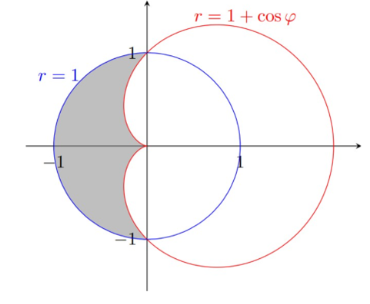 |
| \( r = a(3+2\cos\theta) \) | Limacon | 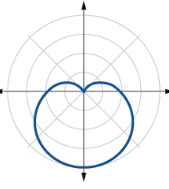 |
| \( r = a\cos 2\theta \) | Four-petalled rose | 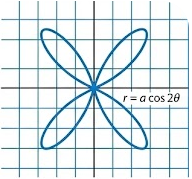 |
| \( r^2 = a^2\cos 2\theta \) | Lemniscate (figure-eight) | 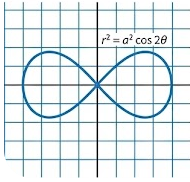 |
Important Ideas for Sketching Polar Curves
- First find where \( r=0 \) to locate points at the origin.
- Evaluate \( r \) at key angles such as \( 0,\ \tfrac{\pi}{2},\ \pi \).
- Use symmetry: If the equation contains \( \cos\theta \), it is symmetric about the x-axis. If it contains \( \sin\theta \), it is symmetric about the y-axis. If it contains \( \cos2\theta \), it is symmetric about both axes.
- Check where \( r^2 \ge 0 \) when equations contain \( r^2 \).
Geometric Meaning of Special Forms
\( r = a(1+\cos\theta) \) produces a cardioid with a cusp at the origin.
\( r^2 = a^2\cos2\theta \) produces two loops symmetric about the axes.
\( r = k\theta \) produces a spiral which moves outward as \( \theta \) increases.
Example
The curve is given by
\( r = 2a\cos\theta \).
Show that this represents a circle and find its centre and radius.
▶️ Answer / Explanation
Using
\( x = r\cos\theta,\quad y = r\sin\theta \)
Multiply both sides by \( \cos\theta \):
\( r\cos\theta = 2a\cos^2\theta \)
So
\( x = 2a\cos^2\theta \)
But
\( \cos^2\theta = \dfrac{x^2}{x^2+y^2} \)
Using \( r^2 = x^2 + y^2 \), we get
\( r = 2a\cos\theta \Rightarrow r^2 = 2ar\cos\theta \Rightarrow x^2 + y^2 = 2ax \)
\( x^2 – 2ax + y^2 = 0 \Rightarrow (x-a)^2 + y^2 = a^2 \)
So it is a circle with centre \( (a,0) \) and radius \( a \).
Example
The curve is given by
\( r = a(1+\cos\theta) \).
Find the values of \( \theta \) at which the curve passes through the origin, and describe the shape of the curve.
▶️ Answer / Explanation
The curve passes through the origin when \( r = 0 \).
\( a(1+\cos\theta)=0 \Rightarrow 1+\cos\theta=0 \Rightarrow \cos\theta=-1 \)
So \( \theta=\pi \).
At \( \theta=0 \):
\( r=a(1+1)=2a \)
So the curve is farthest from the origin on the positive x-axis.
This curve is a cardioid, symmetric about the x-axis with a cusp at the origin.
Example
The curve is given by
\( r^2 = a^2\cos 2\theta \).
Find the values of \( \theta \) for which the curve exists, and sketch the curve.
▶️ Answer / Explanation
Since \( r^2 \ge 0 \), we must have
\( \cos 2\theta \ge 0 \).
This occurs when
\( -\dfrac{\pi}{4} \le \theta \le \dfrac{\pi}{4} \quad \text{or} \quad \dfrac{3\pi}{4} \le \theta \le \dfrac{5\pi}{4} \)
When \( \theta=0 \),
\( r^2 = a^2 \Rightarrow r = a \)
When \( \theta=\dfrac{\pi}{4} \),
\( \cos 2\theta = 0 \Rightarrow r=0 \)
So the curve passes through the origin and forms two loops.
This is a lemniscate (figure-eight shape) symmetric about both axes.