
Area of Polar Curves
For a curve given in polar form \( r = f(\theta) \), the area enclosed between the angles \( \theta=\alpha \) and \( \theta=\beta \) is given by
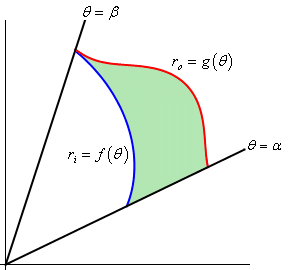
\( A = \dfrac12 \displaystyle\int_{\alpha}^{\beta} r^2\,d\theta \)
This formula comes from splitting the region into small sectors of angle \( d\theta \), each having area \( \dfrac12 r^2 d\theta \).
Tangent to a Polar Curve
If \( r=f(\theta) \), then using
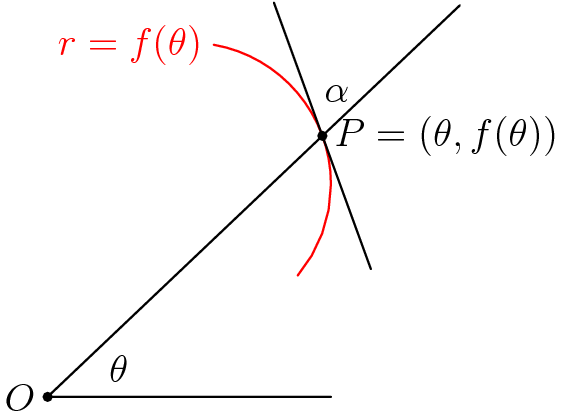
\( x=r\cos\theta,\qquad y=r\sin\theta \)
the gradient of the tangent is
\( \dfrac{dy}{dx}=\dfrac{\dfrac{dr}{d\theta}\sin\theta+r\cos\theta}{\dfrac{dr}{d\theta}\cos\theta-r\sin\theta} \)
This formula is used to find tangents parallel to or perpendicular to the initial line (the positive \( x \)-axis).
A tangent parallel to the initial line has \( \dfrac{dy}{dx}=0 \), so the numerator must be zero.
A tangent perpendicular to the initial line has \( \dfrac{dy}{dx} \) undefined, so the denominator must be zero.
Example
Find the area enclosed by the curve
\( r = 2a\cos\theta \)
for \( 0\le\theta\le\dfrac{\pi}{2} \).
▶️ Answer / Explanation
\( A=\dfrac12\int_0^{\pi/2}(2a\cos\theta)^2\,d\theta \)
\( =\dfrac12\int_0^{\pi/2}4a^2\cos^2\theta\,d\theta \)
\( =2a^2\int_0^{\pi/2}\cos^2\theta\,d\theta \)
\( =2a^2\int_0^{\pi/2}\dfrac{1+\cos2\theta}{2}\,d\theta =a^2\left[\theta+\dfrac{\sin2\theta}{2}\right]_0^{\pi/2} \)
\( =a^2\cdot\dfrac{\pi}{2} \)
Example
For the curve \( r=a(1+\cos\theta) \), find the values of \( \theta \) at which the tangent is parallel to the initial line.
▶️ Answer / Explanation
\( r=a(1+\cos\theta) \Rightarrow \dfrac{dr}{d\theta}=-a\sin\theta \)
For tangents parallel to the initial line:
\( \dfrac{dr}{d\theta}\sin\theta+r\cos\theta=0 \)
\( (-a\sin\theta)\sin\theta+a(1+\cos\theta)\cos\theta=0 \)
\( -a\sin^2\theta+a\cos\theta+a\cos^2\theta=0 \)
Divide by \( a \): \( -\sin^2\theta+\cos\theta+\cos^2\theta=0 \)
\( -1+\cos^2\theta+\cos\theta+\cos^2\theta=0 \)
\( 2\cos^2\theta+\cos\theta-1=0 \)
\( (2\cos\theta-1)(\cos\theta+1)=0 \)
\( \cos\theta=\dfrac12 \) or \( \cos\theta=-1 \)
So \( \theta=\dfrac{\pi}{3},\ \pi \).
Example
For the curve \( r=a\cos2\theta \), find the values of \( \theta \) at which the tangent is perpendicular to the initial line.
▶️ Answer / Explanation
\( r=a\cos2\theta,\quad \dfrac{dr}{d\theta}=-2a\sin2\theta \)
For a perpendicular tangent:
\( \dfrac{dr}{d\theta}\cos\theta-r\sin\theta=0 \)
\( (-2a\sin2\theta)\cos\theta-a\cos2\theta\sin\theta=0 \)
Divide by \( a \):
\( -2\sin2\theta\cos\theta-\cos2\theta\sin\theta=0 \)
Using trig identities, solve for \( \theta \).