
Cartesian and Parametric Equations for the Ellipse
An ellipse is the locus of a point which moves such that the sum of its distances from two fixed points (the foci) is constant.
Standard Cartesian Equation of an Ellipse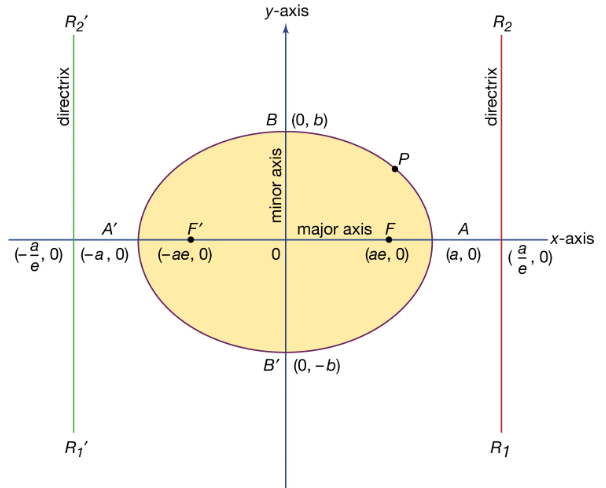
An ellipse centred at the origin with its axes along the coordinate axes has equation
\( \dfrac{x^2}{a^2} + \dfrac{y^2}{b^2} = 1 \)
where:
\( a \) is the semi-major axis
\( b \) is the semi-minor axis
If \( a > b \), the major axis lies along the \( x \)-axis. If \( b > a \), the major axis lies along the \( y \)-axis.
Key Features of the Ellipse
- Centre: \( (0,0) \)
- Vertices: \( (\pm a,0) \) and \( (0,\pm b) \)
- Intercepts on the \( x \)-axis: \( \pm a \)
- Intercepts on the \( y \)-axis: \( \pm b \)
Parametric Equations of an Ellipse 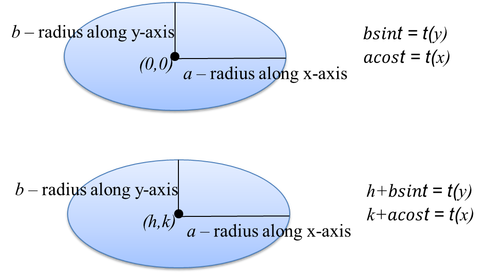
The ellipse
\( \dfrac{x^2}{a^2} + \dfrac{y^2}{b^2} = 1 \)
can be represented parametrically by
\( x = a\cos t \)
\( y = b\sin t \)
where \( t \) is a parameter, usually taken in the range \( 0 \leq t < 2\pi \).
Substituting these into the Cartesian equation confirms the equivalence.
Example :
Write down the Cartesian equation of an ellipse with semi-major axis \( 5 \) along the \( x \)-axis and semi-minor axis \( 3 \).
▶️ Answer/Explanation
Here \( a = 5 \) and \( b = 3 \).
\( \dfrac{x^2}{25} + \dfrac{y^2}{9} = 1 \)
Conclusion: The equation of the ellipse is \( \dfrac{x^2}{25} + \dfrac{y^2}{9} = 1 \).
Example :
Find parametric equations for the ellipse
\( \dfrac{x^2}{16} + \dfrac{y^2}{4} = 1 \).
▶️ Answer/Explanation
Comparing with the standard form:
\( a = 4,\; b = 2 \)
Hence the parametric equations are
\( x = 4\cos t \)
\( y = 2\sin t \)
Conclusion: These parametric equations describe the ellipse.
Example :
Eliminate the parameter to show that the parametric equations
\( x = 6\cos t,\quad y = 4\sin t \)
represent an ellipse, and find its Cartesian equation.
▶️ Answer/Explanation
From the parametric equations:
\( \cos t = \dfrac{x}{6},\quad \sin t = \dfrac{y}{4} \)
Using the identity \( \cos^2 t + \sin^2 t = 1 \):
\( \left(\dfrac{x}{6}\right)^2 + \left(\dfrac{y}{4}\right)^2 = 1 \)
\( \dfrac{x^2}{36} + \dfrac{y^2}{16} = 1 \)
Conclusion: The Cartesian equation of the ellipse is \( \dfrac{x^2}{36} + \dfrac{y^2}{16} = 1 \).
Cartesian and Parametric Equations of the Hyperbola
A hyperbola is a curve defined as the locus of a point for which the absolute difference of the distances from two fixed points (the foci) is constant. In Pure Mathematics, hyperbolas are commonly represented using Cartesian equations and two standard forms of parametric equations.
Standard Cartesian Equation
A hyperbola centred at the origin with transverse axis along the \( x \)-axis has equation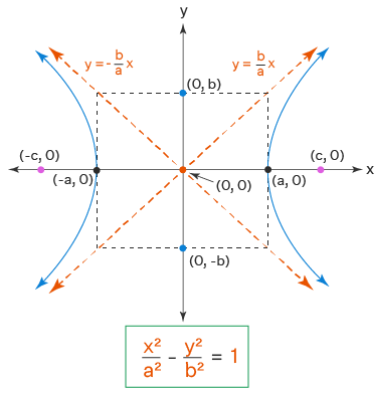
\( \dfrac{x^2}{a^2} – \dfrac{y^2}{b^2} = 1 \)
where:
\( a \) is the semi-transverse axis
\( b \) is the semi-conjugate axis
Key Features of the Hyperbola
- Centre: \( (0,0) \)
- Vertices: \( (\pm a,0) \)
- Asymptotes: \( y = \pm \dfrac{b}{a}x \)
Trigonometric Parametric Form
The hyperbola
\( \dfrac{x^2}{a^2} – \dfrac{y^2}{b^2} = 1 \)
can be represented parametrically using trigonometric functions as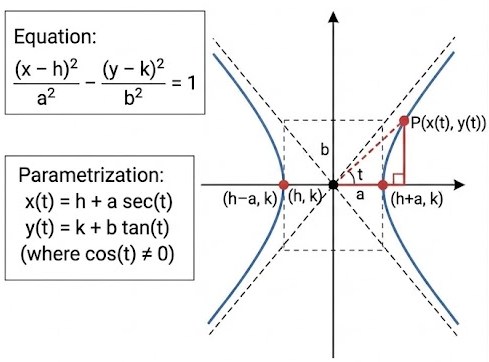
- \( x = a\sec t \)
- \( y = b\tan t \)
This works because of the identity
\( \sec^2 t – \tan^2 t = 1 \)
Hyperbolic Parametric Form
The same hyperbola can also be represented using hyperbolic functions:
- \( x = a\cosh t \)
- \( y = b\sinh t \)
This follows from the identity
\( \cosh^2 t – \sinh^2 t = 1 \)
This parametrisation is especially useful in calculus-based problems.
Example :
Write down parametric equations for the hyperbola
\( \dfrac{x^2}{9} – \dfrac{y^2}{4} = 1 \).
▶️ Answer/Explanation
Here \( a = 3 \) and \( b = 2 \).
Trigonometric form:
\( x = 3\sec t,\quad y = 2\tan t \)
Hyperbolic form:
\( x = 3\cosh t,\quad y = 2\sinh t \)
Conclusion: Either parametrisation correctly represents the hyperbola.
Example :
Show that the parametric equations
\( x = 4\sec t,\quad y = 3\tan t \)
satisfy a Cartesian equation of a hyperbola.
▶️ Answer/Explanation
Rearranging:
\( \sec t = \dfrac{x}{4},\quad \tan t = \dfrac{y}{3} \)
Using \( \sec^2 t – \tan^2 t = 1 \):
\( \left(\dfrac{x}{4}\right)^2 – \left(\dfrac{y}{3}\right)^2 = 1 \)
\( \dfrac{x^2}{16} – \dfrac{y^2}{9} = 1 \)
Conclusion: The curve is a hyperbola with equation \( \dfrac{x^2}{16} – \dfrac{y^2}{9} = 1 \).
Example :
Eliminate the parameter to show that
\( x = 5\cosh t,\quad y = 4\sinh t \)
represent a hyperbola, and find its Cartesian equation.
▶️ Answer/Explanation
From the parametric equations:
\( \cosh t = \dfrac{x}{5},\quad \sinh t = \dfrac{y}{4} \)
Using \( \cosh^2 t – \sinh^2 t = 1 \):
\( \left(\dfrac{x}{5}\right)^2 – \left(\dfrac{y}{4}\right)^2 = 1 \)
\( \dfrac{x^2}{25} – \dfrac{y^2}{16} = 1 \)
Conclusion: The Cartesian equation is \( \dfrac{x^2}{25} – \dfrac{y^2}{16} = 1 \).