
Focus–Directrix Properties of the Ellipse and Hyperbola
Both the ellipse and the hyperbola can be defined using a focus–directrix property. This definition introduces an important parameter called the eccentricity, which determines the shape of the curve.
Eccentricity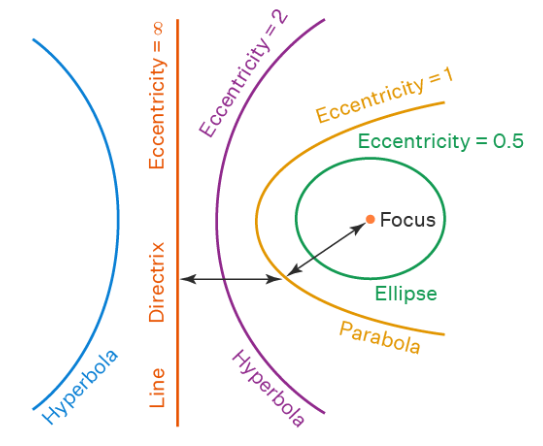
The eccentricity of a conic section is denoted by \( e \) and is defined as
\( e = \dfrac{\text{distance from focus}}{\text{distance from directrix}} \)
For different conics:
- Ellipse: \( 0 < e < 1 \)
- Parabola: \( e = 1 \)
- Hyperbola: \( e > 1 \)
Focus–Directrix Property of the Ellipse
An ellipse is the locus of a point such that the ratio of its distance from a fixed point (the focus) to its distance from a fixed line (the directrix) is a constant less than 1.
For the ellipse with Cartesian equation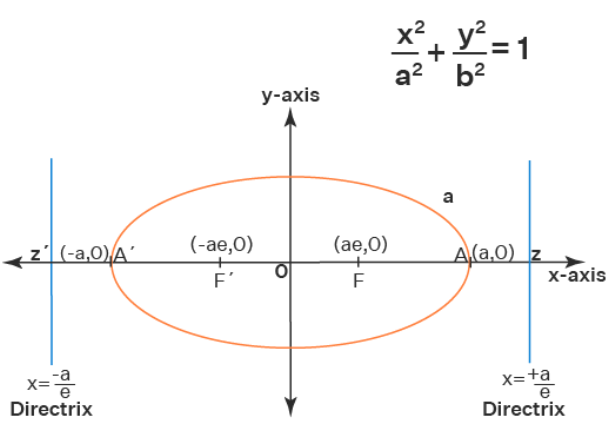
\( \dfrac{x^2}{a^2} + \dfrac{y^2}{b^2} = 1 \), where \( a > b \),
the eccentricity \( e \) is defined by
\( b^2 = a^2(1 – e^2) \)
The key focus–directrix properties are:
Foci: \( (ae, 0) \) and \( (-ae, 0) \)
Directrices: \( x = \dfrac{a}{e} \) and \( x = -\dfrac{a}{e} \)
The major axis lies along the \( x \)-axis and the centre is at the origin.
Focus–Directrix Property of the Hyperbola
A hyperbola is the locus of a point such that the ratio of its distance from a fixed point (the focus) to its distance from a fixed line (the directrix) is a constant greater than 1.
For the hyperbola with Cartesian equation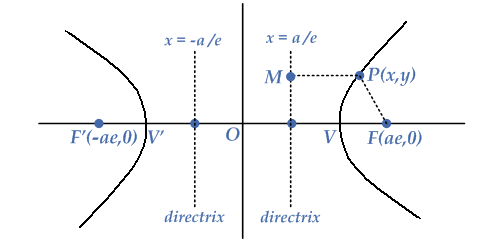
\( \dfrac{x^2}{a^2} – \dfrac{y^2}{b^2} = 1 \),
the eccentricity \( e \) is defined by
\( b^2 = a^2(e^2 – 1) \)
The key focus–directrix properties are:
Foci: \( (ae, 0) \) and \( (-ae, 0) \)
Directrices: \( x = \dfrac{a}{e} \) and \( x = -\dfrac{a}{e} \)
The transverse axis lies along the \( x \)-axis and the centre is at the origin.
Comparison
| Property | Ellipse | Hyperbola |
|---|---|---|
| Eccentricity | \( 0 < e < 1 \) | \( e > 1 \) |
| Relation between \( a,b,e \) | \( b^2 = a^2(1 – e^2) \) | \( b^2 = a^2(e^2 – 1) \) |
| Foci | \( (\pm ae, 0) \) | \( (\pm ae, 0) \) |
| Directrices | \( x = \pm \dfrac{a}{e} \) | \( x = \pm \dfrac{a}{e} \) |
Example :
For the ellipse
\( \dfrac{x^2}{25} + \dfrac{y^2}{9} = 1 \),
find the eccentricity, the coordinates of the foci, and the equations of the directrices.
▶️ Answer/Explanation
Here
\( a^2 = 25,\; b^2 = 9 \)
Using
\( b^2 = a^2(1 – e^2) \)
\( 9 = 25(1 – e^2) \)
\( e^2 = \dfrac{16}{25} \Rightarrow e = \dfrac{4}{5} \)
Hence:
Foci: \( (\pm ae,0) = (\pm 4,0) \)
Directrices: \( x = \pm \dfrac{a}{e} = \pm \dfrac{25}{4} \)
Conclusion: The ellipse has eccentricity \( \dfrac{4}{5} \), foci at \( (\pm4,0) \), and directrices \( x = \pm \dfrac{25}{4} \).
Example :
For the hyperbola
\( \dfrac{x^2}{16} – \dfrac{y^2}{9} = 1 \),
find the eccentricity, the coordinates of the foci, and the equations of the directrices.
▶️ Answer/Explanation
Here
\( a^2 = 16,\; b^2 = 9 \)
Using
\( b^2 = a^2(e^2 – 1) \)
\( 9 = 16(e^2 – 1) \)
\( e^2 = \dfrac{25}{16} \Rightarrow e = \dfrac{5}{4} \)
Hence:
Foci: \( (\pm ae,0) = (\pm5,0) \)
Directrices: \( x = \pm \dfrac{a}{e} = \pm \dfrac{16}{5} \)
Conclusion: The hyperbola has eccentricity \( \dfrac{5}{4} \), foci at \( (\pm5,0) \), and directrices \( x = \pm \dfrac{16}{5} \).
Example :
An ellipse has eccentricity \( \dfrac{3}{5} \) and semi-major axis \( a = 10 \). Find its Cartesian equation, the coordinates of the foci, and the equations of the directrices.
▶️ Answer/Explanation
Given
\( e = \dfrac{3}{5},\; a = 10 \)
Using
\( b^2 = a^2(1 – e^2) \)
\( b^2 = 100\left(1 – \dfrac{9}{25}\right) = 64 \)
\( b = 8 \)
Therefore:
Cartesian equation: \( \dfrac{x^2}{100} + \dfrac{y^2}{64} = 1 \)
Foci: \( (\pm ae,0) = (\pm6,0) \)
Directrices: \( x = \pm \dfrac{a}{e} = \pm \dfrac{50}{3} \)
Conclusion: The ellipse is fully determined using the focus–directrix properties.