
Tangents and Normals to Ellipses and Hyperbolas
For the ellipse and the hyperbola, equations of tangents and normals can be found using differentiation or by using standard results.
Tangent and Normal: General Idea 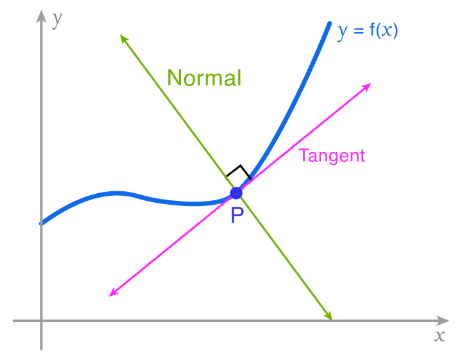
At a point on a curve:
The tangent is the straight line that has the same gradient as the curve at that point
The normal is the straight line perpendicular to the tangent
If the gradient of the tangent is \( m \), then the gradient of the normal is
\( -\dfrac{1}{m} \)
Tangents and Normals to an Ellipse
Consider the ellipse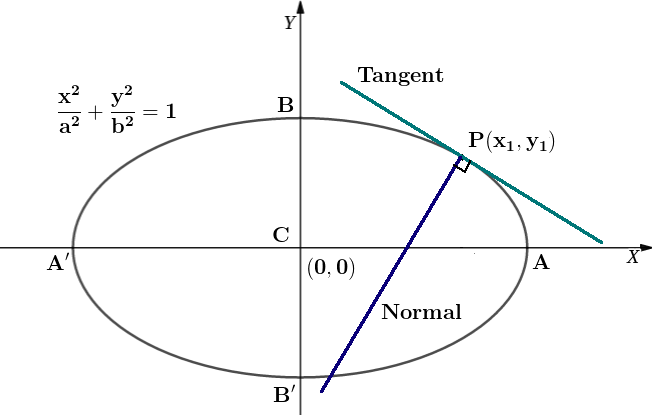
\( \dfrac{x^2}{a^2} + \dfrac{y^2}{b^2} = 1 \)
Equation of the Tangent at a Point
At a point \( (x_1, y_1) \) on the ellipse, the equation of the tangent is
\( \dfrac{xx_1}{a^2} + \dfrac{yy_1}{b^2} = 1 \)
Gradient of the Tangent
Differentiating implicitly:
\( \dfrac{2x}{a^2} + \dfrac{2y}{b^2}\dfrac{dy}{dx} = 0 \)
\( \dfrac{dy}{dx} = -\dfrac{b^2 x}{a^2 y} \)
This gives the gradient of the tangent at any point on the ellipse.
Equation of the Normal
At \( (x_1,y_1) \), the gradient of the normal is
\( \dfrac{a^2 y_1}{b^2 x_1} \)
Condition for \( y = mx + c \) to be a Tangent to an Ellipse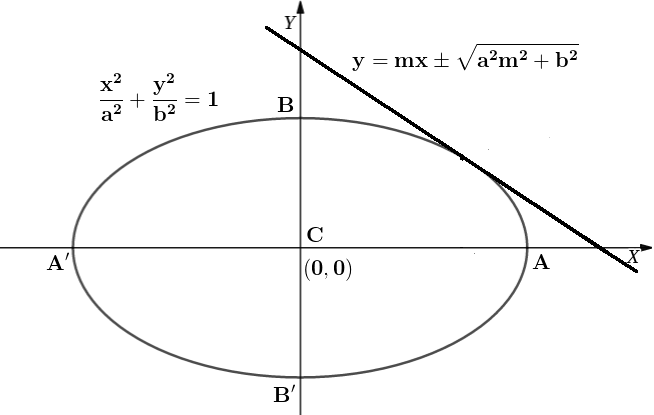
For the ellipse
\( \dfrac{x^2}{a^2} + \dfrac{y^2}{b^2} = 1 \),
the straight line
\( y = mx + c \)
is a tangent if and only if
\( c^2 = a^2 m^2 + b^2 \)
This condition is obtained by substituting \( y = mx + c \) into the ellipse and requiring a repeated root.
Tangents and Normals to a Hyperbola
Consider the hyperbola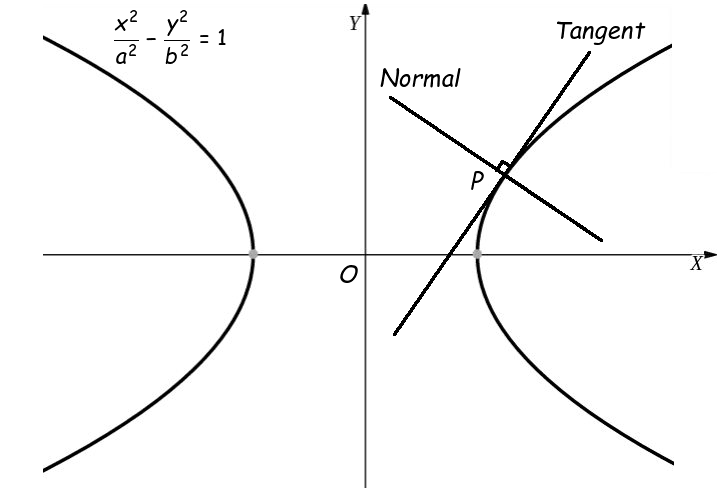
\( \dfrac{x^2}{a^2} – \dfrac{y^2}{b^2} = 1 \)
Equation of the Tangent at a Point
At a point \( (x_1, y_1) \) on the hyperbola, the equation of the tangent is
\( \dfrac{xx_1}{a^2} – \dfrac{yy_1}{b^2} = 1 \)
Gradient of the Tangent
Differentiating implicitly:
\( \dfrac{2x}{a^2} – \dfrac{2y}{b^2}\dfrac{dy}{dx} = 0 \)
\( \dfrac{dy}{dx} = \dfrac{b^2 x}{a^2 y} \)
Equation of the Normal
At \( (x_1,y_1) \), the gradient of the normal is
\( -\dfrac{a^2 y_1}{b^2 x_1} \)
Condition for \( y = mx + c \) to be a Tangent to a Hyperbola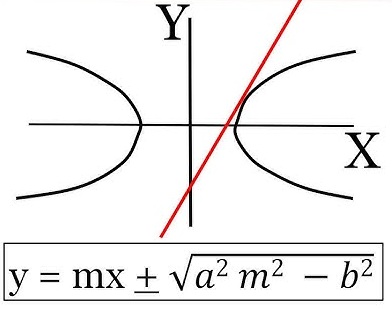
For the hyperbola
\( \dfrac{x^2}{a^2} – \dfrac{y^2}{b^2} = 1 \),
the straight line
\( y = mx + c \)
is a tangent if and only if
\( c^2 = a^2 m^2 – b^2 \)
Note
- Always check whether the curve is an ellipse or a hyperbola before applying a condition
- Memorise the tangent conditions for \( y = mx + c \)
- Normals are obtained using the negative reciprocal of the tangent gradient
Example :
Find the equation of the tangent and the normal to the ellipse
\( \dfrac{x^2}{16} + \dfrac{y^2}{9} = 1 \)
at the point \( (4\cos\theta,\,3\sin\theta) \).
▶️ Answer/Explanation
For the ellipse \( \dfrac{x^2}{a^2} + \dfrac{y^2}{b^2} = 1 \), the tangent at \( (x_1,y_1) \) is
\( \dfrac{xx_1}{a^2} + \dfrac{yy_1}{b^2} = 1 \)
Here \( a^2 = 16 \), \( b^2 = 9 \), \( x_1 = 4\cos\theta \), \( y_1 = 3\sin\theta \).
Tangent: \( \dfrac{x(4\cos\theta)}{16} + \dfrac{y(3\sin\theta)}{9} = 1 \)
\( \Rightarrow \dfrac{x\cos\theta}{4} + \dfrac{y\sin\theta}{3} = 1 \)
Gradient of the tangent:
\( m = -\dfrac{b^2 x_1}{a^2 y_1} = -\dfrac{9(4\cos\theta)}{16(3\sin\theta)} = -\dfrac{3\cos\theta}{4\sin\theta} \)
Gradient of the normal:
\( \dfrac{4\sin\theta}{3\cos\theta} \)
Conclusion: The tangent and normal are obtained directly using standard ellipse results.
Example :
Find the equation of the tangent to the hyperbola
\( \dfrac{x^2}{25} – \dfrac{y^2}{9} = 1 \)
at the point \( (5\sec t,\,3\tan t) \).
▶️ Answer/Explanation
For the hyperbola \( \dfrac{x^2}{a^2} – \dfrac{y^2}{b^2} = 1 \), the tangent at \( (x_1,y_1) \) is
\( \dfrac{xx_1}{a^2} – \dfrac{yy_1}{b^2} = 1 \)
Here \( a^2 = 25 \), \( b^2 = 9 \), \( x_1 = 5\sec t \), \( y_1 = 3\tan t \).
Tangent: \( \dfrac{x(5\sec t)}{25} – \dfrac{y(3\tan t)}{9} = 1 \)
\( \Rightarrow \dfrac{x\sec t}{5} – \dfrac{y\tan t}{3} = 1 \)
Conclusion: This is the required equation of the tangent in parametric form.
Example :
Find the condition on \( c \) for the line
\( y = 2x + c \)
to be a tangent to the ellipse
\( \dfrac{x^2}{9} + \dfrac{y^2}{4} = 1 \).
▶️ Answer/Explanation
For an ellipse, the line \( y = mx + c \) is a tangent if
\( c^2 = a^2 m^2 + b^2 \)
Here \( a^2 = 9 \), \( b^2 = 4 \), \( m = 2 \).
\( c^2 = 9(2)^2 + 4 = 36 + 4 = 40 \)
\( c = \pm \sqrt{40} = \pm 2\sqrt{10} \)
Conclusion: The line is a tangent when \( c = \pm 2\sqrt{10} \).