
Simple Loci Problems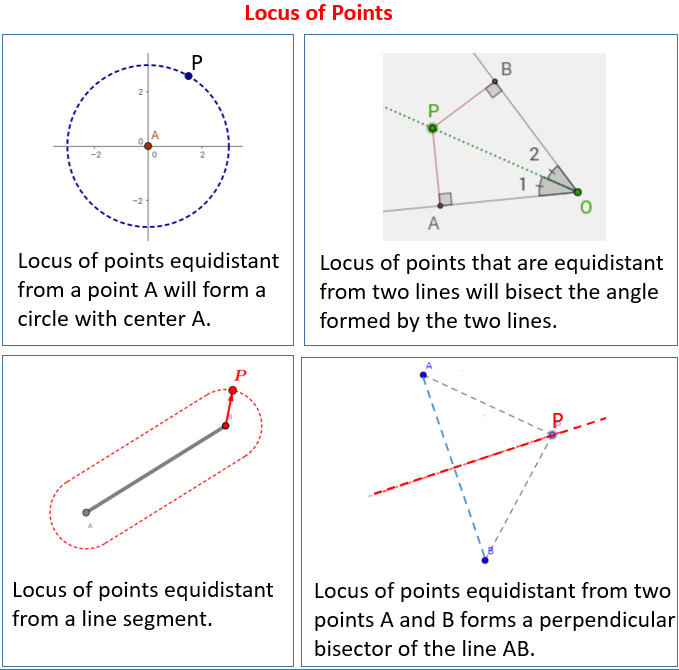
A locus is the set of all points that satisfy a given condition or set of conditions. In coordinate geometry, loci are usually described by forming an equation that represents all points \( (x,y) \) which satisfy the stated condition.
General Method for Solving Loci Problems
To find the equation of a locus:
- Introduce a general point \( P(x,y) \)
- Translate the given geometric condition into an algebraic equation
- Simplify the equation to obtain the required locus
Any restrictions on the region must be clearly stated if required.
Standard Loci You Should Recognise
| Geometric Condition | Resulting Locus |
|---|---|
| Point at a fixed distance from a fixed point | Circle |
| Point equidistant from two fixed points | Perpendicular bisector of the line joining the points |
| Point equidistant from two intersecting lines | Angle bisectors of the lines |
| Ratio of distances from two fixed points is constant | Circle or straight line (depending on ratio) |
Distance Formula
The distance between two points \( (x_1,y_1) \) and \( (x_2,y_2) \) is
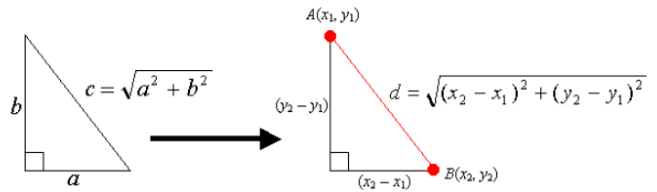
\( \sqrt{(x_2 – x_1)^2 + (y_2 – y_1)^2} \)
This formula is frequently used when forming locus equations.
Equation of a Circle as a Locus
If a point \( P(x,y) \) is at a constant distance \( r \) from a fixed point \( (h,k) \), then the locus of \( P \) is a circle with equation
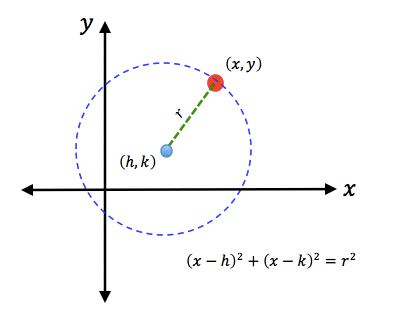
\( (x – h)^2 + (y – k)^2 = r^2 \)
Locus of a Point Equidistant from Two Fixed Points
If a point \( P(x,y) \) is equidistant from two fixed points \( A(x_1,y_1) \) and \( B(x_2,y_2) \), then
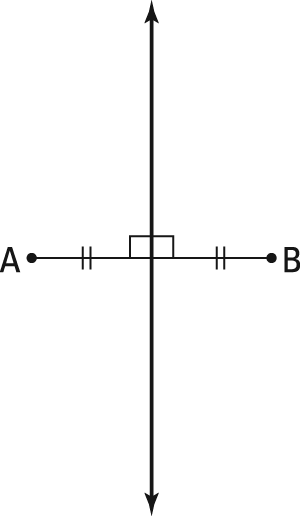
Distance from \( P \) to \( A \) = distance from \( P \) to \( B \)
This leads to a linear equation representing the perpendicular bisector of \( AB \).
Loci Involving Inequalities
Some problems require describing a region rather than a curve. For example:
- Points less than a fixed distance from a point describe the interior of a circle
- Points closer to one line than another describe a half-plane
Boundaries should be included or excluded according to the wording of the question.
Example :
Find the equation of the locus of a point \( P(x,y) \) which is at a distance 5 units from the point \( (2,-1) \).
▶️ Answer/Explanation
Using the distance formula:
Distance from \( P(x,y) \) to \( (2,-1) = 5 \)
\( \sqrt{(x-2)^2 + (y+1)^2} = 5 \)
Squaring both sides:
\( (x-2)^2 + (y+1)^2 = 25 \)
Conclusion: The locus is a circle with centre \( (2,-1) \) and radius 5.
Example :
Find the equation of the locus of a point \( P(x,y) \) which is equidistant from the points \( A(1,3) \) and \( B(5,-1) \).
▶️ Answer/Explanation
Equidistant means:
Distance from \( P \) to \( A \) = distance from \( P \) to \( B \)
\( \sqrt{(x-1)^2 + (y-3)^2} = \sqrt{(x-5)^2 + (y+1)^2} \)
Squaring both sides:
\( (x-1)^2 + (y-3)^2 = (x-5)^2 + (y+1)^2 \)
Expanding and simplifying:
\( x^2 – 2x + 1 + y^2 – 6y + 9 = x^2 – 10x + 25 + y^2 + 2y + 1 \)
\( 8x – 8y – 16 = 0 \)
\( x – y – 2 = 0 \)
Conclusion: The locus is the straight line \( x – y – 2 = 0 \), the perpendicular bisector of \( AB \).
Example :
Find the equation of the locus of a point \( P(x,y) \) which moves so that its distance from the line \( y = 0 \) is equal to its distance from the point \( (0,4) \).
▶️ Answer/Explanation
Distance from \( P(x,y) \) to the line \( y = 0 \) is:
\( |y| \)
Distance from \( P(x,y) \) to the point \( (0,4) \) is:
\( \sqrt{x^2 + (y-4)^2} \)
Equating distances:
\( |y| = \sqrt{x^2 + (y-4)^2} \)
Squaring both sides:
\( y^2 = x^2 + (y-4)^2 \)
Expanding:
\( y^2 = x^2 + y^2 – 8y + 16 \)
\( x^2 – 8y + 16 = 0 \)
Conclusion: The locus is a parabola with equation \( y = \dfrac{x^2}{8} + 2 \).