
Integration of Inverse Trigonometric and Hyperbolic Functions
Integrals involving inverse trigonometric and inverse hyperbolic functions are standard at IAL level. These integrals are most commonly evaluated using integration by parts, together with known derivative formulae.
Key Method: Integration by Parts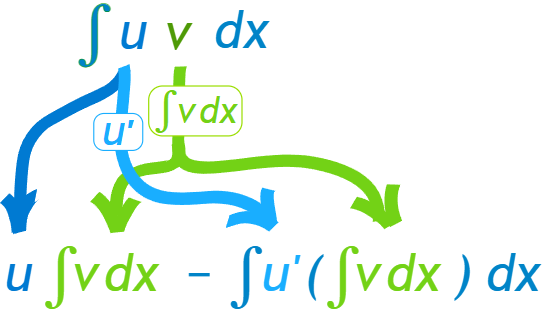
Integration by parts is based on the formula
\( \displaystyle \int u\,dv = uv – \int v\,du \)
For inverse functions, the standard choice is:
\( u = \) inverse function
\( dv = dx \)
Essential Derivatives
| Function | Derivative |
|---|---|
| \( \arcsin x \) | \( \dfrac{1}{\sqrt{1-x^2}} \) |
| \( \arctan x \) | \( \dfrac{1}{1+x^2} \) |
| \( \operatorname{arsinh} x \) | \( \dfrac{1}{\sqrt{1+x^2}} \) |
| \( \operatorname{artanh} x \) | \( \dfrac{1}{1-x^2} \) |
Standard Results (You Should Recognise)
\( \displaystyle \int \arctan x\,dx = x\arctan x – \dfrac{1}{2}\ln(1+x^2) + C \)
\( \displaystyle \int \operatorname{arsinh} x\,dx = x\operatorname{arsinh} x – \sqrt{1+x^2} + C \)
Example :
Evaluate
\( \displaystyle \int \arctan x \, dx \).
▶️ Answer/Explanation
Let \( u = \arctan x \), \( dv = dx \).
Then \( du = \dfrac{1}{1+x^2}dx \), \( v = x \).
\( \int \arctan x\,dx = x\arctan x – \int \dfrac{x}{1+x^2}dx \)
\( = x\arctan x – \dfrac{1}{2}\ln(1+x^2) + C \)
Conclusion: \( x\arctan x – \dfrac{1}{2}\ln(1+x^2) + C \).
Example :
Evaluate
\( \displaystyle \int \operatorname{arsinh} x \, dx \).
▶️ Answer/Explanation
Let \( u = \operatorname{arsinh} x \), \( dv = dx \).
Then \( du = \dfrac{1}{\sqrt{1+x^2}}dx \), \( v = x \).
\( \int \operatorname{arsinh} x\,dx = x\operatorname{arsinh} x – \int \dfrac{x}{\sqrt{1+x^2}}dx \)
\( = x\operatorname{arsinh} x – \sqrt{1+x^2} + C \)
Conclusion: \( x\operatorname{arsinh} x – \sqrt{1+x^2} + C \).
Example :
Evaluate
\( \displaystyle \int \operatorname{artanh}(2x) \, dx \).
▶️ Answer/Explanation
Use integration by parts.
Let \( u = \operatorname{artanh}(2x) \), \( dv = dx \).
Then \( du = \dfrac{2}{1-4x^2}dx \), \( v = x \).
\( \int \operatorname{artanh}(2x)\,dx = x\operatorname{artanh}(2x) – \int \dfrac{2x}{1-4x^2}dx \)
\( = x\operatorname{artanh}(2x) + \dfrac{1}{4}\ln(1-4x^2) + C \)
Conclusion: The integral is evaluated using integration by parts and substitution.