
Integration Using Trigonometric and Hyperbolic Substitutions
Some integrals involving quadratic expressions cannot be evaluated directly. At IAL level, these are handled using trigonometric or hyperbolic substitutions, chosen to simplify square roots or rational expressions.
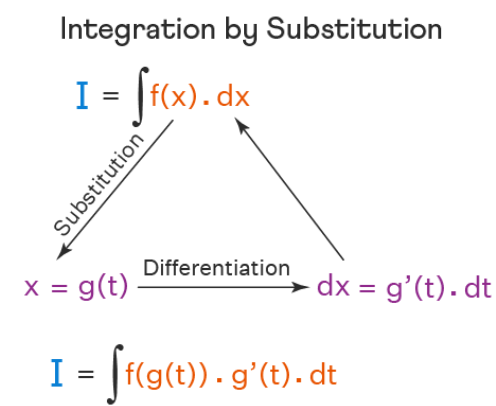
Why Substitution Works
Trigonometric and hyperbolic identities allow expressions such as \( a^2 + x^2 \), \( a^2 – x^2 \), and \( x^2 – a^2 \) to be rewritten in simpler forms.
Trigonometric identities use \( 1 + \tan^2 \theta = \sec^2 \theta \), \( 1 – \sin^2 \theta = \cos^2 \theta \)
Hyperbolic identities use \( 1 + \sinh^2 t = \cosh^2 t \), \( \cosh^2 t – \sinh^2 t = 1 \)
Standard Integrals and Recommended Substitutions
| Integral | Suggested Substitution | Result |
|---|---|---|
| \( \displaystyle \int \dfrac{1}{a^2 + x^2}\,dx \) | \( x = a\tan\theta \) | \( \dfrac{1}{a}\arctan\!\left(\dfrac{x}{a}\right) + C \) |
| \( \displaystyle \int \dfrac{1}{a^2 – x^2}\,dx \) | \( x = a\sin\theta \) | \( \dfrac{1}{2a}\ln\!\left|\dfrac{a+x}{a-x}\right| + C \) |
| \( \displaystyle \int \dfrac{1}{\sqrt{a^2 + x^2}}\,dx \) | \( x = a\sinh t \) | \( \operatorname{arsinh}\!\left(\dfrac{x}{a}\right) + C \) |
| \( \displaystyle \int \dfrac{1}{\sqrt{x^2 – a^2}}\,dx \) | \( x = a\cosh t \) | \( \operatorname{arcosh}\!\left(\dfrac{x}{a}\right) + C \) |
Example :
Evaluate
\( \displaystyle \int \dfrac{1}{9 + x^2}\,dx \).
▶️ Answer/Explanation
This matches the form \( \dfrac{1}{a^2 + x^2} \) with \( a = 3 \).
\( \displaystyle \int \dfrac{1}{9 + x^2}\,dx = \dfrac{1}{3}\arctan\!\left(\dfrac{x}{3}\right) + C \)
Conclusion: \( \dfrac{1}{3}\arctan\!\left(\dfrac{x}{3}\right) + C \).
Example :
Evaluate
\( \displaystyle \int \dfrac{1}{\sqrt{4 + x^2}}\,dx \).
▶️ Answer/Explanation
Use the substitution \( x = 2\sinh t \).
Then \( dx = 2\cosh t\,dt \) and \( \sqrt{4+x^2} = 2\cosh t \).
\( \displaystyle \int \dfrac{1}{\sqrt{4+x^2}}\,dx = \int dt = t + C \)
Since \( x = 2\sinh t \), \( t = \operatorname{arsinh}\!\left(\dfrac{x}{2}\right) \).
Conclusion: \( \operatorname{arsinh}\!\left(\dfrac{x}{2}\right) + C \).
Example :
Evaluate
\( \displaystyle \int \dfrac{1}{\sqrt{x^2 – 16}}\,dx \).
▶️ Answer/Explanation
Use the substitution \( x = 4\cosh t \).
Then \( dx = 4\sinh t\,dt \) and \( \sqrt{x^2-16} = 4\sinh t \).
\( \displaystyle \int \dfrac{1}{\sqrt{x^2-16}}\,dx = \int dt = t + C \)
Since \( x = 4\cosh t \), \( t = \operatorname{arcosh}\!\left(\dfrac{x}{4}\right) \).
Conclusion: \( \operatorname{arcosh}\!\left(\dfrac{x}{4}\right) + C \).