
Arc Length and Surface Area of a Surface of Revolution
This topic concerns the calculation of the length of a curve and the area of a surface generated by rotating a curve about a coordinate axis. At IAL level, curves may be given in cartesian or parametric form. Polar equations are not required.
1. Arc Length of a Curve (Cartesian Form)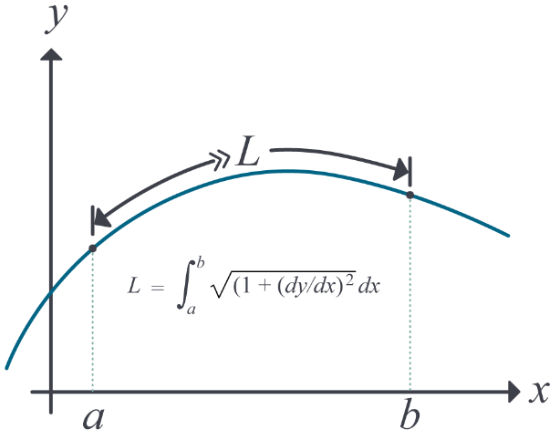
For a curve defined by
\( y = f(x) \), \( a \le x \le b \)
the arc length is given by
\( \displaystyle L = \int_a^b \sqrt{1 + \left(\dfrac{dy}{dx}\right)^2}\,dx \)
2. Arc Length of a Curve (Parametric Form)
If the curve is defined parametrically by
\( x = x(t), \quad y = y(t) \)
for \( t_1 \le t \le t_2 \), then the arc length is
\( \displaystyle L = \int_{t_1}^{t_2} \sqrt{\left(\dfrac{dx}{dt}\right)^2 + \left(\dfrac{dy}{dt}\right)^2}\,dt \)
3. Surface Area of a Surface of Revolution (Cartesian Form)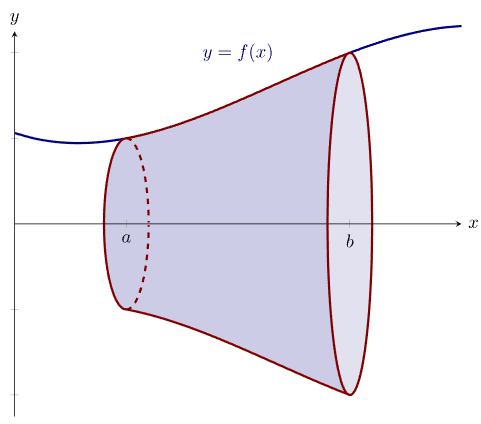
If the curve \( y = f(x) \) is rotated about the x-axis, the surface area is
\( \displaystyle S = 2\pi \int_a^b y \sqrt{1 + \left(\dfrac{dy}{dx}\right)^2}\,dx \)
If the curve is rotated about the y-axis, the surface area is
\( \displaystyle S = 2\pi \int_a^b x \sqrt{1 + \left(\dfrac{dy}{dx}\right)^2}\,dx \)
4. Surface Area of a Surface of Revolution (Parametric Form)
For a parametric curve \( x(t), y(t) \):
About the x-axis:
\( \displaystyle S = 2\pi \int y \sqrt{\left(\dfrac{dx}{dt}\right)^2 + \left(\dfrac{dy}{dt}\right)^2}\,dt \)
About the y-axis:
\( \displaystyle S = 2\pi \int x \sqrt{\left(\dfrac{dx}{dt}\right)^2 + \left(\dfrac{dy}{dt}\right)^2}\,dt \)
Example
Find the length of the curve
\( y = \dfrac{2}{3}x^{3/2} \), \( 0 \le x \le 4 \).
▶️ Answer/Explanation
\( \dfrac{dy}{dx} = x^{1/2} \)
\( 1 + \left(\dfrac{dy}{dx}\right)^2 = 1 + x \)
\( L = \int_0^4 \sqrt{1+x}\,dx \)
\( = \dfrac{2}{3}(1+x)^{3/2}\Big|_0^4 = \dfrac{2}{3}(5^{3/2}-1) \)
Conclusion: The arc length is \( \dfrac{2}{3}(5\sqrt{5}-1) \).
Example
Find the length of the curve defined by
\( x = a\cos t,\; y = a\sin t \), \( 0 \le t \le \dfrac{\pi}{2} \).
▶️ Answer/Explanation
\( \dfrac{dx}{dt} = -a\sin t,\quad \dfrac{dy}{dt} = a\cos t \)
\( \sqrt{(\dfrac{dx}{dt})^2+(\dfrac{dy}{dt})^2} = a \)
\( L = \int_0^{\pi/2} a\,dt = \dfrac{a\pi}{2} \)
Conclusion: The arc length is \( \dfrac{a\pi}{2} \).
Example
Find the surface area formed when the curve
\( y = x^2 \), \( 0 \le x \le 1 \)
is rotated about the x-axis.
▶️ Answer/Explanation
\( \dfrac{dy}{dx} = 2x \)
\( \sqrt{1+(2x)^2} = \sqrt{1+4x^2} \)
\( S = 2\pi \int_0^1 x^2\sqrt{1+4x^2}\,dx \)
This integral is evaluated using substitution.
Conclusion: The surface area is obtained by applying the surface of revolution formula.